
29-Year-Old Malaysian Earning RM12.5K A Month Says He Feels Left Behind
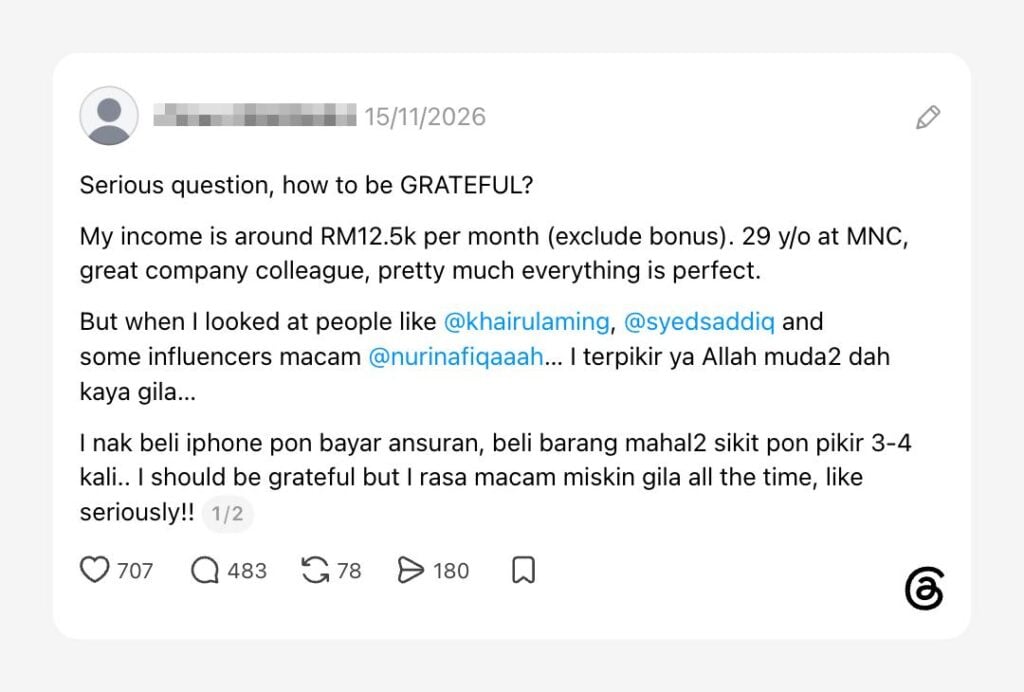
"I feel insanely poor all the time, like seriously," he wrote.


 Cover image via TMR & Qianlong/Imaginechina/AFP
Follow us on Instagram, TikTok, and WhatsApp for the latest stories and breaking news.
A 29-year-old Malaysian earning RM12,500 a month has sparked a discussion online after admitting that he constantly feels financially behind despite having what he described as "an almost perfect life"
In a Threads post published earlier this month, the man said he worked at a multinational company (MNC), had great colleagues, and earned RM12,500 monthly, excluding bonuses.
However, he admitted that seeing younger entrepreneurs and public figures such as Khairul Amin Kamarulzaman, Nurin Afiqah Zulkifli, and Syed Saddiq Syed Abdul Rahman made him feel inadequate about his own financial progress.
"Even if I want to buy an iPhone, I have to pay in instalments, and buying anything slightly expensive makes me think three to four times," he wrote.
He also compared himself with his siblings, one of whom had migrated to Australia, while another held a high-level corporate position with a higher salary.
He said some of his friends also worked in Singapore and in management consulting firms such as McKinsey, Boston Consulting Group (BCG), and Bain & Company.
"I feel insanely left behind," he wrote, asking other users to express their honest opinions.
The post has since attracted around 49,000 views, with the discussion raising questions about financial expectations, social comparisons, and what it means to be financially successful.
While the man's feelings about his financial situation are subjective, Malaysia's latest official wage statistics offer a different perspective
According to the Department of Statistics Malaysia's (DOSM) Employee Wages Statistics (Formal Sector), Second Quarter 2026 report published in October, the national median monthly wage stood at RM3,000 in June 2026.
This means the man's basic monthly salary of RM12,500 is more than four times the national median.
More significantly, DOSM's wage distribution showed that the top 10% of Malaysian formal-sector employees earned at least RM9,600 a month.
In other words, his RM12,500 basic salary already exceeds the threshold for the country's highest-paid 10% of formal employees, even before his bonuses are taken into account.
The report covered approximately 7.2 million Malaysian formal-sector employees.
The difference becomes more evident when his salary is compared with wages across different locations and industries
DOSM reported that Kuala Lumpur recorded the highest median monthly wage among Malaysian states and federal territories in June 2026, at RM4,245. Meanwhile, employees aged between 45 and 49, the country's highest-paid age group, recorded a median monthly wage of RM3,945.
Even Malaysia's highest-paying economic sector, mining and quarrying, recorded a median monthly wage of RM6,722.
His RM12,500 basic salary is nearly three times the median wage in Kuala Lumpur and almost twice the median wage in the mining and quarrying industry.
For further perspective, DOSM also reported that 8.2% of Malaysian formal-sector employees earned less than RM1,700 a month in June 2026. Meanwhile, the bottom 10% of formal employees earned RM1,700 or less.
RM12,500 Salary vs. June 2026 DOSM Wage Benchmarks
Comparison against Malaysia's formal-sector monthly wage benchmarks (June 2026)
| Benchmark Category (June 2026) | Monthly Wage | Comparison |
|---|---|---|
| Bottom 10% of Formal Employees (8.2% earned < RM1,700) |
RM1,700 or less | 7.35x ceiling |
| Highest-Paid Age Group (45–49) | RM3,945 (median) | 3.17x median |
| Highest-Paying State/Territory (KL) | RM4,245 (median) | 2.94x (nearly 3x) |
| Highest-Paying Sector (Mining & Quarrying) | RM6,722 (median) | 1.86x (almost 2x) |
| Poster's Basic Salary | RM12,500 (excl. bonus) | Baseline |
These figures do not mean that someone earning RM12,500 cannot experience financial difficulties. However, they put into perspective just how far his earnings are from what most formal employees in Malaysia receive.
So why does he still feel left behind despite earning so much?
One possible explanation is that he is comparing his financial progress with people who occupy an entirely different income bracket.
Rather than measuring his success against the wider Malaysian workforce, his reference group appears to consist of wealthy entrepreneurs, public figures, high-earning corporate professionals, and friends working overseas.
These comparisons can create a distorted picture of what constitutes a normal financial position.
For instance, comparing a salaried employee's income with that of an established entrepreneur such as Khairulaming, as the Rembayung owner is popularly known, overlooks the differences between earning a monthly salary and building a business.
Similarly, friends working in Singapore or Australia may have higher salaries when converted into ringgit, but their earnings also need to be considered alongside their respective living costs.
The same applies to professionals working at elite management consulting firms, whose compensation packages are not necessarily representative of the wider corporate workforce.
When the people around you are consistently high earners, an income that places you among Malaysia's top 10% of formal employees can still feel ordinary.
There is also a distinction between having a high income and feeling financially comfortable
A person's financial commitments, spending habits, savings, family responsibilities, and long-term financial goals can influence how much money they feel they have available.
Someone earning RM12,500 could still feel financially stretched if a significant portion of their income goes towards housing, car payments, insurance, family support, and other commitments.
Similarly, choosing to pay for an expensive phone through instalments does not automatically mean someone cannot afford it.
However, financial comfort is not measured solely by how much more money someone earns than their friends.
The man's post raises an interesting question: if earning more than most people is still not enough to make someone feel successful, how much money would actually be enough?
Sometimes, the problem is not necessarily how little someone earns, but who they keep comparing themselves with.

Image for illustration purposes only.
Image via Qianlong/Imaginechina/AFP