
DOSM Data Shows Inflation May Be Cooling, But These Everyday Groceries Are Getting Pricier
Malaysia's headline inflation eased to 1.8% in July, but several everyday foods recorded much sharper price increases, including tomatoes, chicken, kailan, and lettuce.


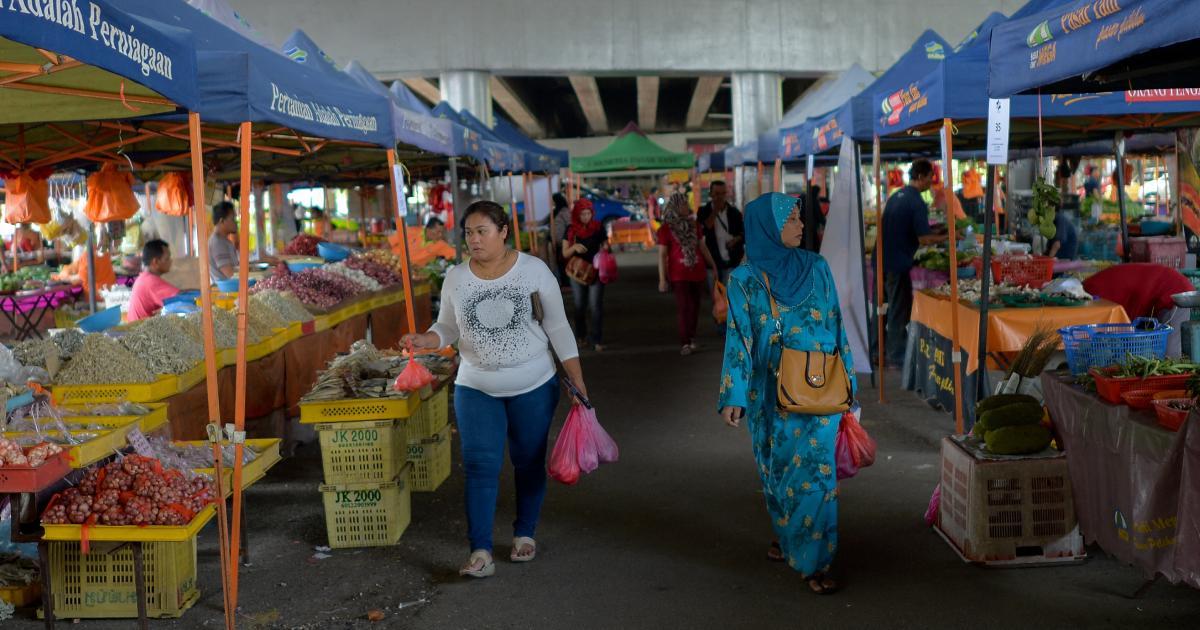 Cover image via Mohd Rasfan/AFP
Follow us on Instagram, TikTok, and WhatsApp for the latest stories and breaking news.
Malaysia's overall inflation may be holding relatively steady, but that does not necessarily mean everything in your grocery basket is getting cheaper
Latest data released by the Department of Statistics Malaysia (DOSM) in its Consumer Price Index (CPI) report showed overall inflation eased slightly to 1.8% year-on-year in July 2026, down from 1.9% in June.
At the same time, inflation for Food & Beverages accelerated to 1.8% from 1.4% in June, with several everyday fresh food items recording significantly higher increases.
The Food at Home category, which covers groceries bought for household consumption, saw inflation more than double from 0.5% in June to 1.2% in July.
Chicken prices jumped 6.7%
Meat was one of the biggest contributors to the increase, with prices rising 3.2% year-on-year in July compared to 1.5% in June.
Fresh standard chicken accounted for much of that increase.
The price of fresh standard chicken rose 6.7% year-on-year in July, a rate more than five times higher than June's 1.2% increase.
In Peninsular Malaysia, standard chicken averaged RM10.17 per kg in July, up from RM9.43 a year earlier and RM10.03 in June.
Nationally, prices averaged RM10.88 per kg, reflecting how heavily poultry weighs on overall food bills, given that standard chicken alone accounts for nearly a third (32.6%) of Malaysia's entire meat expenditure basket.
But where you live still makes a sizeable difference, particularly between Peninsular and East Malaysia.
Standard chicken averaged RM9.68 per kg in Kelantan, the lowest among the states, while Sarawak recorded the nation's highest average at RM13.33 per kg, followed closely by Sabah at RM12.85 and Labuan at RM12.50.
Even within Peninsular Malaysia, urban centres felt tighter pressure, with prices in Penang at RM10.98 and Kuala Lumpur at RM10.94 outstripping the Peninsular average.
The price surge extended beyond whole birds to accelerate the broader Meat category to 3.2% year-on-year growth, up from 1.5% in June.
Chicken parts rose 2.6% year-on-year compared to 1.9% in June, while local lamb grew 1.3% up from 1.1%.

Kimberley Street in George Town, Penang.
Image via Marcin Kilarski/Robert Harding/AFPSome vegetables got even more expensive
Vegetables emerged as another sharp source of pressure for household grocery budgets in July, reversing previous months of relief.
After recording a 1.8% year-on-year decline in June, the Vegetables expenditure class returned to positive inflation of 1% year-on-year and posted a steep 1% jump month-on-month.
This category-wide rebound was spearheaded by leafy and stem vegetables, which rose 4.5% year-on-year and 1.2% month-on-month, and fruit-bearing vegetables, which grew 2.6% year-on-year and 1.9% month-on-month.
Behind those sub-index figures lie even sharper spikes for popular produce items.
Tomatoes saw the largest surge, accelerating to 19.6% year-on-year, up from 12.0% in June. Kailan (Chinese Kale) prices rose more than tenfold to 10.4% year-on-year, compared to just 1.0% in June. Salad and Lettuce climbed 9.5% year-on-year, up from 3.9% previously. Petola (Angle Gourd) grew 8.8% year-on-year, up from 5.5%, while Long Cabbage increased 8.3%, up from 8.2%.
At the wet market counter, these percentage gains translate to noticeable price gaps across regions:
- Tomatoes: Cost RM8.17 per kg nationwide in July. Selangor enjoyed the lowest average at RM6.83 per kg, whereas buyers in Sarawak and Terengganu paid significantly more, at RM9.59 per kg and RM9.42 per kg, respectively.
- Kailan: Averaged RM9.13 per kg nationally. While Perak at RM7.93 per kg and Kelantan at RM7.96 per kg saw lower rates, prices spiked in Putrajaya at RM13.12 per kg and peaked in Sarawak at RM13.78 per kg.
- Petola: Averaged RM7.11 per kg nationwide, ranging from RM6.32 per kg in Sabah to a high of RM9.90 per kg in Labuan.
Eggs, seafood, and other staples also moved
It was not just chicken and vegetables driving up grocery bills in July.
The Milk, Dairy, and Eggs category recorded 0.8% inflation year-on-year, fueled by a sharp acceleration in egg prices, which jumped 4.0% year-on-year and 2.1% month-on-month.
Nationally, Grade A eggs averaged RM4.76 for 10, while Grade B and Grade C eggs averaged RM4.40 and RM3.94m respectively.
However, buyers in East Malaysia faced much higher costs, with Grade A eggs averaging RM5.79 in Sabah, RM5.88 in Sarawak, and RM5.98 in Labuan.
Fish and other seafood recorded 1.1% year-on-year inflation, while Fruits and Nuts also grew 1.1%.
Everyday grocery items continued to show wide regional price gaps:
- Local beef averaged RM35.70 per kg in Peninsular Malaysia, but ranged from RM27.29 in Kelantan to RM40.07 in Selangor, reaching RM65 in Sarawak.
- Red chilli Kulai averaged RM17.20 per kg nationally, spiking to RM22.34 in Sarawak.
- Garlic averaged RM10.37 per kg nationwide.
- Cooking oil in 5kg bottles averaged RM30.82 nationally.
- Standard 5% broken rice averaged RM28.63 nationally, remaining controlled at RM26 for 10kg across most Peninsular states while rising to RM30.17 in Sarawak, RM33.30 in Sabah, and RM35.90 in Labuan.
Not every grocery category went up sharply, however. Basic staples remained relatively stable, with Cereals and cereal products recording just 0.2% inflation year-on-year, while Oils and Fats rose 0.2%.
Food prices vary depending on where you live
The national average also masks sizeable differences between states.
Five states surpassed the national Food and Beverages inflation average of 1.8% in July.
Johor recorded the highest food inflation in the country at 3.3%, followed by Melaka at 2.7%, Negeri Sembilan at 2.6%, Pahang at 2.4%, and Kuala Lumpur at 2.3%. Meanwhile, Kelantan and Labuan recorded zero food and beverage inflation.
So while Malaysia's overall headline inflation rate moderated slightly to 1.8% from 1.9% in June, the summary number does not tell the whole story for households doing their weekly grocery shopping.
For consumers, what matters is not just the overall figure, but how much the specific items in their checkout cart have changed in price, and July's data shows that essential food increases were considerably higher than the national rate.

Inflation by state, June 2026 & July 2026
Image via CPI/DOSM