
Experts Say Nicotine Should Not Be Confused With Smoke. Here’s The Reason Why
Nicotine, while not risk-free, is not the primary cause of smoking-related diseases.


 Cover image via Canva Teams
Follow us on Instagram, TikTok, and WhatsApp for the latest stories and breaking news.
Ask most people what causes smoking-related diseases, and many will say "nicotine"
Nicotine is a natural occurring substance found in tobacco, and is one of the reasons that people smoke, along with other factors, such as taste and ritual.
However, several independent health organisations such as the Royal Society for Public Health (UK) and the US Federal Drug Administration have confirmed that nicotine — while addictive and not risk-free — is not the main cause of smoking-related diseases.
But researchers say nicotine and cigarette smoke are often confused as the same thing, even though the biggest health risks from smoking largely come from the toxic chemicals produced when tobacco burns.
Views on this topic have become increasingly mixed in recent years
In fact, leading tobacco dependence researcher Hayden McRobbie previously told Free Malaysia Today (FMT) that more people are beginning to believe e-cigarettes are even more harmful than cigarettes themselves.
Dr Rashidi Mohamed Pakri Mohamed of Universiti Kebangsaan Malaysia, in the same FMT report, said this confusion may affect smokers who are trying to move away from cigarettes or quit smoking altogether.
"There is a growing number of people, including smokers, who now believe that vaping is equally or more harmful than smoking," he said.
Part of the confusion stems from conflicting public messaging, alongside continued debate over the long-term effects of vaping and newer nicotine products
Concerns over illicit vape products and misuse have also intensified public anxiety, with many people now grouping cigarettes, vapes, and heated tobacco products under the same level of risk despite functioning differently and each carrying very different levels of risks.
Here's a closer look at the different types of nicotine products:
| Category | Cigarettes | Heated Tobacco Products | E-vapor Products | Snus | Nicotine Pouches |
|---|---|---|---|---|---|
| Contains tobacco? | Yes | Yes* | No | Yes | No |
| Contains nicotine? | Yes | Yes | Yes | Yes | Yes |
| How does it work? | Burns tobacco to generate smoke and ash | Heats tobacco to generate a smoke-free aerosol | Heats e-liquid to generate a smoke-free aerosol | Product is placed in the mouth to release nicotine through the saliva | Product is placed in the mouth to release nicotine through the saliva |
| What are the toxicant levels? | Smoke contains high numbers and levels of toxicants | Aerosol contains reduced numbers and levels of toxicants** | Aerosol contains reduced numbers and levels of toxicants** | Snus contains reduced numbers and levels of toxicants** | Nicotine pouch contains reduced numbers and levels of toxicants** *** |
* Heated tobacco products (or heat-not-burn products) may also use non-tobacco consumables containing nicotine.
** Compared with cigarette smoke.
*** Nicotine pouches also have the lowest toxicant profile out of the entire oral smokeless category, including snus.
Important note: Smoke-free products are not risk-free and contain nicotine, which is addictive. The best choice any smoker can make is to quit tobacco and nicotine altogether.
Experts say the biggest danger from cigarettes comes from combustion
When a cigarette is lit, tobacco burns at very high temperatures through a process known as combustion, resulting in cigarette smoke and ash.
"Science shows us that it's the chemicals produced by combustion that are the primary cause of smoking-related diseases," said Dr Gizelle Baker, Director Scientific Engagement, Philip Morris International.
This very smoke contains more than 6,000 identified chemicals, with about 100 linked by public health authorities to smoking-related diseases.
Because of this, many researchers identify combustion as a key driver of the high levels of harm associated with cigarettes.
Health authorities including the World Health Organization (WHO) stress that nicotine itself is still not harmless, as it remains highly addictive.
Malaysia's Health Ministry has also repeatedly raised concerns over vaping and there has been talks that they are aiming to move towards stricter vape regulation and even a ban by 2026.
However, it is important to note that smoke and vapour are not the same thing
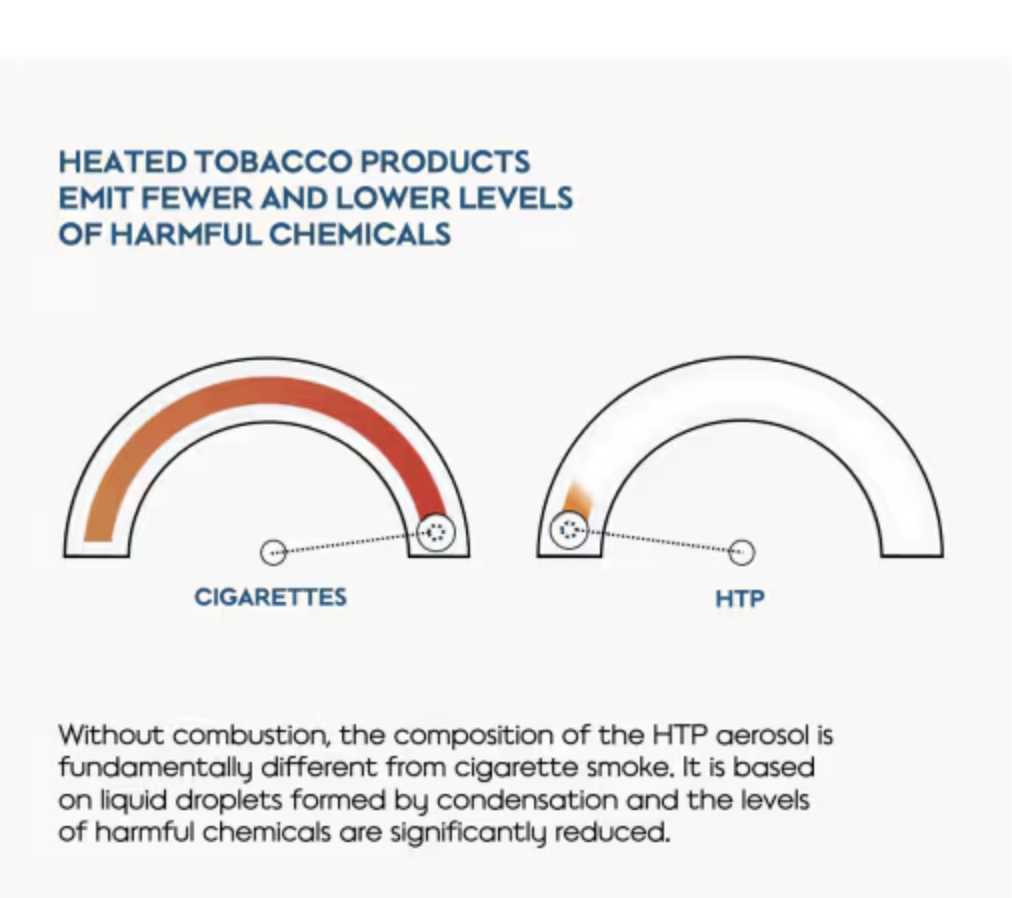
Traditional cigarettes burn tobacco, producing smoke made up of toxic chemicals and ash.
By contrast, vapes and heated tobacco products do not produce ash or smoke from combustion. According to Philip Morris International, they use heating systems to generate an aerosol, and are both "smoke-free", resulting in up to 95% lower levels of harmful and potentially harmful constituents.
A report by the National Cancer Society Malaysia cautioned that these products are "not safe" for never-smokers.
Philip Morris International takes a similar stance, whereby non-smokers should not be encouraged to pick up the habit. For smokers, quitting is the best choice. Smoke-free alternatives should only be targeted towards smokers who don't quit.
While certain sources point to smoke-free alternatives as potentially less harmful than cigarettes for existing smokers, public perception is still divided

Nevertheless, it's important for everyday Malaysians and health officials to be aware of different product categories, as this influences public health strategies moving forward.
Those interested can find out more about this topic here.
