
Malaysia Once Made CNN Apologise For Its Haze Coverage. Here’s What That Says About Us
Malaysia's official air-quality readings and the AQI figures shown on commercial apps can tell very different stories. Here's why they differ, and what the numbers actually mean as the haze worsens.


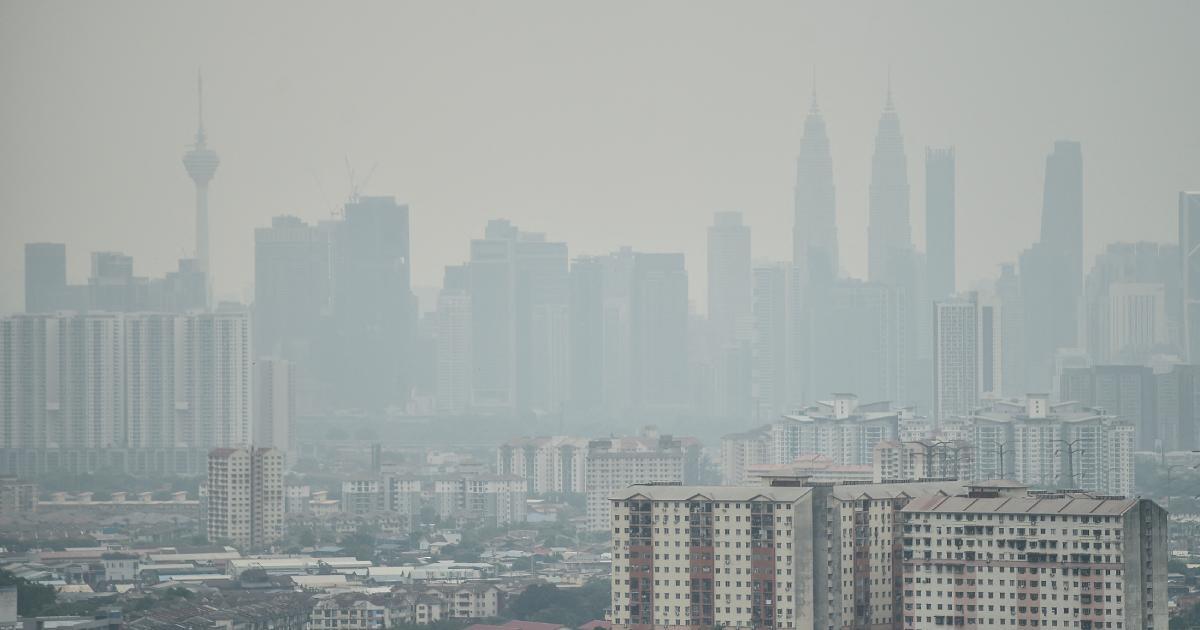 Cover image via Arif Kartono/AFP
Follow us on Instagram, TikTok, and WhatsApp for the latest stories and breaking news.
Outside, the air smells of smoke and the horizon looks grey
Your throat is beginning to feel irritated, and your eyes burn.
You check Malaysia's official air-quality index: the reading says "moderate", with the map marked in assuredly green flags.
It doesn't make sense. The numbers don't match your lived reality.
Then you open any other air-quality app on your phone, and it's as if someone has flipped a switch. The reading is "unhealthy", and the map is all red.
Suddenly, the numbers now mirror your own physical experience.
So which number are you supposed to believe?
SAYS put that exact scenario to Dr Fatimah Ahamad, Chief Scientist at Sunway Centre for Planetary Health, Sunway University: if the government's Air Pollutant Index (API) says "moderate" but an AQI app says "unhealthy", and you're standing outside smelling smoke, which number do you pay attention to?
Her advice was direct: once you can already smell it, stop looking at "Moderate" and follow the guidance meant for "Unhealthy" or "Very Unhealthy" conditions instead.
"If it's bad enough to smell, it's best to take necessary precautions to reduce risk during a rapidly building haze episode," she said.
In other words, trust your senses over the more conservative number.
That advice only makes sense once you understand why the two numbers can disagree this sharply in the first place, and the explanation isn't purely technical. It's also about what data the government collects, what it chooses to publish, and decisions made decades ago about how much the public should be told during a haze crisis.
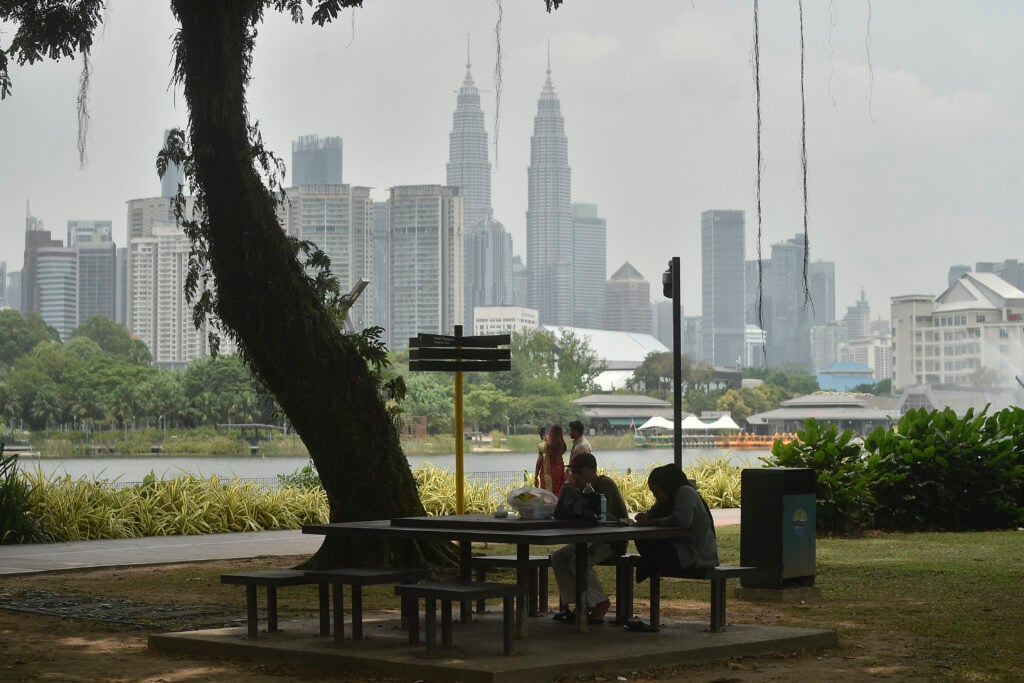
Parkgoers sit by a lake as the landmark Petronas Twin Towers is obscured by haze in Kuala Lumpur on 26 August 2026, amid high levels of air pollution from regional wildfires.
Image via Arif Kartono/AFPTwo indices, two sets of rules
Malaysia's Department of Environment (DOE) calculates its API from six pollutants through the Air Pollutant Index Management System (APIMS), the air-quality module within MyEQMS, the DOE's wider environmental data platform.
Each pollutant receives its own index value, and the one that scores highest becomes the reported API for that location and time.
During haze, that's almost always PM2.5, particulate matter 2.5 micrometres or smaller, small enough to lodge deep in the lungs and enter the bloodstream.
Commercial AQI apps don't necessarily work the same way.
Fatimah said many of the commercial apps people check on their phones calculate AQI from PM2.5 alone, while others factor in additional pollutants.
Even when both systems are reading the same PM2.5 concentration, they can land on different categories.
The formula used by the US Environmental Protection Agency, common among commercial apps, sets fixed concentration thresholds, or breakpoints, marking where "Moderate" ends and "Unhealthy" begins.
Malaysia sets its own breakpoints at different concentrations, which is why, as Fatimah put it, "The same pollutant reading might be rated 'Moderate' on one scale and 'Unhealthy' on another".
That's a disagreement that exists before averaging periods or monitoring locations even enter the picture.
The 24-hour number versus what you're breathing right now
The bigger gap is time. Unlike some pollutants – nitrogen dioxide, for instance, which is averaged hourly – Malaysia calculates PM2.5 as a rolling 24-hour average.
Fatimah said that a longer window reflects cumulative health risk, but "it can mask a developing haze episode" when pollution spikes suddenly.
Dr Helena Varkkey, Associate Professor of Political Ecology at Universiti Malaya's Department of International and Strategic Studies, goes further.
According to her, this isn't a case of the government lacking better data.
The government already has hourly figures, she told SAYS, but it simply doesn't release them.
She argues that averaging over 24 hours flattens the numbers and makes conditions look better than they would appear hourly, a strategy she believes was meant to keep public panic in check.
But she also said that approach is "perhaps not the best strategy anymore", now that people have other ways of checking air quality in real time.
Both researchers pointed to Singapore, which publishes a 24-hour Pollutant Standards Index (PSI) alongside hourly PM2.5 concentrations, telling residents to use the hourly figure for immediate decisions and the 24-hour figure to plan ahead.
Varkkey and her co-author Matthew Ashfold made the same case in a 2023 commentary: publishing Malaysia's own hourly PM2.5 data would require no new infrastructure, since it "is essentially a matter of making public data that already exists".

"Moderate" doesn't mean symptom-free
A "Moderate" reading isn't a clean bill of health.
Fatimah said the category still describes acceptable air quality overall, but unusually sensitive people "may already start experiencing the effects".
She reached for a local comparison to explain the gap between the category and the number behind it: "Think of sambal nasi lemak. How spicy the sambal is can be measured on a scale of one to 10. This is the air quality category. But what really makes the sambal spicy is the type of chilli and how much of it you use to make the sambal. That is your PM2.5 concentration."
She also flagged a pollutant that gets less attention than PM2.5: ground-level ozone, which she said "often contributes to high API readings during non-hazy periods", a reason a bad reading on a clear day isn't necessarily a glitch.
Malaysia's own standard doesn't align with the World Health Organization's (WHO) guidelines
Malaysia's current Ambient Air Quality Standard doesn't track the WHO's 2021 Air Quality Guidelines; it came into force in 2020, a year earlier.
Fatimah noted that a WHO guideline isn't a binding standard; it's designed to give countries room to work towards a target rather than comply immediately. But she was unambiguous about what that means in practice: being under Malaysia's own threshold "does not mean zero exposure to air pollutants", and health risks can remain.
Varkkey takes a different view of the same comparison.
She argues the WHO benchmark is built from a global average that doesn't fit Malaysia's context; applied literally, she said, "Malaysia will never ever have any 'good' days".
Judged against its own range instead, she said a "good" day under Malaysia's system is still meaningfully better than an "unhealthy" one.
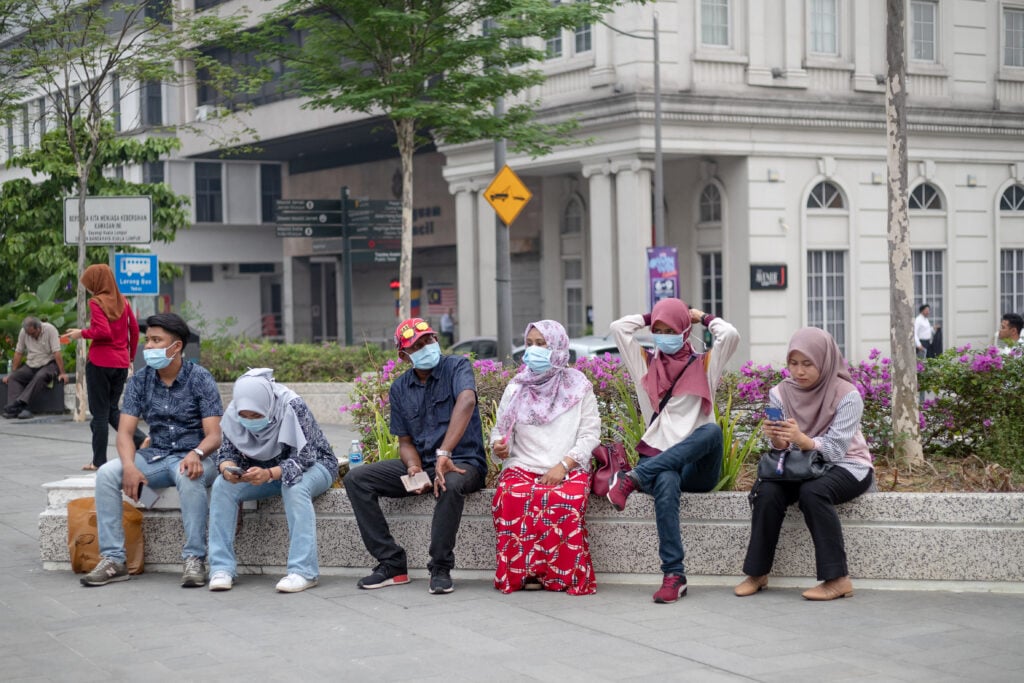
File photo showing group of Malaysians wearing masks due to terrible haze in Kuala Lumpur.
Image via Chris Jung/NurPhoto/AFPClear skies aren't proof of clean air
Fatimah's bigger worry isn't hazy days; it's the ones that look clear.
"Clear blue skies do not mean our exposure is zero," she said.
Malaysia's outdoor-activity restrictions and school closures kick in once conditions are visibly bad, but she said the conversation about exposure on ordinary-looking days barely happens: "What's often missed is conversations about exposure and risk to health when the air is not so hazy or even looks clean."
Varkkey's research points to a related habit: Malaysians have long relied on sight and smell – how far they can see, how strongly the air smells of smoke – to judge whether conditions are safe. That instinct works when haze is visible. It offers nothing on the days pollution is elevated but invisible.
Distance and calibration change what a reading means
Where you're standing relative to a monitoring station matters too.
Fatimah used the example of smoke from a neighbour burning dry leaves reaching you depending not just on the size of the fire, but on "the wind direction and how strong the wind is".
Government stations use reference-grade instruments, sited and maintained to specific requirements.
Low-cost sensors, increasingly used by individuals and communities, can capture hyperlocal conditions a distant government station might miss, but Fatimah warned they lose accuracy over time "unless it is recalibrated".

The gap between numbers isn't new; it's political history
Malaysia's haze-data problem predates the smartphone app.
After the catastrophic 1997–1998 regional haze crisis, the Malaysian Cabinet invoked the Official Secrets Act 1972 in June 1999 to withhold daily API updates from the public entirely.
The figures weren't declassified until 2005.
According to Varkkey's research with O'Reilly, the government's stated reason was that it "did not want irresponsible parties to take advantage of the situation and exaggerate conditions".
Even after declassification, the quality of what was published lagged behind what the DOE was actually measuring.
Malaysia kept reporting API based on the larger, less hazardous PM10 particles for years after it began tracking PM2.5 internally.
In 2015, then-opposition member of parliament (MP) Wong Chen pointed out that Singapore had already switched its PSI to PM2.5 the year before, leaving Johor Bahru's official readings looking far better than Singapore's, just across the causeway, during the same haze episode.
Asked to defend sticking with the older standard, the then deputy minister of Natural Resources and Environment argued that Malaysia's API was "more sensitive to the health effects while Singapore's is more targeted towards outside activities, so if their API reading is 120 or 150, they would possibly tell their people not to participate in outdoor activities, but ours is pegged to health".
Varkkey's assessment of that explanation doesn't hedge: it "may be useful to allay public panic," she writes, but it is "scientifically erroneous".
Malaysia only began incorporating PM2.5 into its API in 2018, around the same time as Thailand, and four years after Singapore.
Downplaying haze has also served economic interests
The pattern extends beyond withholding data.
In 1997 and 2000, Malaysia ran campaigns against international media outlets it accused of misrepresenting the severity of the haze, arguing the coverage was costing the country tourism revenue.
The campaign against CNN ended in an apology and compensation in the form of airtime promoting Malaysia.
In 2019, the then Minister of Primary Industries pushed back against connecting the haze to the palm oil sector, despite what Varkkey describes as strong evidence of a link, warning that doing so would be "playing right into the hands of anti-palm oil campaigners".
Her broader conclusion is that haze data in Malaysia "has been strategically used by the government and politicians to moderate public concern, protect its economic interests, and maintain good relations with its neighbouring states".
Haze doesn't stop at the border, and neither does the mismatch
Malaysia, Singapore, and Indonesia each run their own air-quality systems with their own parameters.
Varkkey points to Johor Bahru and Singapore, separated by a short causeway, where residents can see meaningfully different official readings for what is effectively the same air mass, partly because people end up comparing Singapore's hourly figure against Malaysia's 24-hour average without realising the two aren't measuring the same thing.
The consequences go beyond public confusion.
Varkkey argues inconsistent measurement complicates transboundary accountability directly: when one country calls conditions "bad" and another says "they are making a big deal out of seemingly nothing", this again comes down to the numbers, what different numbers they each observe.
At a regional level, she said, mismatched data becomes a problem "when AQI is used as a tool to avoid action", including in negotiations between ASEAN member states over responsibility for transboundary haze.
Her proposed fix is a standardised ASEAN-wide AQI.
It wouldn't resolve who is responsible for the fires, but it would remove the ability to dispute the severity of a haze episode simply by pointing to a different number.
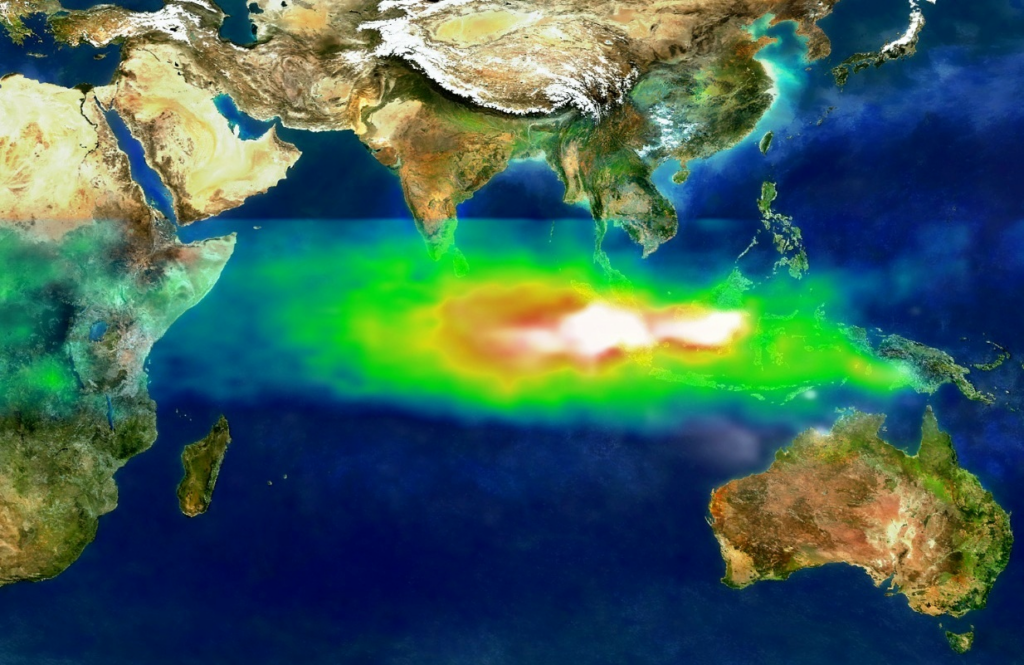
Air pollution over Southeast Asia in October 1997.
Image via WikipediaHaze fatigue is doing some of the government's work for it
Both researchers describe a public that has, to some degree, stopped pushing back.
Varkkey cites a 2015 study by De Pretto et al. in which 35% of Malaysian respondents said they were willing to accept haze as "a fair price to pay for economic development".
Her broader research on the "Seasons of the Anthropocene" argues that the recurring, seasonal nature of haze itself works against sustained public pressure; each episode fades before anger can build into anything lasting.
She contrasts this with Thailand, where terms like PM2.5 and N95 have entered everyday conversation, driven partly by a civil-society-led citizen science movement that emerged specifically because the public didn't trust official data.
No equivalent movement took hold in Malaysia.
Public debate on haze here, in her account, has tended to be triggered by politicians attacking the government of the day rather than a sustained, organised citizen response, one reason, she argues, that distrust never built the kind of independent data infrastructure Thailand has.
Fatimah's version of the same frustration is narrower: the urgency needed to address the causes of haze and poor air quality tends to disappear the moment haze season ends.
"I think what's missing is communicating the urgency in addressing the cause of haze and poor air quality during non-haze episodes," she said.
So which number should you actually use?
Neither expert wants Malaysia to scrap the API in favour of an hourly figure, or vice versa; the two answer different questions.
Fatimah put it plainly: an hourly indicator "would serve two different purposes similar to how the PSI and hourly PM2.5 reading work" – the 24-hour figure suited to longer-range decisions like school closures, the hourly figure suited to deciding whether to step outside right now.
What both actually want is for the public to have access to both, instead of being handed only the slower, more forgiving number and left to reconcile it against whatever their phone shows.
Varkkey's other recommendations: publish hourly PM2.5 data alongside the API, build out the monitoring network beyond its current concentration on the West Coast, add plain-language "small print" on how the API is calculated so people understand it's a scientific reading based on specific parameters rather than a be-all and end-all number, give health advice more specific than "wear a mask", and treat air-quality communication as a year-round job rather than a haze-season one, and eventually, a standardised ASEAN-wide index.
Fatimah wants people to treat the numbers as a starting point for judgment, not a verdict.
"Ultimately, the numbers are meant to help us assess risk, and we can decide which numbers to use to decide our course of action aside from the official circulars. And by that I not only mean reducing outdoor activities but also reporting open burning."
Until then, her advice for the moment you're standing outside, smelling smoke, unsure which app to believe, still stands: trust the more cautious signal, not the more comfortable one.
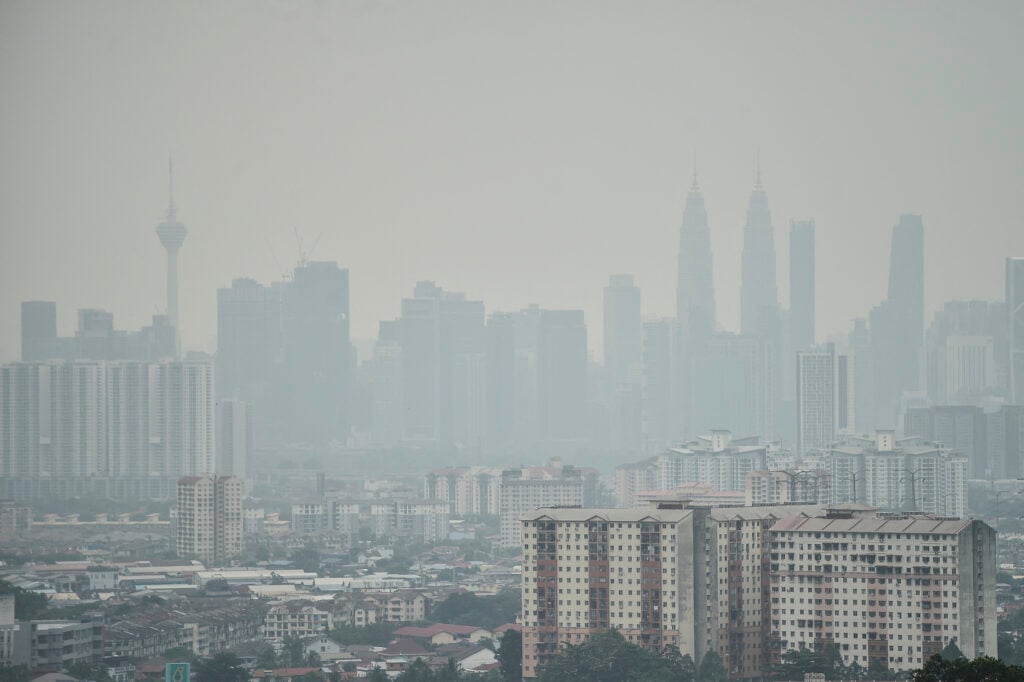
Haze shrouds the Kuala Lumpur skyline on 26 August 2026, amid high levels of air pollution from regional wildfires.
Image via Arif Kartono/AFP