
First-Time Voter Guide: Everything Malaysians Should Know Before Casting Their Vote
Key election terms, what to expect on polling day, and more.


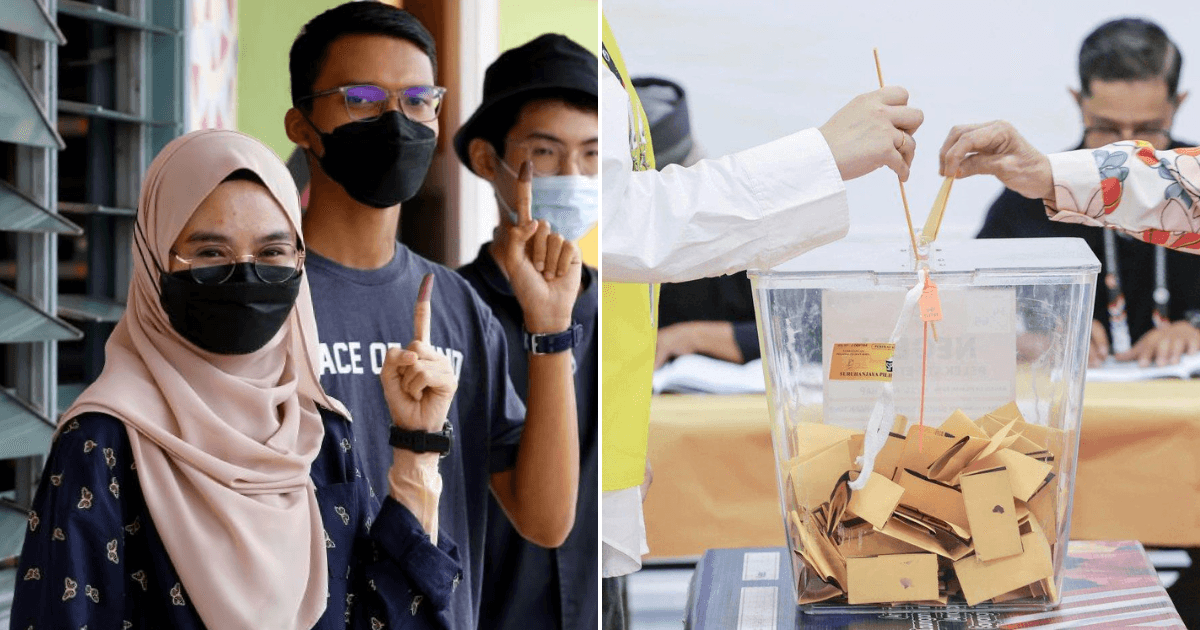 Cover image via
 You do not need to be a political expert before walking into a polling station
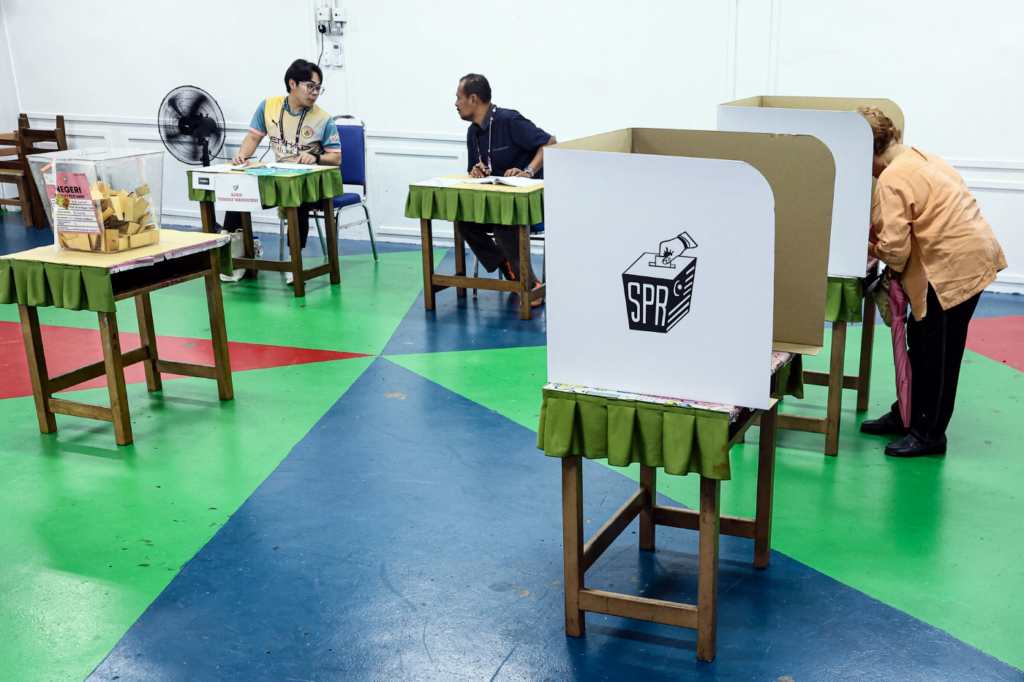
Voting for the first time can feel confusing, especially when people start talking about Parliament, state seats, coalitions, manifestos, and saluran all at once.
However, you don't need to understand every political debate before casting your first vote. What matters is knowing whether you're registered, where you're supposed to vote, what your vote decides, how to compare your choices and what happens on polling day.
"But I know nothing about politics"
What should you understand before voting, and what does your vote actually decide?

First, know what you are voting for
In Malaysia, you vote for the candidate that will be representing you. In a general election, you vote for a Member of Parliament, or MP, to represent your parliamentary seat in the Dewan Rakyat. You do not vote directly for the prime minister. The prime minister is appointed based on who commands majority support in the Dewan Rakyat after the election. In a state election, you vote for a State Assemblyperson, or ADUN, to represent your state seat in the State Legislative Assembly.
If a general election and a state election are held at the same time in your area, you will receive two ballot papers: One for your parliamentary seat and one for your state seat.
You are choosing a person, but the party also matters
Your ballot shows candidates contesting in your constituency. Most represent political parties, which may also belong to larger coalitions. This matters because the candidate who wins becomes your representative, while their party or coalition may affect who forms the government after the election.
Here are a few of the basic election terms first-time voters should know:
EC
Election Commission, the body that manages elections
MySPR Semak
Official system to check voter and election details
Electoral roll
The official list of registered voters
Polling centre
The place where you vote
Saluran
Your voting stream or room inside the polling centre
Ballot paper
The paper you mark to choose a candidate
Indelible ink
Ink placed on your finger to show you have voted
Candidate
The person contesting in your seat
Political party
The organisation a candidate may represent
Coalition
A group of parties working together
Manifesto
A list of promises or policy plans
Parliament
The federal law-making body
State Legislative Assembly
The state law-making body
MP
Member of Parliament
ADUN
State Assemblyperson
ㅤ
For a comprehensive list of election terms, check out this story.
What is the difference between a party, coalition and government?
Candidate
The person contesting the election in your parliamentary or state seat.
Political party
The organisation the candidate belongs to or represents during the election.
Coalition
A group of political parties that work together under a shared arrangement.
Government
The side that has enough elected support to lead after the election.
ㅤ
For example, you vote for a candidate who may belong to a political party. That party may be part of a coalition. After the election, the number of seats won and the support of elected representatives determine who can form the government.
What should first-time voters check before polling day?
| What to check | Why it matters |
|---|---|
| Voter status | Confirms that you are listed as a voter |
| Registered voting address | Determines your voting area |
| Parliamentary seat | Shows the Parliament seat you vote in |
| State seat | Shows the state seat you vote in, where applicable |
| Polling centre | Tells you where to go on polling day |
| Saluran | Tells you which room or line to join |
| Recommended voting time | Helps manage crowds |
| Voter sequence number | Helps election workers find your name faster |
Pro-Tip: Save or screenshot your MySPR Semak details before leaving home. If you cannot access MySPR Semak, check official Election Commission channels, state Election Office channels, or the EC hotline (+603-8892 7200).
How should you decide who to vote for?
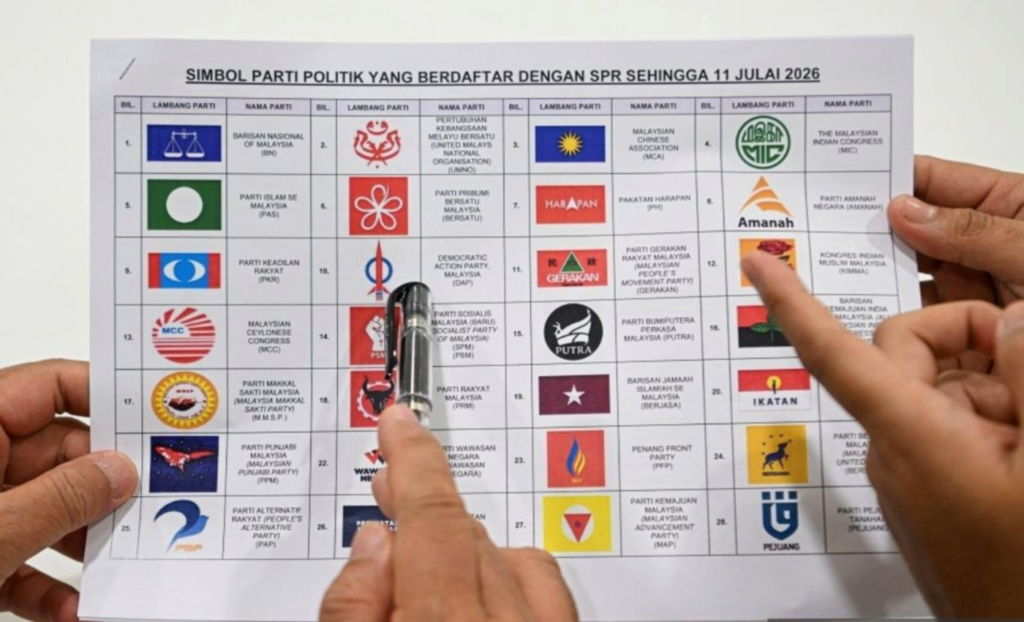
National leaders may dominate the news, but the candidates on your ballot paper are the people you can actually vote for. Here are four practical ways to research them:
- Check who's contesting in your seat. Look for the candidates' names and the parties or coalitions they represent. You can use official EC candidate information when available.
- Look at their track records. Have they held public office before? What have they done for their constituency? If they're incumbent representatives, look at their work, statements and public record.
- Compare their promises. Read relevant manifesto commitments and consider whether the proposals are realistic and meaningful to you.
- Focus on issues that affect you. These might include cost of living, wages, housing, public transport, healthcare, education, corruption or local infrastructure.
Ready to cast your ballot? Use a simple decision checklist to narrow down your vote:
Election periods can be noisy. So, how do you tell if an election claim is reliable?

Before believing or sharing an election claim, check where it came from, when it was made, and whether another reliable source confirms it.
During election season, you may see screenshots, edited videos, forwarded WhatsApp messages, fake quotes, old news clips, or claims without context. If a claim makes you feel shocked, furious, or scared immediately, pause before sharing it.
Ask important questions like, "Who is the original source?", "Is the date current?", "Is it a verified statement or just a screenshot?", and "Has the video been cropped?"
What happens on polling day?
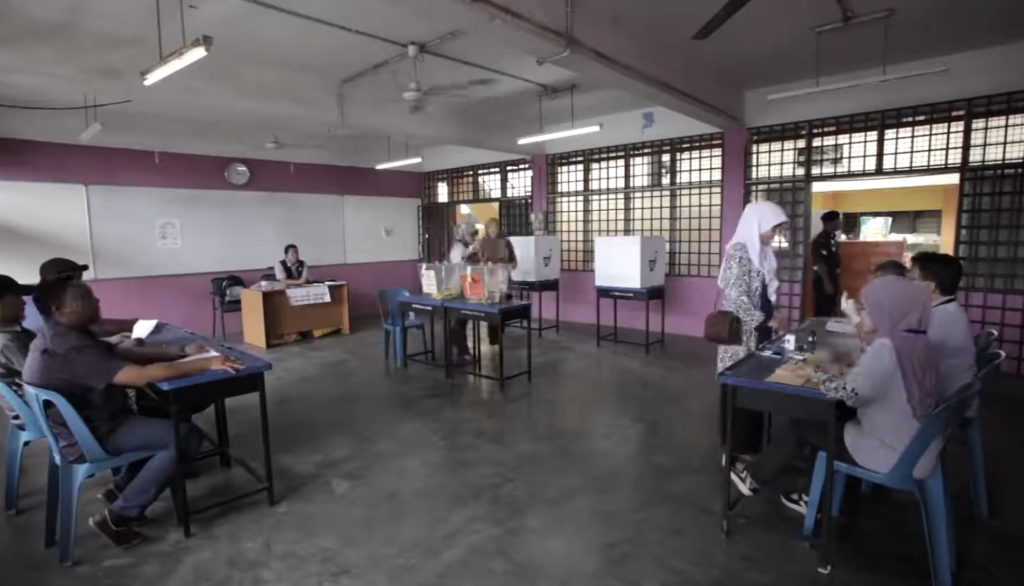
On polling day, you go to your assigned polling centre, verify your identity, receive your ballot paper, mark your vote and place it in the ballot box.
The usual steps are:
-
Go to your assigned polling centre.
-
Find your voting stream, or saluran.
-
Show your MyKad or accepted identity document.
-
Let election workers verify your voter details.
-
Have your finger marked with indelible ink.
-
Receive your ballot paper.
-
Follow the phone instructions given by election workers.
-
Mark your ballot clearly with the pen provided.
-
Place the ballot paper into the correct ballot box.
-
Leave the polling station after voting.
ㅤ
Do not take photos or videos of your ballot paper or inside the voting booth.
What is a saluran, and how do you find yours?
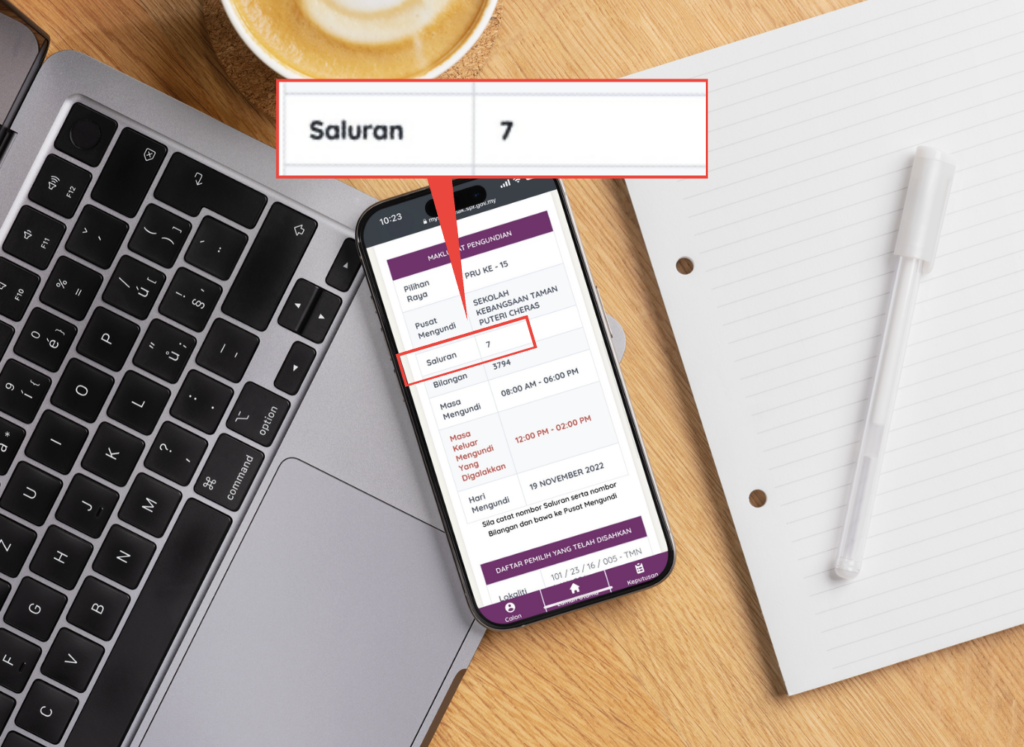
A saluran is your assigned voting stream or room inside the polling centre, and you can find it through MySPR Semak once polling details are available for that election.
For example, a school may serve as a polling centre with several classrooms used as different saluran. You and your friend could vote at the same school but be assigned different rooms. If you already know your saluran, you can usually go directly to the correct room without joining the queue at the EC checking booth, known as the barung. If you're unsure where to go, ask an election worker instead of joining a random queue.
How do you mark your ballot paper correctly?
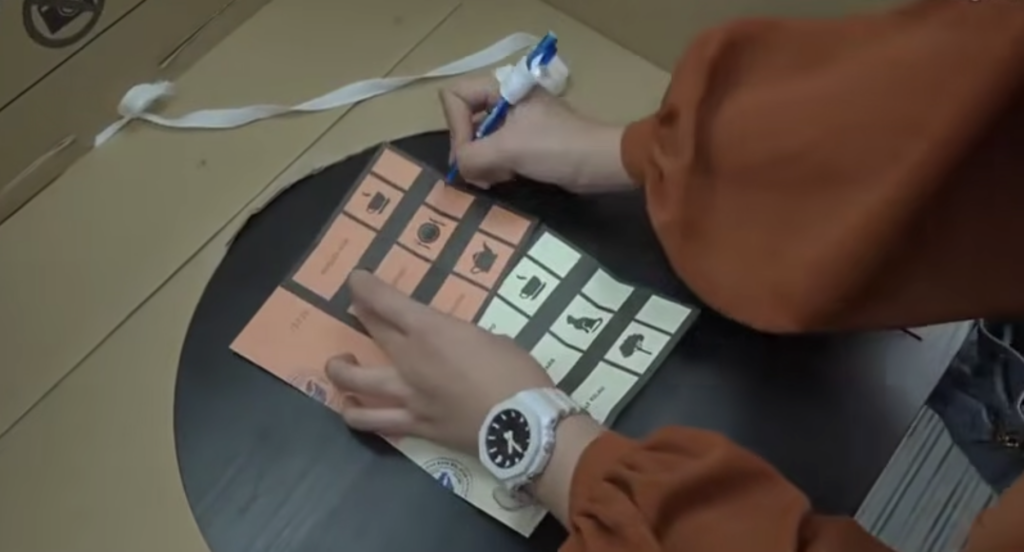
Use the pen provided to place one clear 'X' in the space beside your chosen candidate.
Do not mark your ballot with your thumb. Do not use indelible ink on the ballot. Do not write your name or add extra words. Your vote should clearly show which candidate you are choosing.
Is "X" the only way to mark your ballot?
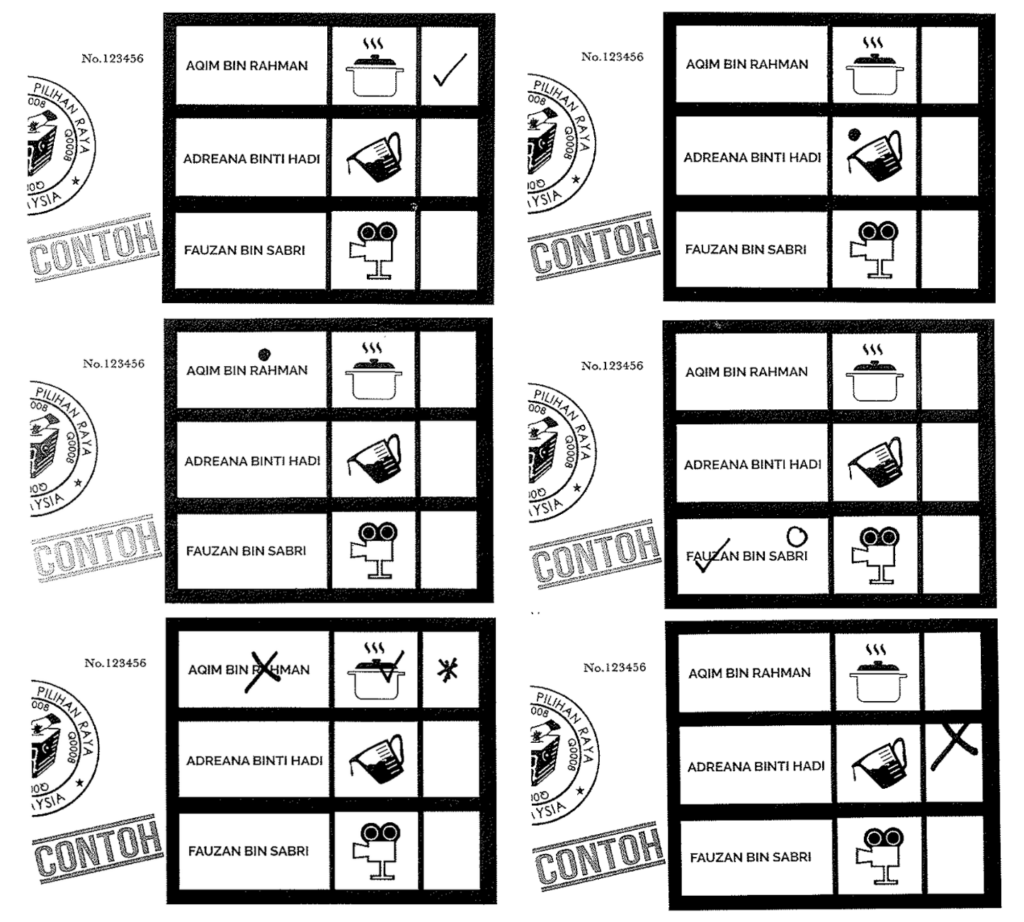
No, but "X" is still the safest mark for voters to use.
The EC's Panduan untuk Memutuskan Undi Ragu contains 39 examples of ballot markings that may still be accepted during counting when the voter's choice is unambiguous.
In simple terms, the mark should point to one candidate only. It should not overlap with another candidate's box, create uncertainty, or make it look like you selected more than one person.
Examples of markings that may be accepted:
- Clear marking on the right side of the ballot
- Marking on the candidate's name
- Marking on the preferred party's symbol
- Making a mark more than once but in the same row of the preferred candidate
- One or more markings in the same box
- Marking outside the space of the preferred candidate but not touching a different box
ㅤ
That said, voters should not try to be creative. A ballot may be rejected when it appears to select more than one candidate, contains an identifying mark or does not clearly indicate the voter's choice.
Can you ask for a new ballot paper if you make a mistake?
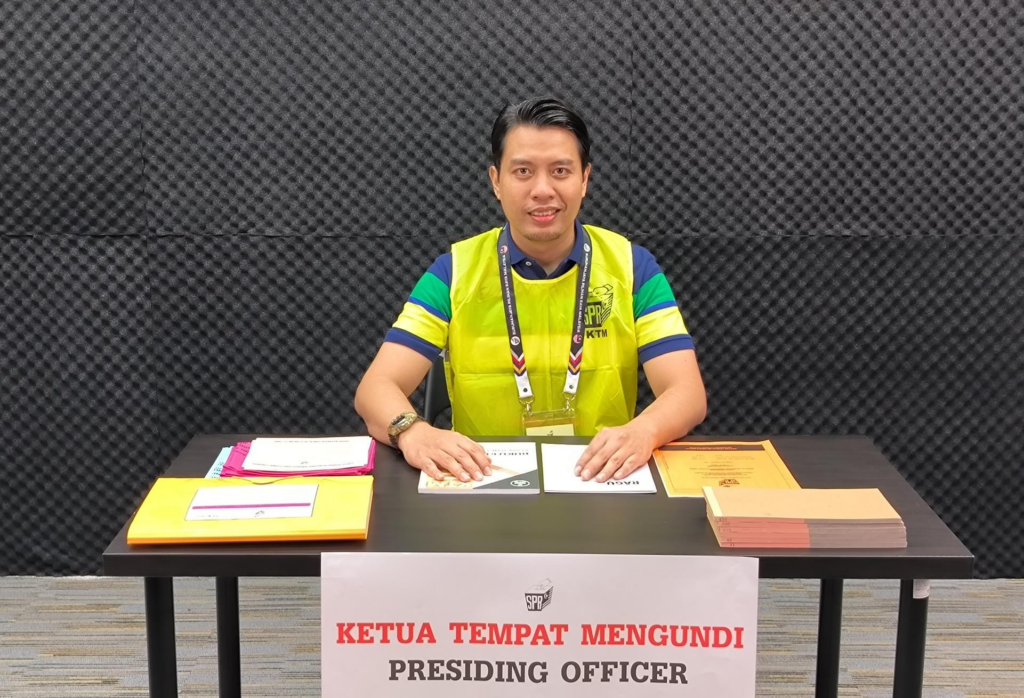
You may request a replacement if you accidentally spoil your ballot before casting it, but a replacement is not automatic.
For example, you might accidentally mark the wrong candidate or notice that your ballot paper is damaged. If that happens, inform the Ketua Tempat Mengundi, or presiding officer, immediately.
Do not tear, throw away, hide or scribble over the ballot paper. The officer will handle the spoiled ballot and any replacement according to the official procedure. Most importantly, raise the problem before placing the ballot into the ballot box. Once cast, it generally cannot be retrieved.
As a rule of thumb, always start by checking your ballot paper the moment you receive it. Tell the polling officer immediately if the ballot paper is torn, is already marked, looks incorrect, or seems to be missing the required official marking.
Is it okay to intentionally "spoil" your vote?
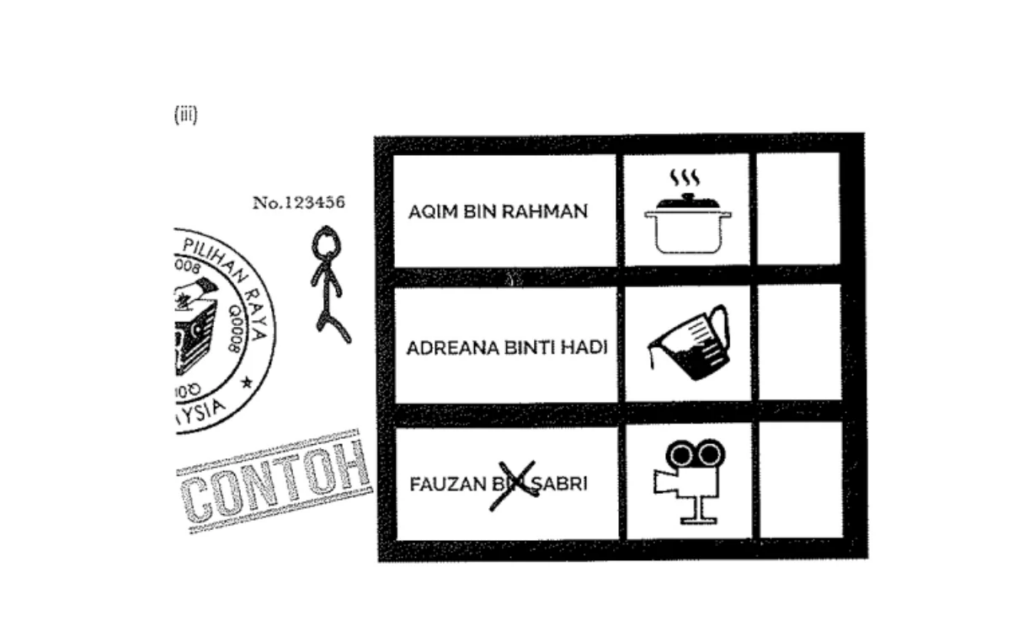
Some voters deliberately leave their ballot blank, mark several candidates, or add words and drawings as a form of protest. However, there is a difference between a spoilt ballot and a rejected ballot.
| Term | What it means |
|---|---|
| Spoilt ballot (undi rosak) | A ballot cancelled before it is cast |
| Rejected ballot (undi ditolak) | A ballot cast into the box but rejected during counting |
In everyday conversation, people often say they want to "spoil" their vote. Technically, if they deliberately cast an invalid ballot, the result is usually a rejected ballot, which may appear in election statistics but does not count towards any candidate.
Intentionally "spoiling" your vote is not illegal, but voters should know that a rejected ballot is not counted for any candidate. It may still appear in election statistics, but it will not help elect anyone.
Frequently asked questions by first-time voters:
1. Can your family know who you voted for?
No one should be able to know who you voted for unless you choose to tell them.
Your vote is secret. Inside the voting booth, you mark your ballot privately. You should not take a photo of your ballot paper, show it to anyone or create proof of who you voted for. They may know that you went to vote. They should not know who you voted for.
2. What if someone pressures you to vote for a certain person?
You still mark your ballot privately in the voting booth.
No one should demand proof of how you voted. Be careful if someone asks for proof that you voted for a certain candidate. Your ballot is secret. Do not photograph it. If you feel unsafe or pressured, focus on following the official voting process at the polling station.
3. Do I need to read every manifesto?
No. Focus on the parts that affect your life and area. Look for specific plans, not just slogans.
What if I cannot find much information about a candidate?
Look for their party, coalition, public statements, past work, or campaign events. If information is limited, that itself may be something to consider.
4. Common mistakes first-time voters should avoid:
- Waiting until polling day to check your polling centre
- Assuming you can vote at any polling centre
- Forgetting your MyKad or accepted identity document
- Joining a random queue without checking your saluran
- Using your phone inside the voting room or booth
- Taking a photo of your ballot paper
- Wearing clothing with party logos or campaign slogans
- Marking more than one candidate
- Arriving too close to closing time
5. Can you vote with painted nails or acrylic nails?
Yes. Nail polish, gel nails or acrylic nails generally do not prevent you from voting.
However, election workers must still apply indelible ink according to the polling procedure. A manicure does not exempt you from this requirement.
6. Can you bring your phone into the voting booth?
You may bring your phone to the polling centre, but you should not use it inside the voting room or voting booth. Smartphone use is not allowed inside the voting room or voting booth. Do not use your phone while receiving, marking, or casting your ballot.
Last updated: 15 October 2026
Read more trending stories on SAYS

Flight Attendant Who Ploughed Into Work Crew, Killing DBKL Road Supervisor, Granted Bail
Mohd Iman Nafiz Fong Mohd Sabirin, 26, allegedly recorded a blood alcohol level above Malaysia's legal limit.