
Ancient Fault Lines In Johor Showing Signs Of Reactivation, Says Expert
Despite recent tremors, there is no evidence indicating an increase in Malaysia's earthquake risk.


 Cover image via
 Follow us on Instagram, TikTok, and WhatsApp for the latest stories and breaking news.
Ancient fault lines across Malaysia are showing signs of renewed activity, most notably with the reactivation of the Mersing Fault in Johor after more than a century of relative seismic inactivity
Geologists recently identified these developments following a series of localised tremors, prompting renewed discussions about the stability of geological structures beneath Peninsular Malaysia, as reported by the New Straits Times.
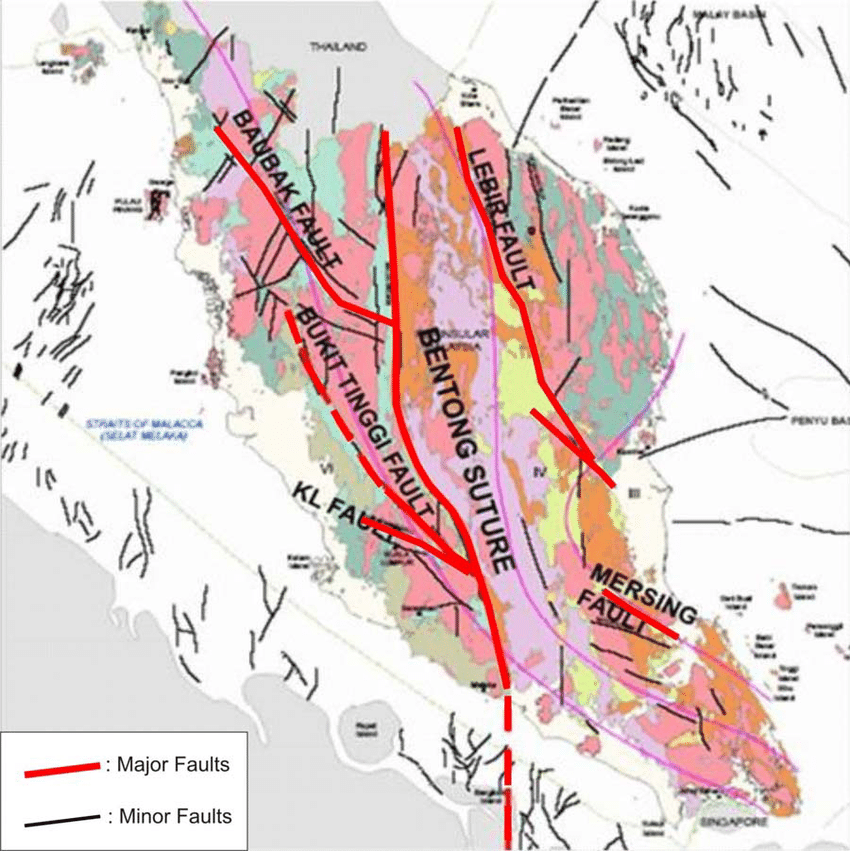
A seismotectonic map of Peninsula Malaysia.
Image via Kamaludin Mohd Omar (ResearchGate)According to Associate Professor Dr Mohd Rozi Umor, a senior geology lecturer at Universiti Kebangsaan Malaysia (UKM), several recent tremors point to ongoing adjustments along this specific fault system
Segamat recently experienced a magnitude 4.1 earthquake, followed by aftershocks measuring magnitudes 2.8 and 3.2. A magnitude 3.3 tremor shook Batu Pahat within a relatively short period, suggesting that parts of the crust may be undergoing ongoing tectonic adjustments.
Mohd Rozi said seismic activity in Peninsular Malaysia is not entirely unprecedented, with historical archives documenting stronger events in Johor. The state recorded significant earthquakes in 1922, measuring magnitudes 5.4 and 5.0.
Similar examples can be found elsewhere in the country, including recurring minor tremors along the Bukit Tinggi fault zone in Pahang and the 2015 Ranau earthquake in Sabah, showing that local fault lines can remain active over long periods.
Between 2016 and 2020, the Department of Minerals and Geoscience Malaysia (JMG) mapped 11 active fault zones nationwide, six of which are located in the peninsula. These include the Bok Bak fault in Kedah and Perlis, as well as the Kuala Pilah fault in Negri Sembilan.

Associate Professor Dr Mohd Rozi Umor.
Image via UKMDespite the recent series of tremors, experts emphasise that there is no conclusive evidence indicating an increase in Malaysia's earthquake risk
Advancements in monitoring technologies have made minor seismic events significantly more visible to the public, with seismic sensors operated by the Malaysian Meteorological Department (METMalaysia) and JMG expanded significantly over the past two decades.
Malaysia currently operates 47 passive seismic stations nationwide, allowing authorities to detect and report minor tremors between magnitudes 2.0 and 3.0 that may previously have gone unnoticed.
The country's monitoring framework also remains capable of tracking distant earthquakes and issuing immediate regional tsunami warnings
For example, METMalaysia provided real-time risk assessments within minutes of a magnitude 5.4 earthquake near the Sulawesi Sea.
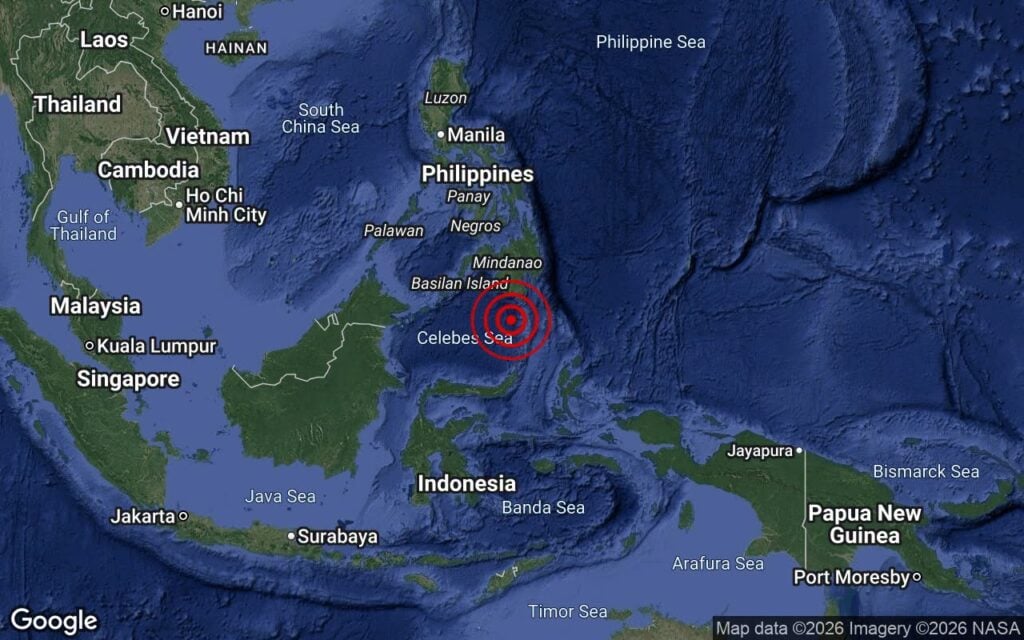
In less than 10 minutes, METMalaysia published a report on the recent seismic activity in the region.
Image via METMalaysiaTo bolster domestic safety measures, JMG is collaborating with local universities to update the Malaysian Seismic Hazard Map while expanding sensor coverage across smaller fault networks in Peninsular Malaysia.
Malaysia also participates in regional security data-sharing initiatives with Indonesia and the Philippines under frameworks established by ASEAN and the UNESCO Intergovernmental Oceanographic Commission.
