
DOSM Releases First-Ever Food Security Index With National Score Of 61.5
Here's what the score means and how it affects the food you eat every day.


 Cover image via
 Follow us on Instagram, TikTok, and WhatsApp for the latest stories and breaking news.
Malaysia's food security status achieved a historic milestone, with the nation receiving a 'good performance' rating for the first time under the newly established Malaysia Food Security Index (MFSI)
The Department of Statistics Malaysia (DOSM) officially launched the index on 6 July, revealing that the country's overall score climbed sharply to 61.5 in 2024 from 54.5 recorded in the previous year.
Chief Statistician Datuk Seri Dr Mohd Uzir Mahidin said that the progressive metric tracks 25 key indicators spanning more than a decade to provide a comprehensive, evidence-based measurement of domestic food resilience aligned with global frameworks.
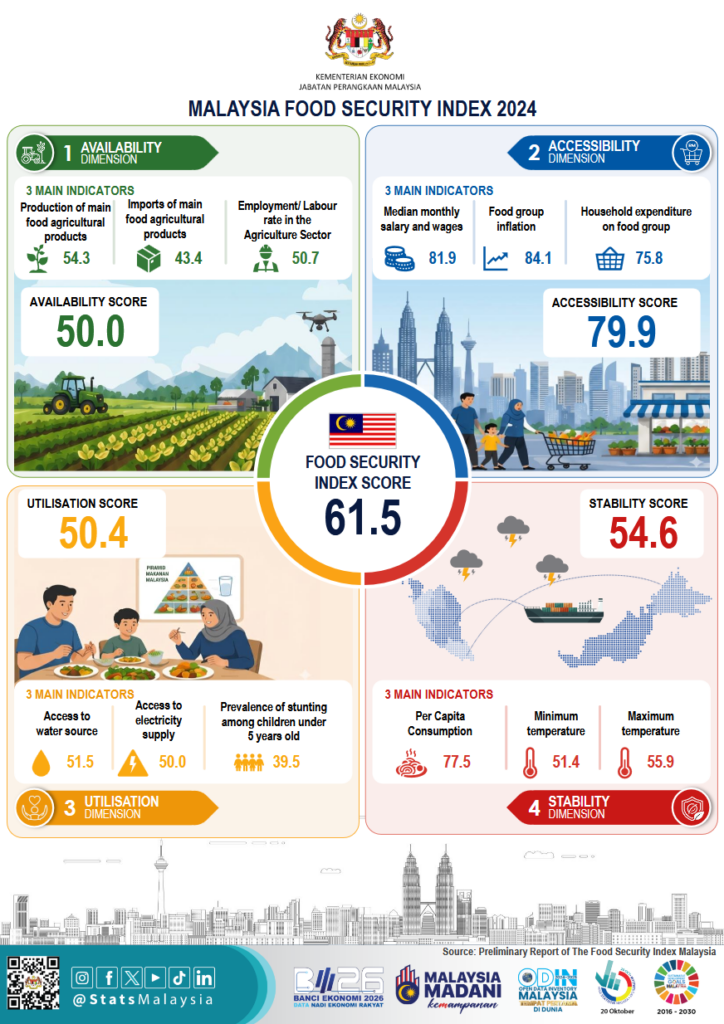
The architecture of the index relies on four structural pillars — availability, accessibility, utilisation, and stability — to gauge the holistic health of the national food supply
Among these main components, the accessibility dimension registered the most dramatic expansion, surging to 79.9 in 2024 from 59.6 in 2023.
Several highly positive socio-economic factors drove this upward trajectory, including a significant drop in domestic food inflation, enhanced rural road connectivity, and rising median salary levels across the local workforce.
Within this pillar, the individual indicator for food inflation notched the highest overall performance score at 84.1, closely followed by infrastructure metrics like unpaved roads at 83.6 and median wages at 81.9.

Image used for illustration purposes only.
Image via Falaq Lazuardi/UnsplashParallel improvements were also recorded in the stability and utilisation dimensions, demonstrating that targeted socio-economic strategies are yielding tangible benefits for the public
The stability index experienced a substantial boost, rising to 54.6 from 40.2 due to robust per capita food consumption patterns and favourable environmental temperatures.
Concurrently, the utilisation index edged upwards to 50.4 from 48.5, a positive shift backed by critical advancements in public health frameworks. These include better childhood nutritional profiles, increased life expectancy at birth, and broader community access to clean water systems.
In contrast, the availability index experienced a notable contraction, slipping to 50.0 from 54.3 in 2023 to expose lingering structural vulnerabilities within domestic supply loops
This minor decline was primarily driven by weaker performance in the import and export of primary agricultural commodities, persistent post-harvest losses, and fluctuations in the available dietary energy supply per capita.
Despite these specific challenges, the actual production volume of major agricultural food products recorded steady improvements during the year, remaining a high-scoring baseline indicator alongside total food exports.
Mohd Uzir noted that the overall index growth proves that while domestic supply constraints remain, ordinary Malaysians generally enjoyed vastly superior food access and financial affordability compared to previous years.
Here's what it means for Malaysians
While international market shocks continue to impact trade, the typical grocery run remains largely insulated from severe household shortages.
Local shortfalls in domestic production are currently being successfully balanced through proactive import strategies, ensuring that standard household ingredients remain economically accessible.
Structural developments under the index's stability pillar also indicate that families face fewer abrupt spikes in market prices.
Enhanced transport logistics and better rural road infrastructure mean that essential pantry staples move efficiently from regional shipping ports to neighbourhood supermarkets, keeping local shelves steadily stocked.

Image used for illustration purposes only.
Image via Kent Ng/PexelsOn a deeper community level, the index reveals a direct correlation between national food security monitoring and improved public well-being
For Malaysians, this translates to better health outcomes, including superior childhood nutrition baselines and more reliable access to clean water systems.
The collective data demonstrates that the basic dietary energy supply remains robust across all segments of society, directly supporting a general rise in national life expectancy.
However, the findings also highlight critical vulnerabilities where local consumers could still feel the pinch
The decline in the food availability dimension emphasises Malaysia's heavy, continuing reliance on imports for essential agricultural products, a structural vulnerability that leaves local wallets exposed to external climate shocks and international conflicts that can rapidly drive up import costs.
To protect Malaysian kitchens from future global crises, the government is accelerating the modernisation of domestic farming. For local agricultural workers and consumers alike, this means an imminent shift towards large-scale commercial farming integrated with drones and Internet of Things (IoT) devices, aiming to establish a more self-sufficient food grid for the nation.
