
Is MSG Non-Halal? Govt Department Denies Claims That ‘Umami Seasoning’ Contains Pork
Monosodium glutamate (MSG) is permitted food additive by the Health Ministry.


 Cover image via Bahagian Keselamatan dan Kualiti Makanan JKWPKL&P (Facebook)
Follow us on Instagram, TikTok, and WhatsApp for the latest stories and breaking news.
A government health department has refuted claims that 'umami seasoning' is derived from pork bones
In a statement on Monday, 24 August, the Food Safety and Quality Division (FSQD) at the Kuala Lumpur and Putrajaya Federal Territories Health Department urged members of the public not to believe nor spread unverified information online.
The department said claims that monosodium glutamate (MSG) contains traces of pork are false.
The statement included a screenshot of a Facebook post alleging that the packaging of a popular MSG brand contains the word 'umami', and claiming that the Japanese word is linked to pork.
"Umami is the fifth basic taste that can be detected by the human tongue, alongside sweet, sour, salty, and bitter.
"This taste is produced when receptors on the tongue detect glutamate compounds, a type of amino acid naturally found in various foods.
"MSG is the sodium salt of glutamic acid, which is used as a flavour enhancer to boost the umami taste in food," the statement read.
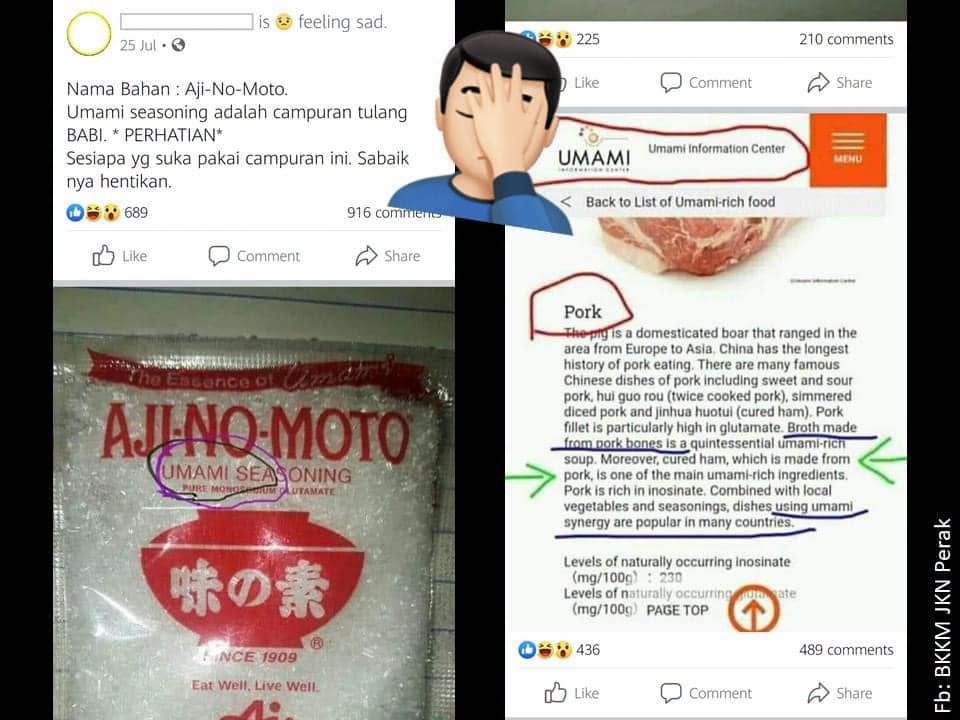
FSQD said many natural foods contain glutamate, including seaweed, soy sauce, cheese, budu (anchovy sauce), cassava, mushrooms, meat, and breast milk
"This indicates that humans are exposed to the umami taste from the very early stages of life.
"In Malaysia, the use of MSG is permitted by the Ministry of Health Malaysia (MOH) as a food additive under the flavour enhancer category," it said.
The department added that glutamate is a non-essential amino acid naturally produced by the human body, explaining that MSG can be derived from various protein-rich sources.
It also noted that MSG products sold in Malaysia with halal certification must meet strict halal requirements, with many manufacturers using raw materials such as cassava and sugarcane to produce the seasoning.
"Therefore, the public is advised to always refer to authoritative sources before drawing conclusions or spreading information, especially concerning food safety and the halal status of a product," FSQD said.
Read more trending stories on SAYS

Flight Attendant Who Ploughed Into Work Crew, Killing DBKL Road Supervisor, Granted Bail
Mohd Iman Nafiz Fong Mohd Sabirin, 26, allegedly recorded a blood alcohol level above Malaysia's legal limit.