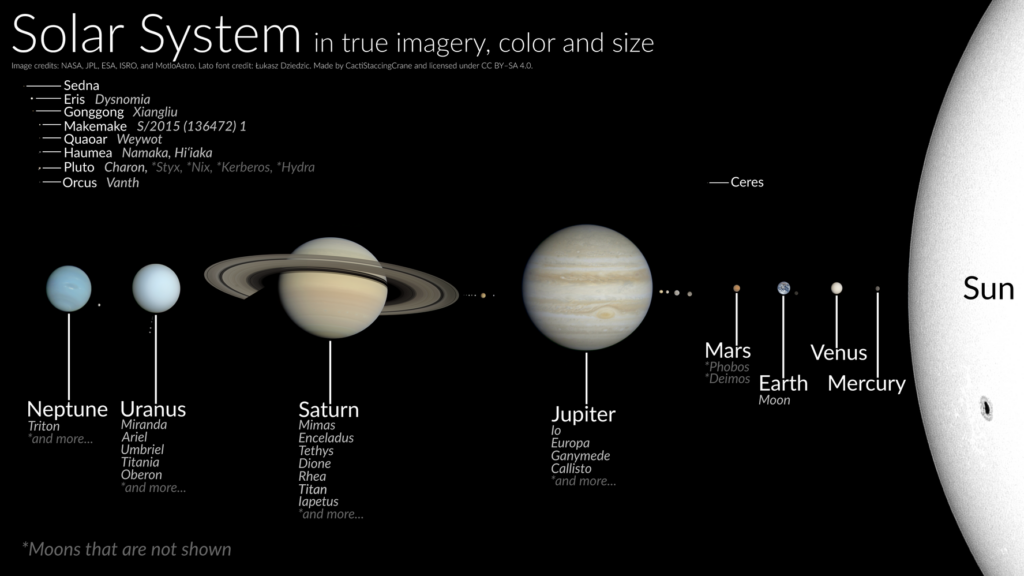
Scientists May Have Found A New Dwarf Planet In Our Solar System
They have classified the newly discovered celestial body as a dwarf planet.


 Cover image via
Follow us on Instagram, TikTok, and WhatsApp for the latest stories and breaking news.
Astronomers have discovered a celestial body on the frozen outskirts of our solar system, potentially making it one of the largest dwarf planets ever identified
The deep-space object, designated 2026 ED138, sits far beyond Neptune, the outermost of the eight planets in our solar system.
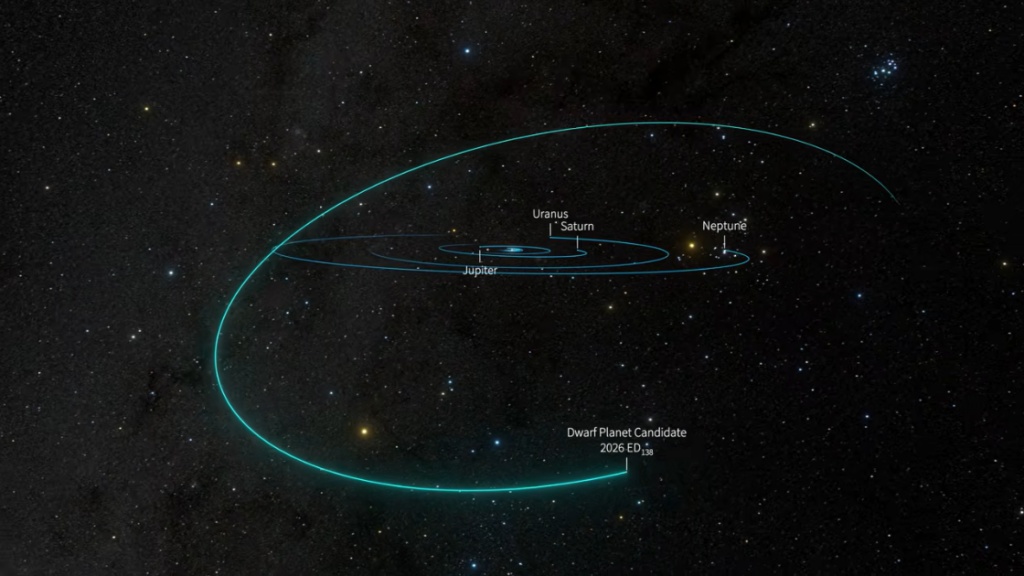
Early observations suggest the dwarf planet candidate has a diameter of between 595km and 1,496km, although further orbital tracking is needed before its classification can be confirmed
The discovery was made using the state-of-the-art Vera C. Rubin Observatory in Chile, an advanced astronomical facility equipped with the largest digital survey camera ever built.

Astronomer Matthew Holman initially detected the faint signature on 13 October while processing wide-field photographic plates captured earlier this year
"My first reaction was one of excited disbelief," Holman said in an official statement released by the observatory.
"Objects like this are very rare, so I immediately started checking whether I or the code had done something wrong."
Orbiting at approximately 46 times the distance between Earth and the Sun, the object circles deeper in the Kuiper Belt than Pluto's average orbital path
Despite its impressive scale, the celestial body evaded detection for decades because its trajectory transits across an exceptionally dense starry backdrop of the Milky Way, blending into millions of background stellar sources.
Under International Astronomical Union definitions established when Pluto was reclassified in 2006, dwarf planets are massive enough for their own gravitational pull to shape them into roughly spherical bodies, yet they have not cleared their immediate orbital neighbourhoods of other debris. Five worlds currently hold formal dwarf planet status: Pluto, Ceres, Eris, Haumea, and Makemake.
Should ongoing telescope scans confirm that 2026 ED138 possesses hydrostatic equilibrium, it will join that list. Researchers anticipate further discoveries in the coming months, suggesting that several more massive trans-Neptunian bodies remain undetected in the dark outer fringes of our cosmic neighbourhood.