
How To Understand TNB Monthly Electricity Bill Breakdown?
Learn how to read your TNB electricity bill from top to bottom.


 Cover image via SAYS
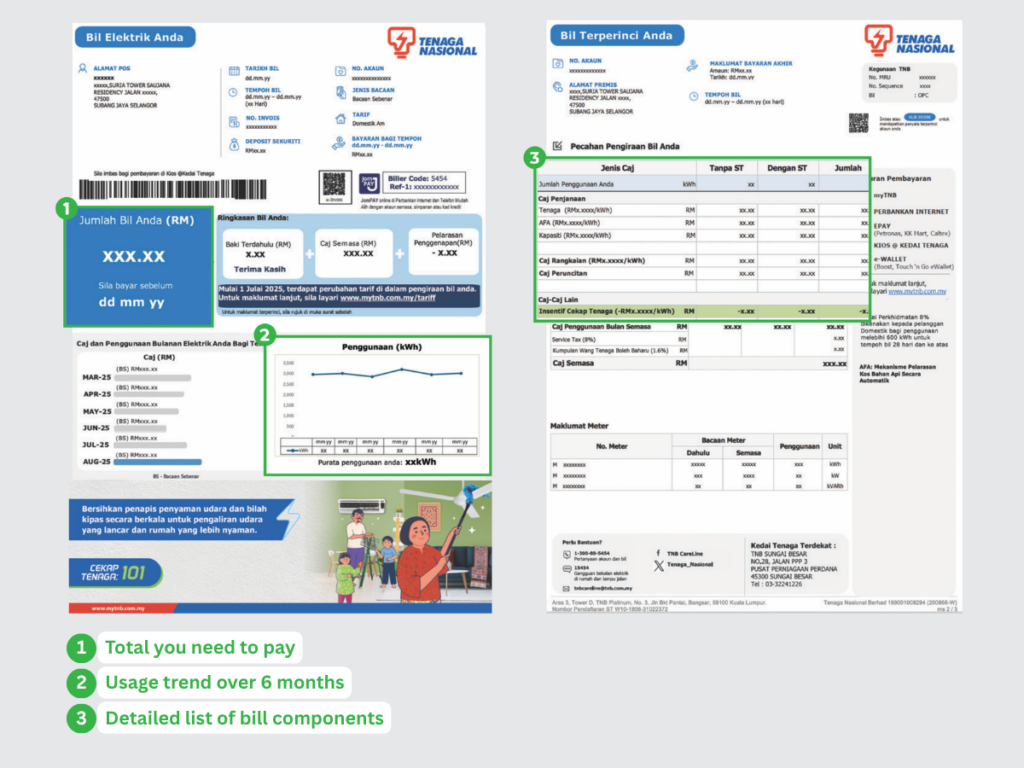
The easiest way to understand your TNB bill is to read it from top to bottom instead of looking only at the final RM amount.
Your bill tells you how much electricity you used, how the usage was recorded, which tariff applies, what charges or deductions were included, and how much you finally need to pay.
What should I check first on my TNB bill?
Before going through every line item, check these parts first. Together, they usually tell you what changed and what you are actually being charged for.
| What to check | What it tells you |
| Billing period | The dates covered by the bill. A longer or shorter billing period can affect how much electricity appears in that month's bill. |
| Electricity usage (kWh) | How much electricity your household used during that billing period. This is the most useful number for comparing consumption from one month to another. |
| Reading Type | Shows whether the bill is based on an actual meter reading or an estimated reading, where applicable. If an estimated reading is used, the account may later be adjusted when an actual reading becomes available. Smart Meter customers generally have remotely recorded interval readings instead of relying on a manual site reading. |
| Tariff type | Whether the account is on the domestic General Tariff or Time of Use (ToU), which affects how the Energy Charge is applied. |
| Current Month Usage Charge | The charges relating to electricity used in the current billing period after applicable components and incentives are taken into account. |
| Deductions or additional charges | Look for items such as the Energy Efficiency Incentive, AFA, KWTBB, Service Tax, rebates, or credits. |
| Previous balance | Any unpaid amount brought forward from an earlier bill. This can make the amount due higher even if current-month usage is normal. |
| Amount due | The final amount you need to pay after current charges, previous balances, credits, and other applicable adjustments are included. |
How do I read a TNB electricity bill from top to bottom?
A quick way to read the bill is:
- Account details: Confirm the account, premises, bill date, and billing period.
- Usage: Check how many kWh were recorded for the month.
- Meter information: Check the meter readings and whether the Reading Type is actual or estimated.
- Tariff and charges: Look at the Energy, Capacity, Network, Retail, and AFA lines that apply.
- Incentives and adjustments: Check for deductions such as the Energy Efficiency Incentive, as well as KWTBB, Service Tax, rebates, or credits.
- Amount due: Finish with the final amount payable and check whether any previous balance has been included.
What do the different charges on my TNB bill mean?
Under the current tariff structure, TNB itemises the costs of generating and delivering electricity instead of presenting them as one single electricity charge.
| Bill item | What it means |
| Energy Charge | The energy-related cost of generating the electricity you use |
| AFA | A monthly adjustment that reflects changes in generation costs and can appear as a surcharge or rebate where applicable |
| Capacity Charge | The cost associated with keeping sufficient generation capacity available |
| Network Charge | The cost of transmitting and distributing electricity to your premises |
| Retail Charge | Covers retail services such as billing and account management |
| Energy Efficiency Incentive | A reduction given to eligible domestic customers based on their level of monthly consumption |
| KWTBB | Contribution to the Renewable Energy Fund where applicable |
| Service Tax | Government tax shown separately when applicable |
| Current Month Usage Charge | The electricity-related charges for that billing period after applicable components are taken into account |
| Previous balance / adjustments | Any earlier outstanding amount, credit, or other account adjustment |
| Amount due | The final amount you need to pay |
Here are a few important details to note:
AFA can move in either direction. It can be a surcharge or a rebate depending on the applicable monthly adjustment. Under the current temporary September–December 2026 arrangement, domestic customers with monthly consumption of 800kWh and below are exempt from AFA (the normal exemption is 600 kWh and below).
Energy Efficiency Incentive is a deduction, not another charge. Eligible domestic customers using up to 1,000 kWh receive an incentive, with the rate depending on their consumption band. A negative value on this line therefore reduces the bill.
KWTBB is a charge, not a rebate. It is a contribution to the Renewable Energy Fund, although domestic customers using 300 kWh or less are currently exempt.
The full calculation behind these components is separate from simply reading the bill. TNB also provides a bill calculator that itemises usage, AFA, Capacity, Network, Retail, Energy Efficiency Incentive, Service Tax, and KWTBB.
Why does my TNB bill show a negative amount?
A negative amount on your TNB bill generally means money is being deducted from the bill rather than added to it.
For example, an Energy Efficiency Incentive may appear as a negative figure because it reduces the charges you would otherwise pay.
If the bill shows Energy Efficiency Incentive: -RM57.75
That means RM57.75 is being deducted from the bill, not charged to you.
Where can I view or download my TNB bill?
TNB customers can access electricity bills through the myTNB portal and app.
Keeping several months of bills can also be useful if you want to compare your normal consumption, meter readings, and bill components over time.
FAQ
Does every TNB household pay AFA?
No. AFA only applies where the relevant rules require it. Under the current September–December 2026 protection arrangement, domestic customers with monthly consumption of 800 kWh and below are exempt.
Why does my bill say "estimated" instead of "actual"?
An estimated reading can be used when an actual meter reading is not obtained. A later actual reading may then adjust the difference.
Where can I check if I am on the ToU tariff?
Check the tariff type on your TNB bill or myTNB account. ToU customers are charged different Energy Charge rates during peak and off-peak periods.
Last updated: 20 November 2026
