
How MCMC Kept 261,000 People Securely Connected At Sepang During The F1 Bahrain GP
There were some spectacular things happening behind the scenes.


 Cover image via
 Follow us on Instagram, TikTok, and WhatsApp for the latest stories and breaking news.
With an official attendance of 261,000, the Formula 1 Gulf Air Bahrain Grand Prix in Malaysia 2026 was one of the biggest public events held in Malaysia this year
But alongside the racing hype, another part of the experience required attention: Internet connectivity.
Throughout the event, the Malaysian Communications and Multimedia Commission (MCMC) was on the ground monitoring telecommunications network performance around Sepang International Circuit (SIC).
While fans recorded videos, livestreamed the action, uploaded photos, or messaged family and friends, MCMC worked with telecommunications providers to keep track of network conditions across the venue.
Here's how they did it:
1. A total of 38 telecommunications structures supported the event's connectivity needs
These comprised 13 existing structures and 25 temporary structures, with the temporary additions providing extra capacity to support increased network traffic.
The infrastructure involved six telecommunications providers: CelcomDigi, Maxis, U Mobile, TM, YTL, and Digital Nasional Berhad (DNB).
With large crowds gathering at the circuit, the additional structures helped support the rise in demand as visitors used their phones throughout the race weekend.
2. MCMC teams actively monitored connectivity where fans were gathering
MCMC teams carried out checks at key areas and visitor hotspots around SIC to assess coverage and communications performance.
These on-site tests provided a direct view of connectivity from the locations visitors were actually using.
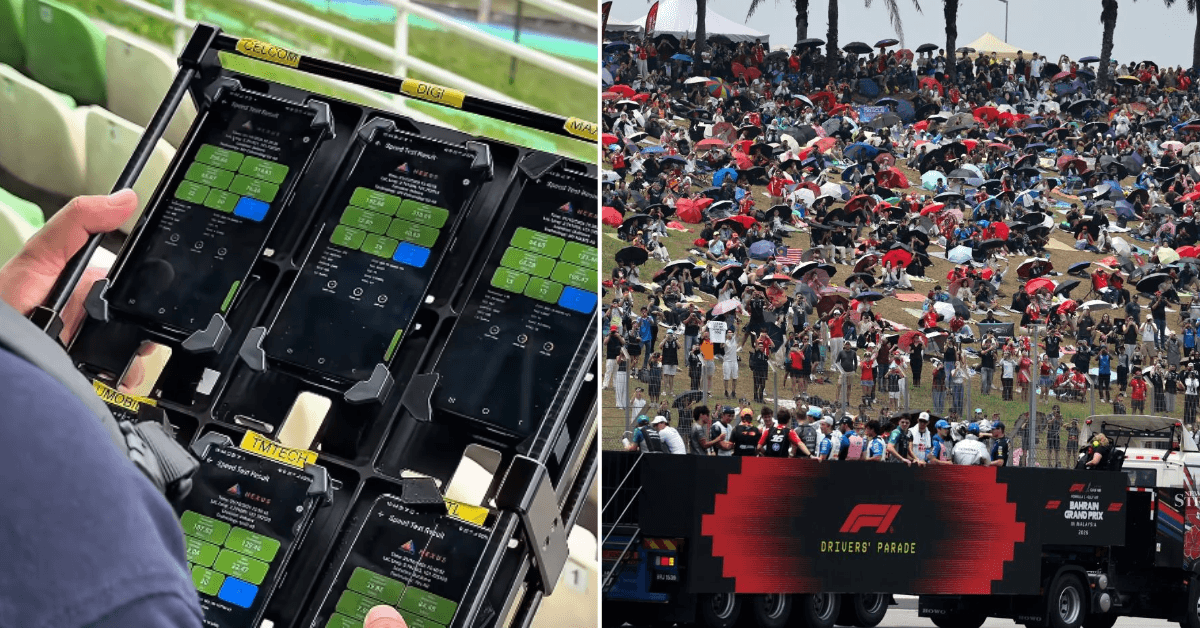
Teams used MCMC Nexus to conduct speed tests at hourly intervals between 8am and 10pm, subject to the event schedule.
Together with technical data from telecommunications providers, the measurements helped build a fuller picture of network conditions throughout the event.
3. 500 F1 volunteers helped test network speeds from their locations around the venue
These volunteers were equipped with the MCMC Nexus app to conduct speed tests from their respective locations.
Their measurements helped provide a broader view of connectivity across different parts of the venue, capturing network performance from a user's perspective.
Meanwhile, telecommunications providers monitored capacity usage, active user numbers, data traffic, and site alarms to identify changes or signs of disruption that needed attention.
The MCMC Nexus test results were displayed on the MCMC Nexus Monitoring Dashboard, helping MCMC and the providers assess conditions alongside their technical monitoring and coordinate follow-up action when needed.
4. Each telco had a representative at the monitoring centre
For an event as big as F1, sharing information and coordinating responses were also part of the job.
The Network Monitoring Centre (NMC) served as the monitoring and coordination hub between MCMC and telecommunications providers throughout the event.
Each provider stationed a liaison officer there to monitor network performance and coordinate improvements based on the data received.
If conditions changed or signs of congestion emerged, the centre allowed the relevant teams to share information and coordinate their next steps.
5. Radio frequencies were monitored to help detect interference that could affect communications
Such interference could affect communications and operations around the circuit, including those of the participating racing teams.
At SIC, MCMC carried out this work in coordination with the National Spectrum Management Operations Centre (NASMOC), allowing potential issues to be identified and followed up promptly.
MCMC's Chief State Affairs Officer, Tuan Haji Bukhari, said continuous monitoring helps teams respond to rapid changes in network demand during F1 events
He explained that user numbers and network traffic can change quickly at major events such as Formula 1. That is why monitoring takes place continuously, rather than beginning only when a disruption occurs.
Combining providers' technical data with on-site MCMC Nexus tests helped give a more comprehensive view of conditions from both the network and user perspectives.
For fans at Sepang, much of this work probably went unnoticed amid the racing atmosphere
But behind every F1 moment captured and shared was a team of MCMC personnel working behind the scenes to keep the connectivity running smoothly.
At an international event of this scale, being able to stay connected is also part of the experience.
