
Haven’t Settled Taxes? Here Are Payment & Instalment Options For Individuals Or Businesses
It's really not that complicated.


 Cover image via
 Follow us on Instagram, TikTok, and WhatsApp for the latest stories and breaking news.
This Spotlight is sponsored by HASiL.
Many of us often feel as though filing taxes is a complicated task.
In reality, the whole process is actually simpler than most people think!
These days, most tax-related matters can be handled through the digital services made available by HASiL. Once you know how the system works and the options available, staying on top of your taxes becomes much more straightforward.
Malaysia adopts a Self-Assessment System (SAS), where taxpayers are fully responsible for calculating and reporting their own taxes
Under this system, every taxpayer is required to:
- Declare income through e-Filing via the MyTax Portal
- Calculate the amount of tax payable
- Pay within the stipulated period
If you earn income in Malaysia, you are generally required to file a tax return, even if your income has not reached the taxable threshold
Whether you're a salaried employee, business owner, freelancer, e-hailing driver, consultant, or commission earner, you may fall under the category of taxable persons if your income exceeds the prescribed threshold.
Foreign workers who work and earn income in Malaysia are also subject to tax, with tax rates depending on their residency status.
For companies, registered entities such as private limited companies (Sdn Bhd) and sole proprietorships are required to declare and pay tax on income earned, subject to prevailing tax laws and regulations.
One of the most common misconceptions involves Monthly Tax Deduction (MTD), also known as PCB
Even if your employer has deducted PCB every month, you are still required to submit your annual tax return through e-Filing.
This is because PCB is merely an advance or estimated tax payment. The actual tax payable can only be determined after your income declaration has been submitted.
Paying taxes is almost as easy as paying your utility bills
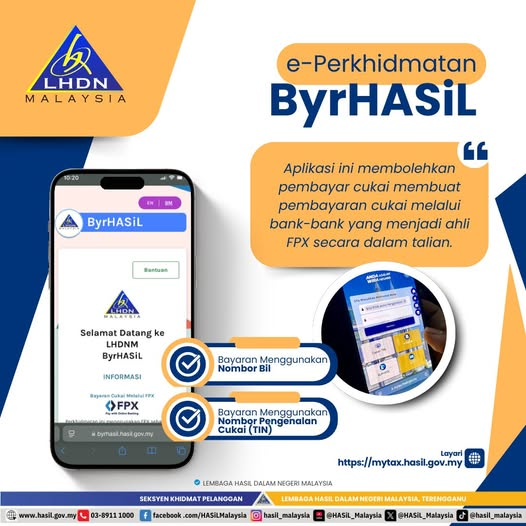
Long queues at payment counters are no longer necessary. ByrHASiL is one of several payment channels that lets taxpayers with different preferences.
Taxpayers can make payments through internet banking (FPX), with payment limits of up to RM5 million for individuals and RM250 million for corporate and business taxpayers.
For those who prefer more conventional payment methods, ATM and telephone banking remain available.
Meanwhile, payments can also be made directly at selected HASiL collection agent counters or through participating online banking services.
For overseas payments, you can use the e-TT system
The e-TT system is designed for taxpayers without Malaysian banking facilities and for those making payments from overseas.
Payments can be made through Telegraphic Transfer (TT), Electronic Fund Transfer (EFT), or Interbank GIRO (IBG).
To make a payment, taxpayers only need their Bill Number, as stated in the tax notice, or their Tax Identification Number (TIN).
Simply log in, make the payment, and you're done.
Not everyone is able to settle their tax liabilities in a single payment, and HASiL recognises this
Through the e-Ansuran facility on the MyTax Portal, eligible taxpayers may apply to make instalment payments instead.
The facility is subject to several conditions:
- Outstanding tax amount must exceed RM300
- Instalment payments range between two and six instalments
What's more, eligible applications for e-Ansuran may be automatically approved online without the need to visit a HASiL office.
Checking whether your payment has been recorded only takes a few clicks
Taxpayers can log in to the MyTax Portal and access the e-Ledger service (think of e-Ledger as a dedicated bank statement for your tax account).
Through e-Ledger, taxpayers can check:
- Records of Income Tax, Withholding Tax, and RPGT payments
- PCB deductions made by employers
- Dates of deductions
- Outstanding tax balances
- Excess payments or credits
Review it regularly and don't wait until you receive a notice from HASiL before taking action.
These are the deadlines every taxpayer should remember
- Individuals without business income must file before 15 May. This category generally covers salaried employees.
- Individuals with business income must file before 15 July. This includes business owners, freelancers, and self-employed individuals.
Income should always be declared accurately and honestly. Most importantly, tax payments should be made within the prescribed period to avoid penalties.
Late payment may result in a 10% increase in tax under Section 103 of the Income Tax Act 1967.
Staying on top of your tax obligations doesn't have to be difficult.
With various payment channels and instalment facilities in place, taxpayers now have more ways to manage them with ease.
For further info, visit the official HASiL website
Got some cool brand news to share?

Take a look at all of our Spotlight stories to date here.
