
Govt To Abolish Universities & University Colleges Act. Here’s What You Need To Know
The controversial Act has been in place for more than 55 years.


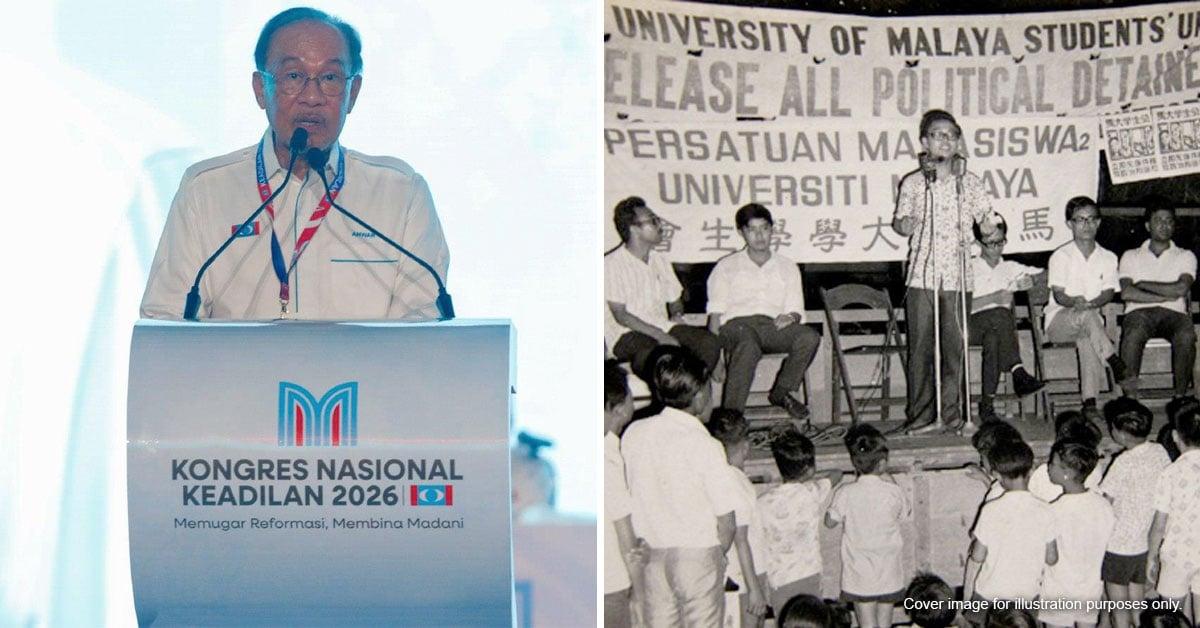 Cover image via
 Follow us on Instagram, TikTok, and WhatsApp for the latest stories and breaking news.
The government has proposed to abolish the Universities and University Colleges Act 1971 (AUKU)
Universities were governed by the Emergency (Essential Powers) Ordinance No 74 following the events of 13 May 1969 after then prime minister Tunku Abdul Rahman called for a national state of emergency.
The Ordinance ultimately became the basis of AUKU, which was eventually gazetted in April 1971.
Since its introduction, the law has remained controversial throughout much of its 55-year history, with critics arguing that it restricts political and activist activities on campus and limits universities' autonomy in governance.
Although the law has gone through seven amendments, including a major reform in 2019 under the Pakatan Harapan administration that allowed political activities on campus, Prime Minister Datuk Seri Anwar Ibrahim said concerns over university students' freedoms remain unresolved, as vice-chancellors can still restrict such activities.

To help you understand the significance of the proposed abolition and what would be permitted on campus after it, here are some key takeaways you need to know:
1. AUKU established a common legal framework for public universities
Year: 1971
Minister responsible: Education Minister Tun Hussein Onn
Major changes:
- Established a common system for creating and administering public universities.
- Introduced a model university constitution covering the university Council, Senate, Vice-Chancellor, faculties, staff, and students.
- Gave universities powers to own property, enter contracts, and manage teaching, examinations. and research.
- Introduced restrictions on students associating with political parties or organisations declared unsuitable.
When introducing the Bill, Hussein Onn explained that the government wanted a common framework so that parliament would not need to pass a separate Act whenever a new university was established, reported FMT.
Political activity was already restricted since its introduction, although the restrictions were not yet as severe as those introduced in 1975.
2. Parliament strengthened oversight of university governance
Year: 1971
Minister responsible: Education Minister Tun Hussein Onn
Major changes:
- Required university incorporation orders to be presented to parliament.
- Required audited university accounts to be laid before both houses of parliament.
- Adjusted the composition of university Senates.
- Corrected parts of the original model constitution.
This was mainly an administrative amendment. It improved parliamentary scrutiny but did not substantially expand student freedom or change the political restrictions in the Act.
3. The 1975 amendment imposed AUKU's most severe restrictions
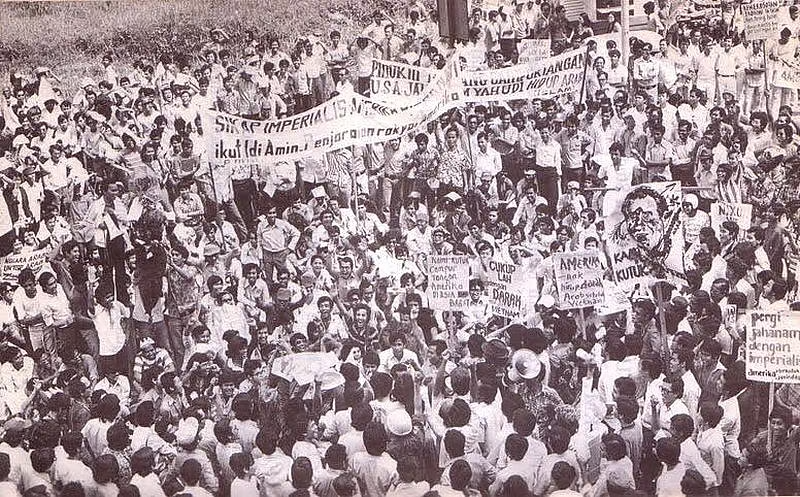
Malaysian farmers and students rose in protest against rising food costs and a sluggish economy in 1974.
Image via National Archives via FMTYear: 1975
Minister responsible: Education Minister Tun Dr Mahathir Mohamad
Major changes:
- Prevented students from joining or associating with many outside organisations without university approval.
- Prohibited students from expressing support, sympathy, or opposition towards political parties, trade unions, and prohibited organisations.
- Restricted student organisations from collecting or controlling money.
- Expanded disciplinary powers over students and student organisations.
- Introduced suspension and expulsion consequences when students were charged with or convicted of certain offences.
The amendment came after a period of intense student activism, including the 1974 Baling demonstrations concerning rural poverty and inflation. Prime Minister Datuk Seri Anwar Ibrahim was one of the many students detained in the protest, although he was detained under the Internal Security Act (ISA) 1960.
The controversial change transformed AUKU from a university-administration statute with political restrictions into a much more extensive system of student control. Politics, external association, fundraising, and public advocacy became activities carrying potentially serious academic consequences.
This amendment is largely responsible for AUKU's reputation as a law designed to depoliticise Malaysian campuses.
4. Public universities were 'corporatised', but ministerial control remained
Year: 1996
Minister responsible: Education Minister Datuk Seri Najib Razak
Major changes:
- Replaced the large university Council with a smaller Board of Directors.
- Expanded universities' commercial, investment, and borrowing powers.
- Allowed universities to establish companies and commercialise research.
- Transferred the appointment of vice-chancellors from the Yang di-Pertuan Agong to the minister.
The government presented the changes as a way to professionalise university management and allow administrators to make faster financial and commercial decisions.
However, the reform primarily produced managerial autonomy, not democratic or academic autonomy.
5. Students regained some civil-society rights and disciplinary safeguards
Year: 2009
Minister responsible: Higher Education Minister Datuk Seri Mohamed Khaled Nordin
Major changes:
- Allowed students to join most lawful, non-political outside organisations without first obtaining the Vice-Chancellor's permission.
- Removed the blanket prohibition on association with trade unions.
- Protected genuine academic discussion connected to a student's studies or research.
- Converted many AUKU breaches from criminal offences into university disciplinary matters.
- Replaced automatic suspension or expulsion with more discretionary procedures.
- Introduced clearer rights to be heard and to appeal disciplinary decisions.
- Established a search committee to advise on vice-chancellor appointments.
What happened next: In 2011, the Court of Appeal ruled that prohibiting students from expressing political support or opposition was incompatible with their constitutional freedom of expression in the Muhammad Hilman Idham & Ors v Kerajaan Malaysia & Ors case.
The decision was significant as it affirmed that university students did not lose their constitutional rights simply because they were enrolled at a university. It also increased pressure on the government to liberalise Section 15.
6. Students were allowed to join political parties, but they could only campaign outside campus
Year: 2012
Minister responsible: Higher Education Minister Datuk Seri Mohamed Khaled Nordin
Major changes:
- Allowed university students to become members of political parties.
- Allowed students to participate in political-party activities outside campus.
- Allowed students to publicly express support or opposition concerning political parties.
- Retained the prohibition against party-political activity inside campus under section 15(2)(c).
What happened next: After the amendments, students participated more openly in the 13th General Election (GE13) in May 2013.
Student groups such as Gerakan Mahasiswa 13, or GM13, conducted political education, distributed election information and acted as pressure groups. Research on the election found that the amendment gave students greater latitude to participate in electoral politics.
7. Parliament finally removed the campus political-party prohibition

Year: 2019
Minister responsible: Education Minister Dr Maszlee Malik
Major changes:
- Repealed section 15(2)(c), which prohibited political-party activities within campus.
- Allowed students to participate in party politics both inside and outside university grounds.
- Made corresponding changes to legislation governing other educational institutions.
What happened next #1: Cross-party figures began appearing at campus forums.
In February 2019, UKM held a forum featuring UMNO vice-president Datuk Seri Ismail Sabri Yaakob, PAS vice-president Datuk Idris Ahmad, and Bersatu vice-president Mohd Rafiq Naizamohideen.
Seeing three senior representatives from competing political parties appearing at the same campus forum would have been difficult to imagine under the earlier AUKU regime.
What happened next #2: More than 250,000 students participated in voter education.
Following the introduction of Undi18, the Higher Education Ministry and Election Commission conducted 200 voter-education programmes involving 252,188 public higher-education students.
The ministry had said students could participate in party politics inside and outside campus and could even stand as election candidates.
This represented a major change in official thinking: university students were increasingly treated as adult voters and possible policymakers, rather than a population that had to be isolated from politics.
8. Students gained greater control over their own finances
Year: 2024
Ministers responsible: Higher Education Minister Datuk Seri Mohamed Khaled Nordin (first reading), Higher Education Minister Datuk Seri Dr Zambry Abdul Kadir (second and third readings)
Major changes:
- Allowed Students' Representative Councils (SRC) and recognised student bodies to collect and receive money.
- Allowed SRCs to establish and manage their own funds, subject to university financial regulations.
- Required student accounts to be properly maintained and audited.
- Replaced the Vice-Chancellor as the original disciplinary authority with a Student Disciplinary Committee.
What happened next: Student councils opened their own bank accounts.
In one example, Universiti Utara Malaysia's SRC collected RM290,651.51 from 18,927 donors in four days for victims of the UPSI Gerik bus tragedy.
The policy change shows that students could mobilise and administer a significant national relief effort instead of waiting for every initiative to be financed directly by university management.
9. Why abolish AUKU if students can already conduct political activities on campus?
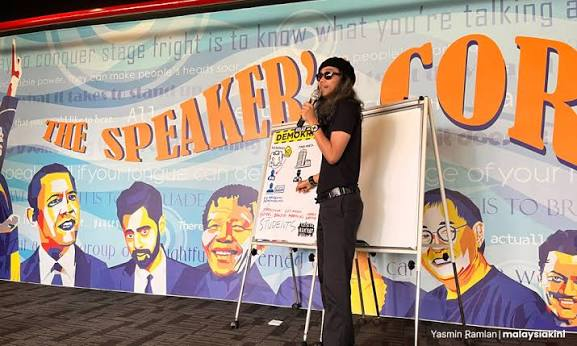
political graphic designer Fahmi Reza.
Image via Yasmin Ramlan/MalaysiakiniRepealing section 15(2)(c) removed the clearest statutory prohibition against campus party politics, but it did not give students an unconditional right to organise any event, invite any speaker, or establish any organisation.
Several broad controls remain in the law:
- Section 15(5) says universities may regulate student activities within campus.
- Section 16 allows a vice-chancellor to suspend or dissolve a student organisation considered detrimental or prejudicial to the university, its students or employees, or to public order, safety or security. The organisation must be allowed to make written representations and may appeal to the minister.
- Section 49 of the model constitution requires at least 10 students to obtain the Vice-Chancellor's prior approval before establishing a student body.
In other words, students may legally participate in politics, but university authorities may still control the organisation, venue, format and approval of an activity.
In one example, political graphic designer Fahmi Reza toured universities with his non-partisan Kelas Demokrasi, which explained matters such as how MPs are elected, and the role of the Dewan Negara, among other aspects of democratic knowledge.
Despite the deletion of section 15(2)(c), he was reportedly barred or escorted out by security personnel at several public universities, including Universiti Malaya (UM), Universiti Kebangsaan Malaysia (UKM), Universiti Teknologi Mara (UiTM), and many more.
The reason commonly given was that he had not obtained permission to conduct the class.
The existence of the law shows that students still do not have complete freedom to engage in political discourse without approval from their university management.
With the proposed abolishment, Anwar claimed that it will not be replaced with another Act to control students' freedom
"I want to make this clear. I don't want amendments. AUKU must be abolished completely.
"I will not allow any [new] regulation or law that restricts university students," he said at the 2026 PKR National Congress yesterday, 16 August.
He added that students, like ordinary Malaysians, will remain subject to existing laws, including criminal laws, and the abolition of AUKU did not mean they would be exempt from the ordinary legal framework, reported the New Straits Times.
