
Malaysia’s Economy Grows 5.4% In Q1 2026 Despite Global Uncertainty, Says BNM
The country's solid fundamentals has so far provided buffers against the brunt of the shocks.


 Cover image via
 Follow us on Instagram, TikTok, and WhatsApp for the latest stories and breaking news.
Malaysia's economy grew by 5.4% in the first quarter of 2026, supported by steady household spending, investment activity, and continued demand for electrical and electronics (E&E) exports, according to Bank Negara Malaysia (BNM)
In a press release today, 15 May, BNM said growth was driven mainly by Malaysians continuing to spend, alongside strong exports linked to the tech sector, particularly E&E products and ICT-related services.
Private consumption, which accounts for 61.6% of GDP, rose 4.7% in Q1, supported by stable employment, tourism-related spending, and government assistance measures.
BNM said domestic spending was boosted by cash aid programmes such as STR and SARA, back-to-school assistance, civil service salary adjustments, as well as festive spending, school holidays, and toll discounts.
On the supply side, all major sectors recorded growth except mining and quarrying. Construction led with 7.7%, followed by manufacturing at 5.9% and services at 5.6%, while agriculture grew 2.6%. Mining and quarrying declined by 2.1%.
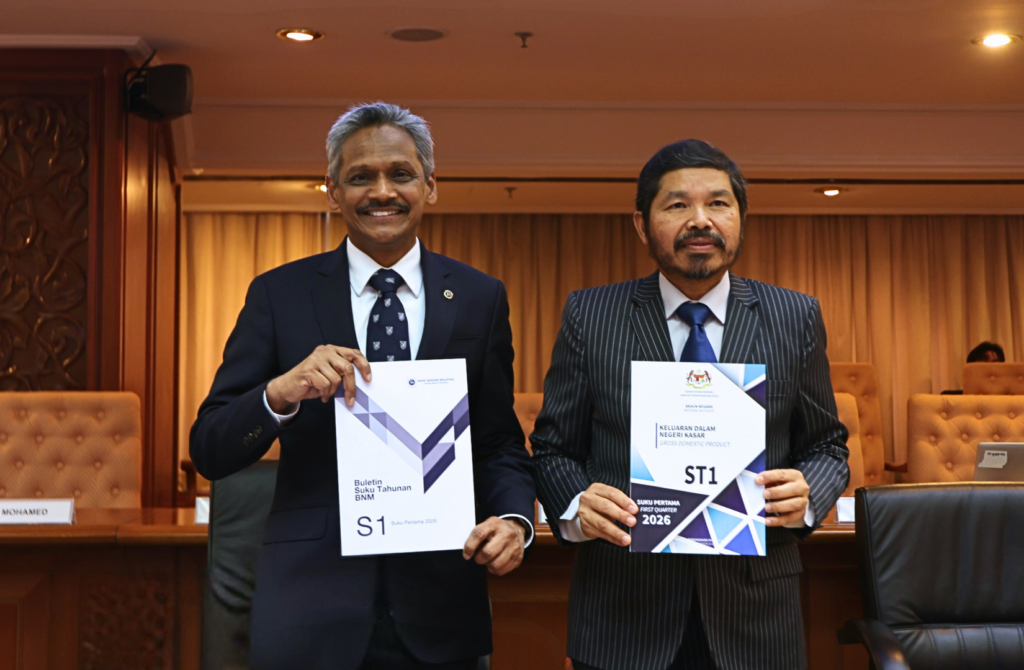
BNM governor Datuk Seri Abdul Rasheed Ghaffour and Chief Statistician Datuk Seri Dr Mohd Uzir Mahidin.
Image via Bank Negara MalaysiaAt the same time, BNM warned that the ongoing conflict in the Middle East has begun affecting global supply chains and commodity prices, especially energy
BNM governor Datuk Seri Abdul Rasheed Ghaffour said Brent crude rose to around USD102 per barrel within a month, increasing cost pressures through energy and petrochemical supply chains.
He said the conflict could affect Malaysia through higher import costs, weaker global demand, and more cautious financial markets, which may affect investment and business decisions.
He added that headline inflation rose to 1.6% in Q1, up from 1.3% in the fourth quarter of 2025, partly driven by higher global energy prices that pushed up domestic fuel costs, including RON97 and unsubsidised diesel.
Inflation for the full year is projected to average between 1.5% and 2.5%, but may trend towards the upper end if the conflict escalates further.
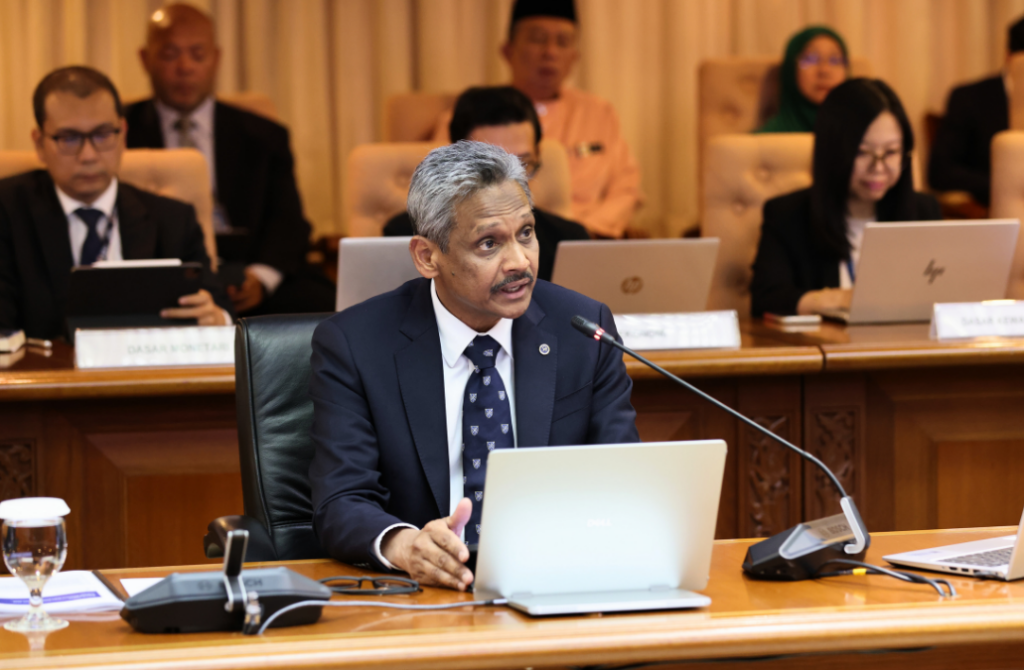
Despite external pressures, Abdul Rasheed said the country's solid fundamentals has so far provided buffers against the brunt of the shocks
"First, as a net energy exporter, higher oil and gas prices are expected to support Malaysia's net energy trade balance, providing buffer against external pressures.
"Second, Malaysia's diversified growth drivers underpins our economic resilience, supported by firm domestic demand and continued momentum in key export engines — particularly E&E and ICT-related activity.
"Third, a low and stable inflation environment provides a supportive backdrop for macroeconomic stability, helping the economy to absorb external shocks more smoothly," he said.
He added that BNM also kept the Overnight Policy Rate (OPR) unchanged at 2.75%, saying the current monetary policy stance remains appropriate to support growth while maintaining price stability.
Despite the global uncertainty, the central bank maintained Malaysia's full-year growth forecast at 4% to 5%, saying domestic demand and ongoing investments are expected to continue supporting the economy
"Malaysia's strong fundamentals will continue to underpin the economy's resilience. Domestic demand is expected to remain strong, driven by sustained household spending and forthcoming investments," Abdul Rasheed said.
Read more trending stories on SAYS

Malaysian Government Bans Public Servants From Using Waze Over Data Security Concerns
As an alternative, public servants and road users are encouraged to adopt TuJu, a locally developed navigation app.