
She Was Told The OKU Parking Spot Was “Wheelchair Only” — A Lawyer Says Malaysian Law Doesn’t Say That
A viral dispute at Klebang Walk has sparked a wider debate over who can use OKU parking spaces, after a man with a prosthetic leg was asked to move his car.


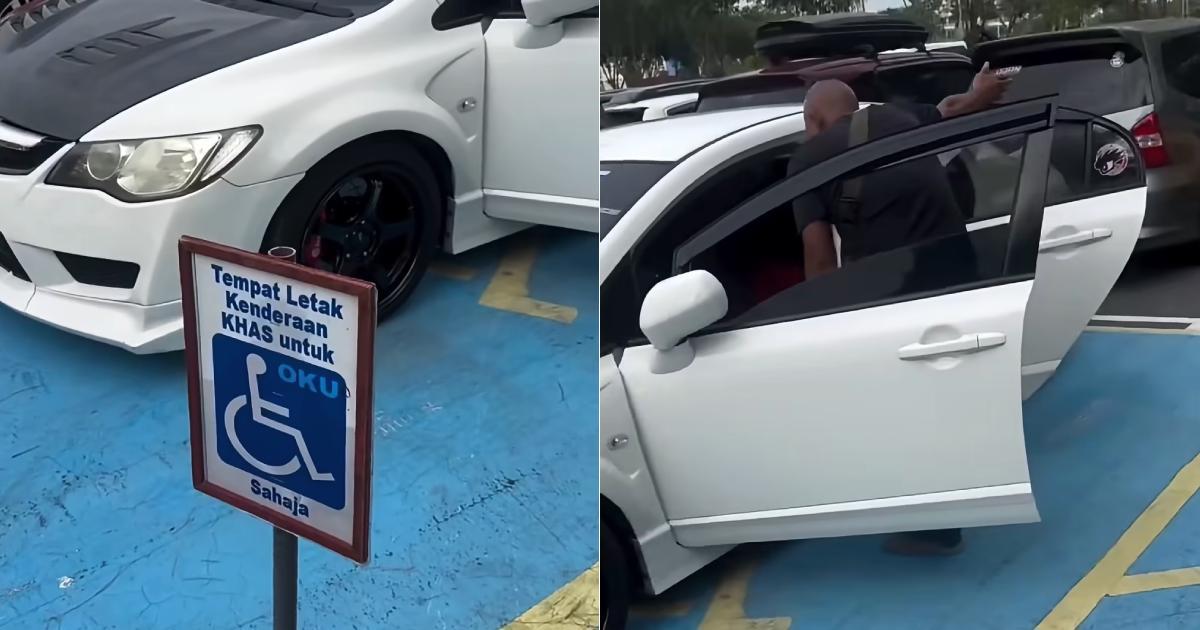 Cover image via Threads
Follow us on Instagram, TikTok, and WhatsApp for the latest stories and breaking news.
A visit to Klebang Walk in Melaka turned into a viral dispute after a woman said her husband, who has an amputated leg and uses a prosthetic limb, was told to move his car from a designated OKU parking space
The woman, who posted about the incident on Threads, said her husband had both a valid OKU card and the required OKU sticker displayed on their vehicle.
According to her now-deleted post, a man approached them after they parked and told them the space was meant for wheelchair users only.
She said they tried to explain that her husband was a registered person with disabilities, but the disagreement continued.
"In my 24 years of life, today is the first time I learned that even OKU (disabled) cardholders can be chased away when trying to park in an OKU space," read her now-deleted post.
"My husband is physically disabled; his leg was amputated due to an accident, so he uses a prosthetic leg. We went to Klebang Walk and saw an OKU parking spot close to the eatery where we were meeting a group of friends.
"My husband parked as usual since we have both the card and the sticker, but a man came up and said we couldn't park there. We thought maybe he just didn't notice the card, so we tried to explain that we have the card and what kind of disability my husband has."
The incident was subsequently filmed and shared online, sparking a debate over whether OKU parking spaces are legally reserved specifically for wheelchair users.

Screenshot from the deleted Threads post.
Image via ThreadsSo, does an OKU parking space mean "wheelchair only"?
According to lawyer Arif Azmi of Arif Azmi & Co, the answer is no.
Speaking to Sin Chew Daily, Arif said Malaysian law does not restrict OKU parking spaces exclusively to people who use wheelchairs.
He pointed to the Persons with Disabilities Act 2008, which defines persons with disabilities broadly to include people with long-term physical, mental, intellectual, or sensory impairments. He also said an OKU card serves as proof that the holder is officially registered as a person with disabilities.
Arif said local council parking rules generally require an eligible person to possess or display an OKU card and have the appropriate OKU sticker on the vehicle, rather than requiring that person to use a wheelchair.
He added that vehicles parked in designated OKU spaces without the required documentation can be subject to enforcement action, including being moved or impounded by the relevant local authority.
"So, the next time before you pull out your phone to record, block, or drive someone away simply because they 'don't look disabled', remember that it is your behaviour that is entirely unfounded, not theirs," he concluded.
But the other side says the issue was about giving wheelchair users priority
The woman later deleted her original post and published an apology and explanation.
She said the video was recorded because the man had claimed there was a sign stating that the parking space was strictly for wheelchair users, and she wanted to check whether such a sign actually existed.
She maintained that her husband was entitled to use the space because he is an OKU cardholder and said they had parked there because his mobility can sometimes be more difficult, particularly when his amputated leg is sore or injured.
She also acknowledged that the spaces are larger and can make it easier for wheelchair users to get in and out of their vehicles.
However, she argued that the particular space they had used was beside a divider leading towards the shops, while another space suggested to them was closer to the main entrance and, in her view, could actually be easier for wheelchair users to access.
She said they ultimately moved their vehicle and did not park in another OKU space.

Screenshot from the deleted Threads post.
Image via ThreadsThen the alleged parking attendant's daughter responded
The dispute took another turn after a woman claimed that the older man seen in the deleted video was her father.
She said she had contacted the owner of the Threads post privately and asked for the video to be removed because she believed it had exposed her father's identity, including his motorcycle licence plate.
According to the daughter, her father was a parking attendant at the location and had been trying to direct vehicles to make the limited OKU spaces more accessible to wheelchair users.
She acknowledged that the man's tone may have sounded harsh, but said he naturally speaks loudly and that he was trying to manage the parking situation rather than challenge the husband's OKU status.
She also disputed the suggestion that her father had acted improperly, saying he had shown the couple another designated space and had explained why he wanted the particular space kept available for wheelchair users.
The daughter also said the family's concerns went beyond the original parking dispute. She claimed that she herself received threats after the video spread online, including messages threatening to cut off her legs.
She argued that while the original poster had been concerned about the effect of the incident on her husband's mental wellbeing, the viral backlash had also affected her father and the rest of their family
She said her father could have lodged a police report but chose not to, and claimed that he told her to leave the matter alone. She also said the family wanted the original post removed and asked the woman to apologise directly to her father, rather than only apologising to people online.
The dispute is really about two different questions
The first is whether an OKU parking space is legally restricted to wheelchair users. The lawyer cited by Sin Chew Daily said Malaysian law does not impose such a restriction simply because a person has a different physical disability.
The second is whether people using these spaces should consider the specific accessibility needs of other OKU users where more than one parking option is available.
The two sides have given different accounts of what happened at Klebang Walk and why the man asked the couple to move.
What is clear is that the incident has highlighted a distinction that can easily get lost in arguments over OKU parking: not every person with a disability uses a wheelchair, and not every accessibility need looks the same.
