Anwar Explains Why He Didn’t Block Najib’s Pardon Application
Anwar's remarks come amid accusations that he has betrayed his anti-corruption principles.


 Cover image via Anwar Ibrahim (Facebook)
Follow us on Instagram, TikTok, and WhatsApp for the latest stories and breaking news.
Prime Minister Datuk Seri Anwar Ibrahim has explained why he personally brought Datuk Seri Najib Razak's pardon application before the Pardons Board in 2023, saying he did not want to deny him his constitutional right to seek clemency
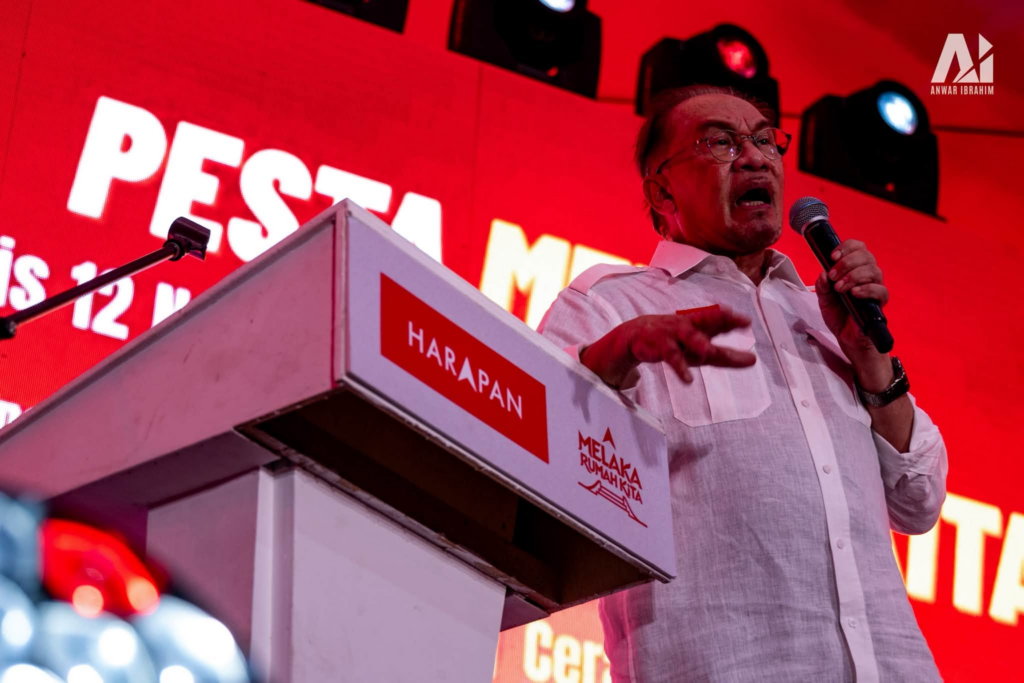
Speaking at the Pesta Melaka, Rumah Kita programme at Taman Melaka Perdana yesterday, 12 November, Anwar said every prisoner has the right to submit a petition for a royal pardon under the country's laws.
He said he would have risked being seen as deliberately "victimising" Najib if he had refused to facilitate the application, Berita Harian reported.
"I want to explain why I brought Datuk Seri Najib's case to the Pardons Board in 2023. Because as Prime Minister, I cannot bear to be seen as victimising anyone.
"Under our country's Constitution, every prisoner has the right to submit an appeal to the Yang di-Pertuan Agong for consideration. If I didn't allow it, it would be as though I were denying his rights," he said.
While the prime minister cannot grant a royal pardon, he has a role in the process
Under Article 42 of the Federal Constitution, the power to grant pardons for offences committed in the Federal Territories belongs to the Yang di-Pertuan Agong. The Federal Territories Pardons Board advises the King on such applications, with the Prime Minister not being a member of the board.
However, the federal administration plays an important administrative role in processing applications and arranging for them to be considered. The board's secretariat, the Legal Affairs Division (BHEUU), is under the Prime Minister's Department.
This means the prime minister cannot personally approve or reject a pardon, but can play a role in ensuring an application reaches the board for consideration.
In fact, Anwar previously told the Dewan Rakyat on 10 December 2024 that Najib's application was not initially included in the agenda for the Pardons Board meeting on 8 December 2023. He said he personally raised the matter with the Yang di-Pertuan Agong at the time, who subsequently agreed to have the application considered.
Anwar said he was accused of betraying anti-corruption principles
Anwar, who is also Pakatan Harapan (PH) chairperson, acknowledged that his decision drew criticism from those who accused him of going against the anti-corruption principles he had long championed.
He said he faced criticism regardless of which course of action he took.
"If I don't do it, it's betrayal. If I do it, it's betrayal. What is this?" he said.
Anwar also explained that supporting documents, including medical reports, prison records, and reports on Najib's behaviour while in prison, were submitted during the consideration process.
He stressed that allowing the application to be considered did not mean the government was compromising its stance against corruption and abuse of power.