
We Read The Full Grounds Of Judgment In The BU School Murder Case. Here’s What You Need To Know
The 77-page judgment explains what the court heard about the teenager's mental state, the months leading up to the killing, his fixation on the victim, and why the judge found him not criminally responsible for her death.


 Cover image via SAYS
Follow us on Instagram, TikTok, and WhatsApp for the latest stories and breaking news.
Editor's Note: Reader discretion is advised, as this report contains details that some readers may find distressing.
The Shah Alam High Court's full grounds of judgment in the Bandar Utama school murder case were released yesterday, 23 September
It came nine days after Judge Adlin Abdul Majid acquitted and discharged the 15-year-old teenager who was accused of killing his 16-year-old schoolmate.
The 77-page grounds of judgment explain in detail why the court found that the teenager was of unsound mind when the incident occurred on 14 October 2025, including the psychiatric evidence presented, his behaviour in the years leading up to the killing, his fixation on the victim, and what the court found about his state of mind during and after the attack.
The judgment also sets out the prosecution's arguments and explains why the judge rejected them, including the argument that the teenager's apparent months-long preparation showed that he understood the nature and consequences of his actions.
We read the full grounds of judgment. Here are the key highlights from what the court found.
The High Court did not find that the killing did not happen
The High Court accepted that the boy, 14 at the time, killed Yap Shing Xuen at SMK Bandar Utama Damansara (4), a secondary school in Bandar Utama, Petaling Jaya, on 14 October last year.
What the court had to decide was whether he was criminally responsible for the killing.
The defence did not dispute that he had caused the girl's death. Instead, it relied on Section 84 of the Penal Code, which provides a defence where a person is incapable of understanding the nature of an act, or that what they are doing is wrong or contrary to law, because of unsoundness of mind.
After considering the evidence, High Court Judge Adlin Abdul Majid found that both requirements had been established on a balance of probabilities.
She therefore acquitted and discharged the teenager of the murder charge and ordered him to be detained and treated at Hospital Bahagia Ulu Kinta in Perak.
The boy followed the victim into the school toilet
According to the judgment, the teenager, identified in the grounds of judgment by his initials, saw the victim heading towards the female toilet during an examination and followed her there.
He confronted her with a knife and led her into the second cubicle. Inside, he locked the door, asked whether she was the girl he had been following, and told her that he liked her. When she resisted and tried to leave, he pushed her back and began stabbing her.
A post-mortem found between 180 and 200 stab and incised wounds across various parts of her body. The fatal injuries were to her neck and chest. The judge accepted that the teenager had caused those injuries and her death.

The victim, Yap Shing Xuen, and the accused, identified as 'L'.
Image via SAYSHis mental health problems had been developing for years
The psychiatric evidence presented a history that went back to around 2020, when the boy was nine.
His family and teachers observed that he became increasingly withdrawn, isolated himself in his room, and stopped communicating with his family. He developed a persistent belief that he was physically unattractive and that other students were laughing at and talking about him.
He began wearing a mask constantly, even after Malaysia's pandemic-era public health requirements had ended, and became increasingly anxious about people watching him.
By 2023, his beliefs had developed into a conviction that CCTV cameras had been secretly installed in his home. He believed his parents had placed cameras in his bedroom and bathroom and that the technician who supposedly installed the system was remotely watching him.
The belief later extended to his school.
He became convinced that security guards and teachers were monitoring him through CCTV, including while he was hiding inside the school washroom. He also believed that cameras in shopping malls were specifically directed at him.
The psychiatrist described these as paranoid delusions and delusions of reference.
He had been untreated for about five years
The court-appointed forensic psychiatrist, Dr Ian Lloyd Anthony, said the teenager had experienced psychiatric symptoms for about five years without medical treatment by the time of the killing.
The judgment noted that the Malaysian mean duration of untreated psychosis was 28.7 months, compared with approximately 60 months in the teenager's case.
Anthony explained that untreated psychosis does not simply remain static. Delusions can become more elaborate and internally logical to the person experiencing them, while becoming increasingly resistant to correction.
By the time of the killing, the forensic psychiatrist said the teenager's reality testing had become severely impaired. The court accepted Anthony's diagnosis of very early-onset schizophrenia, with psychopathic and sadistic traits.
The boy became fixated on the victim
Around August 2024, the teenager developed an infatuation with the victim. He watched and followed her at school and created social media accounts to follow her online.
He eventually became convinced that she loved him and that his feelings were reciprocated, despite having never actually spoken to her or otherwise interacted with her.
Anthony described this as an erotomanic delusion.
The fixation later changed.
After watching a video about a Japanese man, Tatsuya Ichihashi, who raped and murdered a British teacher, Lindsay Ann Hawker, in 2007, the teenager's infatuation developed into envy, anger, and hatred, followed by an intention to kill the girl.
Around March last year, about seven months before the killing, he also began experiencing auditory hallucinations in the form of a voice he attributed to Dylan Klebold, one of the Columbine school shooters, instructing him to kill her.
His phone contained a journal documenting his thoughts
One of the important pieces of evidence was a journal on the teenager's mobile phone. Written in Mandarin, it contained entries dating from around six months before the killing and documented his thoughts during the period leading up to the incident.
The entries recorded beliefs that classmates were conspiring against him and deserved to die, a wish for mass casualties, and fears that others would lie to police to frame him.
He also referred to classmates, teachers, his parents, and society as "NPCs" — non-player characters from video games.
The psychiatrist said the teenager viewed these people as "subhuman, valueless game objects" and lacking independent thought.
The journal also showed that he identified with Kira, a fictional character from Death Note who felt entitled to judge and eliminate others, as well as with Eric Harris and Dylan Klebold, the perpetrators of the Columbine school shooting.
The judge regarded the journal as significant because it documented his beliefs before he was assessed for the purposes of the trial.
He was preparing for an attack
The judgment also shows that there was considerable preparation before the killing.
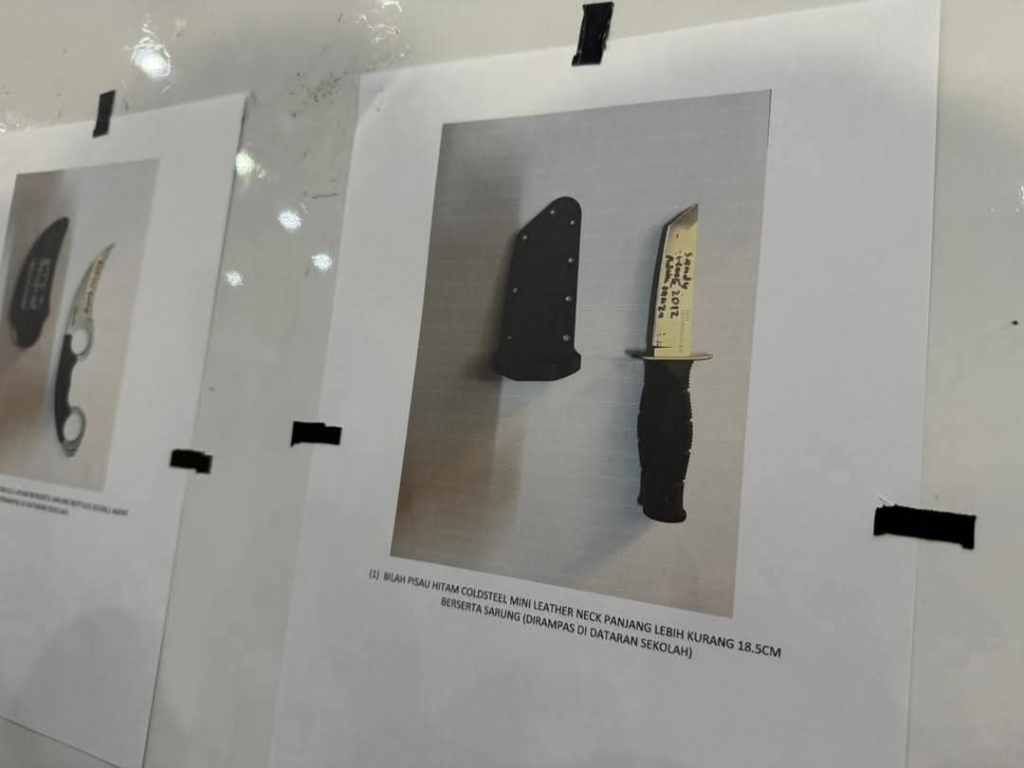
The teenager bought three knives in July and August 2025, and carried them to school for around two weeks.
Two knives were inscribed with the names of Cho Seung-Hui, a South Korean mass murderer who perpetrated the Virginia Tech shooting on 16 April 2007, and Salvador Ramos, who carried out the Uvalde school shooting on 22 May 2022.
The boy also assembled clothing based on what the Columbine perpetrators had worn.
The original date he had selected for the attack was 20 April 2027, which coincided with the anniversary of the Columbine High School massacre.
But after he was suspended from school following an incident involving two classmates, he became concerned that he would be expelled. He subsequently brought the date forward to 2025.
This was one of the main areas where the prosecution argued that the teenager had demonstrated planning, organisation, and an ability to understand what he was doing.
The judge ultimately disagreed with that interpretation.
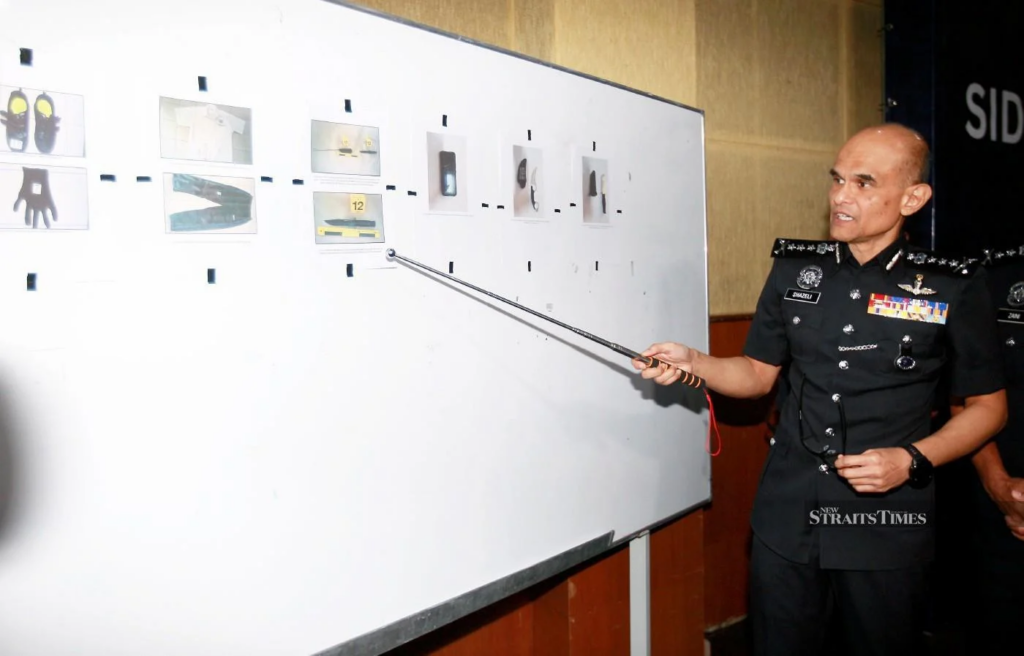
Some of the items seized by police after the boy stabbed the victim.
Image via Faiz Anuar/New Straits TimesWhy the judge said the 'plan' did not prove rational intent
The prosecution argued that the months of preparation showed that the teenager had been capable of organising, sequencing, and adjusting his actions towards a specific objective.
Adlin rejected that argument.
She found that the material elements of the plan had themselves been generated by his delusional system. The victim had been selected because of an erotomanic delusion. The date was connected to the Columbine shooting. The knife inscriptions were made at the instruction of a hallucinated voice. The clothing was assembled to imitate the Columbine perpetrators.
In the judge's assessment, this was not evidence of a rational, self-interested plan directed towards a real-world objective, but the enactment of a delusional identification. The judge also pointed out that the teenager had not planned an escape, disposed of evidence, or taken meaningful steps to avoid being caught.
The knives had been purchased in his own name and delivered to his own home. He also left evidence behind rather than attempting to conceal it.
He did not believe death was final
One of the most important findings in the judgment concerned what the teenager actually believed would happen to the victim.
The court heard that he did not understand death as final. He believed the victim "would be reincarnated as a ghost, who will seek him out for revenge by suddenly appearing on the road while he is driving, causing him to crash his car and die. He would then be reunited with her in the afterlife".
Adlin described this as the most telling evidence that he did not comprehend the nature of the act he was committing.
The judge said that knowing a knife was being pushed into someone's body and that the person would bleed was not, by itself, enough to show that the teenager understood the nature of the act.
She said the nature of homicide involved understanding that the object of the act was a real living person whose life would be permanently destroyed.
The court found that, because of his psychosis, the teenager instead understood the incident through the fictional and delusional world he had constructed.
The court also found that the boy did not understand the act was wrong
The prosecution argued that even if the teenager was mentally ill, he understood what he was doing and knew that killing was wrong.
The judge rejected that argument.
She accepted the psychiatric evidence that he believed he had become Kira, a god-like figure who was entitled to judge and eliminate others.
His delusions therefore did not merely provide him with a motive to kill. According to the judge, they fundamentally affected his ability to appreciate that the act was wrong.
"He equated people who were different from him to pigs, and therefore, killing them was easy, as their lives are meaningless… He believed that what he was doing at that time was righteous."
The court also accepted the evidence that he believed a hallucinated voice belonging to Dylan Klebold was instructing him to kill the victim.
"Dylan commanded him to kill the victim, as a form of revenge on the injustices that the world had brought upon him. He believed that he was completely under the control of Dylan and that their hearts were connected. Dylan planned the murder and instructed him on how to proceed."
What happened after the stabbing was also important
The prosecution pointed to the teenager's behaviour immediately after the attack as evidence that he was aware of what he had done.
But the judge reached the opposite conclusion.
After the attack, he walked through the school amid alarms and screams, stopped to retrieve his water bottle, and drank from it while still holding the knife. He did not attempt to run away. He did not wash his hands or change his bloodstained shirt.
When his brother took the knife from him, he did not resist. He also did not resist when he was arrested.
Adlin found that this behaviour was consistent with the psychiatric evidence that he was dissociated and did not appreciate the significance of what had happened.
The judge said that she was satisfied that the boy's "psychotic illness had deprived him of the capacity to comprehend that he was taking the life of a living person" and that "he did not have the capacity" to know the nature of the act he committed.
The number of wounds did not change the court's finding
The prosecution also argued that an attack of such ferocity and multiplicity can only be the product of a determined, guilt-aware intention to ensure death, leaving the victim no opportunity to be rescued.
However, the judge rejected this as evidence that necessarily established criminal responsibility.
The psychiatrist noted that the teenager recalled inflicting only five stabs, despite the post-mortem recording between 180 and 200 stab and incise wounds.
Adlin said the disparity supported the finding that his mind had been overwhelmed by psychosis and dissociation during the attack.
The judge also accepted the psychiatrist's evidence that the violence went far beyond what was required to cause death and served no apparent purpose.
According to the judge, the nature of an attack, however ferocious, does not by itself establish that an accused knew that what he was doing was wrong.
In her assessment, the nature of the injuries therefore did not contradict the psychiatric evidence.
Why the judge accepted the psychiatrist's evidence
Dr Ian was not simply giving an opinion based on a single examination. He was a court-appointed forensic psychiatrist who observed the teenager as an inpatient for about three months and conducted more than 34 sessions with him.
His assessment also drew on interviews with family members, school records, counselling records, psychological testing, medical reports, the teenager's journal, and other evidence from the case.
The prosecution challenged his conclusions during cross-examination but did not call its own psychiatric expert to rebut his diagnosis.
The judge therefore accepted that Dr Ian's evidence on the teenager's psychiatric condition remained effectively unchallenged on the central issues.
She also noted that after the teenager was prescribed antipsychotic medication, his hallucinations ceased and his delusions began to dissolve. He also began engaging more warmly with his family in a way they had not seen for years.
So, why was he acquitted?
The court ultimately found that the teenager had established both parts of the defence under Section 84 of the Penal Code, which provides that the act of a person of unsound mind is not an offence.
First, because of his unsoundness of mind, he did not have the capacity to understand the nature of the act he committed. Second, he did not have the capacity to understand that the act was wrong or contrary to law.
That meant the court found that he had committed the physical act that caused the girl's death, but was not criminally responsible for it under the law because of his mental state at the time.
He was therefore acquitted and discharged of the murder charge.
The court ordered him to be detained and treated at Hospital Bahagia Ulu Kinta in Perak at the pleasure of the Sultan of Selangor.
The judge, however, stressed that the victim must not be forgotten
Adlin ended her judgment by stressing that the finding of unsoundness of mind did not make the girl's death any less real or devastating.
"The court's finding should not be understood to diminish the life of Yap Shing Xuen, or to cause any one of us to forget her. This is not a finding that [she was not murdered], or that no one was responsible for it. It is a finding that the person who committed the act was at the time in the grip of a serious psychotic illness that had gone unrecognised and untreated for years, and that the law does not hold such a person criminally responsible for conduct he could not, at that moment, appreciate as wrong," read the judgment.
She said the judgment should not be interpreted as diminishing the victim's life or the grief of her family. The judge described her as a young student with close family and friends and a bright future ahead of her, and said her death was an immense and irreversible loss.
"Her untimely and tragic death is an immense and irreversible loss to all who knew her. Nothing in these findings should be read as suggesting that her death was any less devastating or any less real, because it was brought about by an illness, rather than by malice," said the judge.
She also said the case showed how severe mental illness could progress in a child while remaining unrecognised. In this case, symptoms had been present from around the age of nine and had been documented through family accounts, school records, and teachers' observations.
But the signs, including withdrawal, delusional thinking, refusal to remove his mask, chronic lateness, and hallucinated voices, were understood as behavioural or disciplinary problems rather than symptoms of a serious medical emergency.
"The cost of that misreading has now been borne by two families," Adlin said.
The judge said the case should prompt parents, schools, courts, and the wider public to better recognise the warning signs of serious mental illness in children so that symptoms can be treated earlier.
The Attorney General's Chambers has since filed a notice of appeal against the acquittal. The appeal, which was filed at the Court of Appeal on 22 September, has been welcomed by the victim's family.

The victim's family, with her mother in the centre and her sister.
Image via China Press