
Dewan Rakyat Passes MCMC Amendment Bill 2026. Here’s What’s Affected
This new Bill aims to create more adaptive legislation for the rapidly evolving online world.


 Cover image via
 Follow us on Instagram, TikTok, and WhatsApp for the latest stories and breaking news.
The Dewan Rakyat passed the Malaysian Communications and Multimedia Commission (Amendment) Bill 2026 on Wednesday, 15 July, to strengthen the regulatory body's framework and ensure it can keep pace with Malaysia's rapidly evolving communications sector
Members of parliament (MPs) approved the legislative amendments through a majority voice vote following a spirited debate involving 14 representatives from both government and opposition benchesaccording to Bernama.
Winding up the debate, Deputy Communications Minister Teo Nie Ching clarified that the ministerial authority to appoint the MCMC chairman and commission members has existed under statutory body regulations since 1998.
However, the newly passed amendment introduces a key safeguard by explicitly barring any sitting member of parliament or state assemblyman from serving as chairman. The Bill also restructures the commission's board composition by increasing its maximum membership from nine to 11 members, allowing up to seven non-government representatives with specialised expertise in law, economics, and technology.

A major financial change under the Bill raises the MCMC's independent contract approval limit from RM5 million to RM50 million without requiring prior ministerial concurrence or Treasury approval
Teo explained that the adjustment aligns with Treasury procurement circular WP7.5 for self-funded federal statutory bodies, taking into account inflation, rising material costs, and technological advances since the original threshold was set in 1998.
Opposition lawmakers raised several recommendations on regulatory oversight during parliamentary proceedings. Dr Halimah Ali (PN-Kapar) urged the government to establish an open selection framework similar to the mechanism used for the Human Rights Commission of Malaysia (SUHAKAM), while requiring all ministerial directives to be formally recorded.
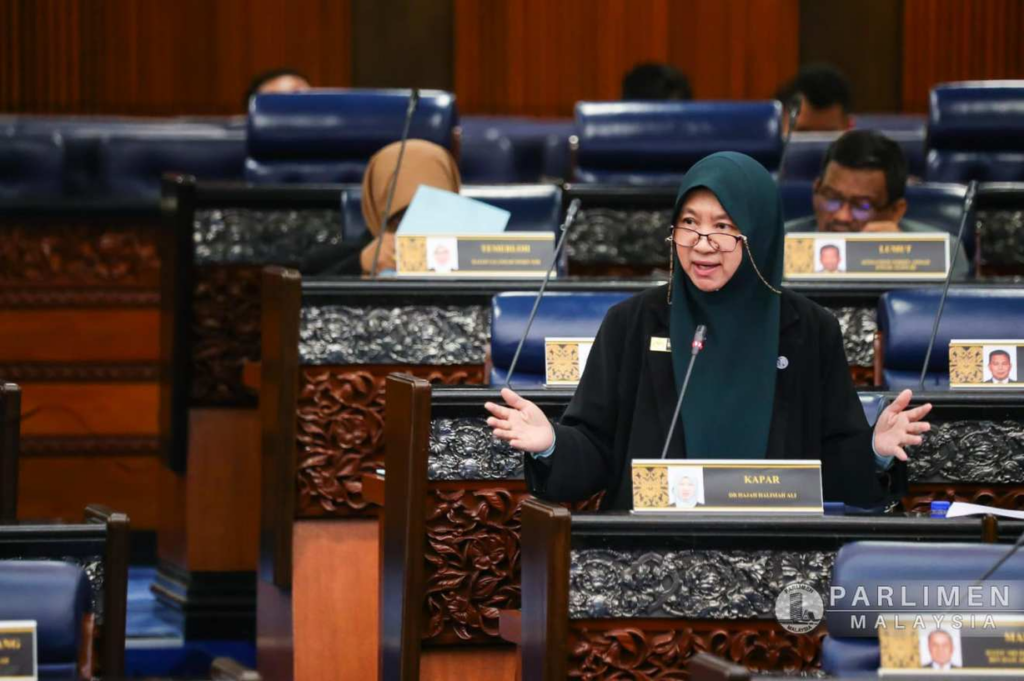
Dr Halimah Ali.
Image via Code BlueSimilarly, Datuk Mas Ermieyati Samsudin (PN-Masjid Tanah) called for stronger checks and balances regarding the Universal Service Provision (USP) Fund.
Supporting the amendments, Dr Richard Rapu (GPS-Betong) said the amendments to Act 589 would establish a professional, independent, and future-ready regulatory body capable of navigating complex challenges in the digital economy.
Here's what is affected:
The passage of the MCMC (Amendment) Bill 2026 directly impacts several core areas of Malaysia's regulatory landscape, beginning with leadership integrity.
By legally barring active politicians from serving as chairman, the commission aims to strengthen the integrity of its leadership, which also functions as the chief executive officer, by reducing direct political influence.
This shift ensures that key regulatory decisions involving telecommunications operators, spectrum allocations, and content guidelines are based on technical expertise and professional merit.
Operational efficiency and infrastructure rollout speed will also see substantial improvements across the country
Raising the independent procurement limit tenfold to RM50 million enables the regulator to rapidly approve large-scale digital connectivity contracts, cutting through months of administrative bureaucracy.
Enhanced auditing powers allow the commission to directly inspect licensees, while a new public disclosure mechanism permits the publication of civil, criminal, and compound actions taken against non-compliant service providers.
The broader legal overhaul reinforces national digital security and consumer protection across the telecommunications ecosystem
By integrating national security protocols into the USP framework, the regulator can allocate resources towards safeguarding critical network infrastructure against severe cyber threats, data breaches, and service outages.
As the underlying fund relies on mandatory contributions from licensed telecommunication operators, these enhanced security measures will be deployed nationwide without imposing any additional tariffs or fees on everyday Malaysian consumers.
