


 Cover image via
 Follow us on Instagram, TikTok, and WhatsApp for the latest stories and breaking news.
The Malaysian Institute of Road Safety Research (MIROS) launched a three-month proof-of-concept trial on 1 August, introducing minimum advisory speed limits on selected expressways to tackle chronic lane hogging and improve traffic flow
Conducted in collaboration with the Malaysian Highway Authority (LLM), PLUS Malaysia Berhad, and SKVE Holdings, the 'Had Laju Nasihat Minimum' initiative will gather traffic observation data and public feedback until 31 October.
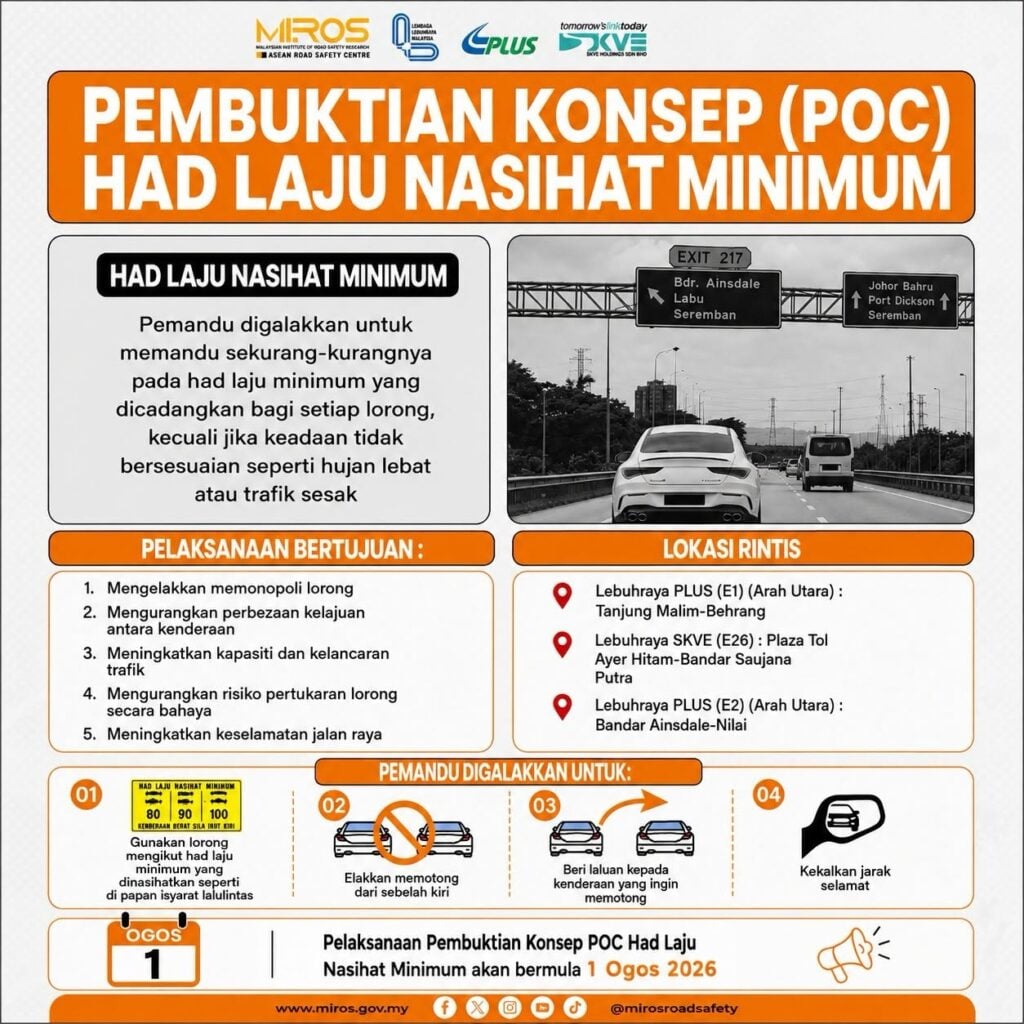
Under the framework, recommended minimum speeds are tailored according to lane configurations displayed on overhead signboards
On two-lane expressways, the right overtaking lane carries an advisory minimum speed of 80km/h, while the left cruising lane is set at 60km/h. On three- and four-lane stretches, the rightmost lane has a recommended speed limit of 100km/h, while the middle lanes are designated at 80km/h or 60km/h, and the leftmost lane remains at 60km/h.
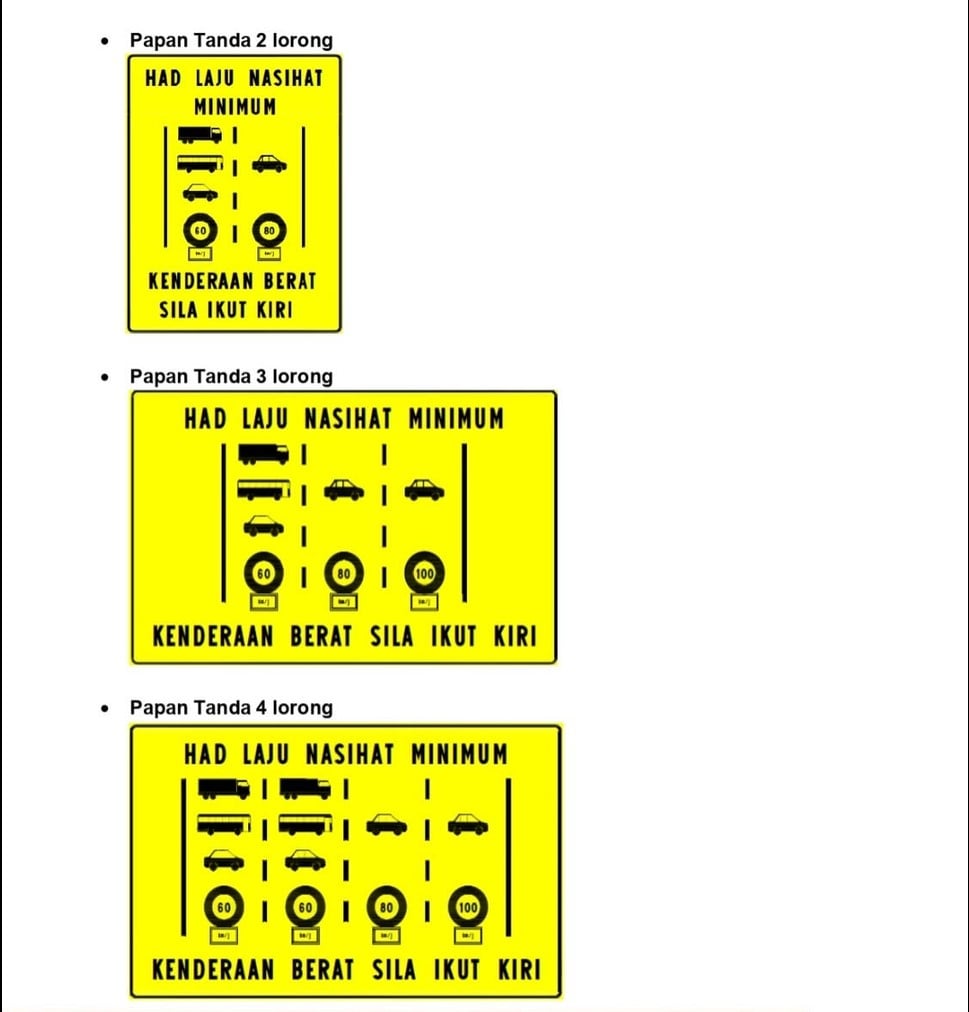
The pilot programme spans three high-density corridors across the Klang Valley and the West Coast
These include the northbound PLUS E1 stretch between Tanjung Malim and Behrang (KM400.1 to KM388.0), the SKVE E26 link from the Ayer Hitam toll plaza to Bandar Saujana Putra (KM9.6 to KM16.7), and the northbound PLUS E2 route connecting Bandar Ainsdale to Nilai (KM267.8 to KM278.8).
MIROS emphasised that the posted figures serve strictly as advisory guidance, not mandatory minimum speed limits. Existing maximum speed limits and vehicle-specific speed restrictions, particularly those for heavy commercial vehicles, remain fully in force.
Motorists are also exempt from following the advisory speeds during adverse conditions, such as heavy rain, poor visibility, severe congestion, road accidents, or maintenance closures.
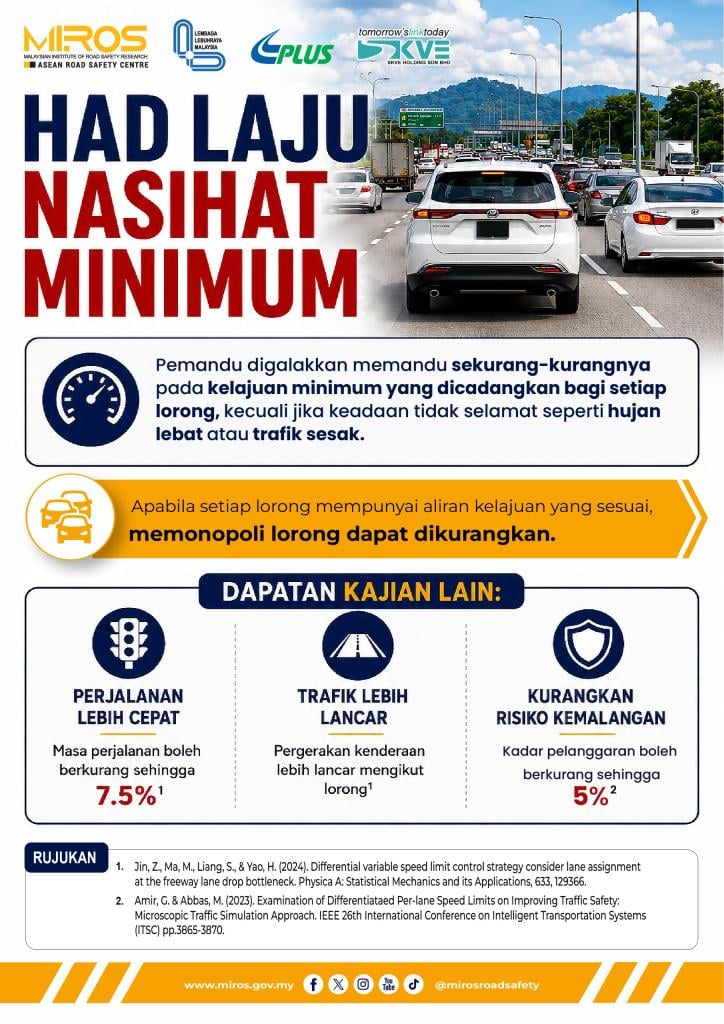
The trial aims to curb the dangerous ripple effects caused by slow-moving vehicles occupying fast lanes
When a driver cruises slowly in the overtaking lane, vehicles behind may be forced to brake suddenly or make risky lane changes, creating sudden speed variations that increase the risk of collisions.
Traffic research has shown that large speed differences on highways can contribute to phantom traffic jams and increase crash risks, making lane discipline an important factor in maintaining road capacity and public safety.
While the new signage provides guidance, obstructing traffic in the right lane remains an offence under Malaysian road transport laws, with compound fines of up to RM2,000.
Read more trending stories on SAYS
Rocky’s Owner Shares Account Of What Happened On The Night He Died
Roghini Devi showed photographs of Rocky, whom she said she had rescued from the streets as a puppy two years ago.
