
Study Reveals 16 Professions Most At Risk Of Being Replaced By AI
Despite rapid shifts in certain fields, it's not all doom and gloom.


 Cover image via
 Follow us on Instagram, TikTok, and WhatsApp for the latest stories and breaking news.
The rapid rise of artificial intelligence (AI) has many people worried about job security
With ChatGPT ranking seventh among global searches and Google's Gemini emerging as the eighth fastest-rising term this year, AI has firmly cemented its place in the public consciousness. In fact, "AI" itself is the 13th most searched query worldwide.
Given that these tools now rival major social media platforms in popularity, experts at Gigacalculator examined global search data from January to November 2025. Their study sought to identify which professions are seeing the sharpest shifts towards AI alternatives, and which industries are most concerned about automation.
Here's what the study revealed:
According to Gigacalculator, the financial sector is experiencing the most dramatic shift.
Interest in AI alternatives for financial advisors surged the most, with search volumes jumping over 166% since the start of the year.
Correspondingly, anxiety within this profession appears to be peaking, with job security queries skyrocketing by 200%. Accountants trailed closely behind, seeing a 100% monthly average increase in searches for "AI accountant", while concerns about automation replacing their role rose by 60%.
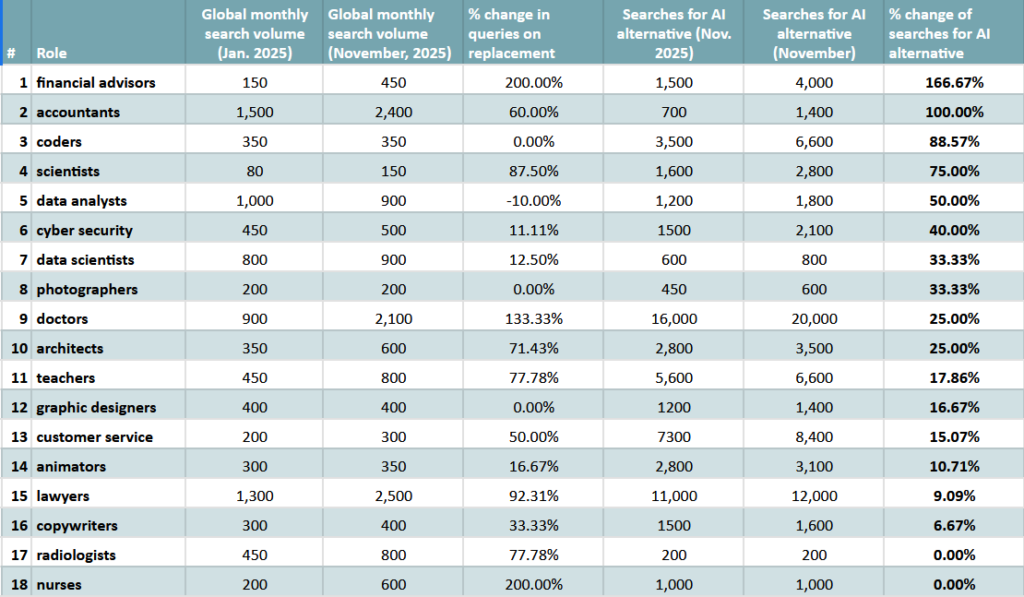
Rounding out the top five were coders (+88%), scientists (+35%), and data analysts (+50%).
However, sentiments in these technical fields differ significantly from those in finance. Despite the growing interest in AI tools, search terms signalling fear of displacement have largely remained stable or even decreased for coders and analysts. Scientists are also relatively unconcerned, with only about 150 monthly inquiries on the threat of AI.
On the other hand, the study also revealed a decline in AI alternative searches for certain professions
Despite ongoing fears of job displacement, searches for AI-based therapy alternatives have actually fallen by 13%, dropping from 15,000 to 13,000 monthly inquiries. This decline likely reflects a growing realisation of the risks associated with AI in mental health, though the sector still retains the fifth-highest search volume in the dataset.
A similar trend is evident among artists. While the debate over AI replacing human creativity continues, searches for "AI art" have decreased by nearly 19%, falling from 271,000 to 220,000. It appears the initial novelty of AI-generated imagery is fading, replaced by a more grounded understanding of the technology's role in the creative process.
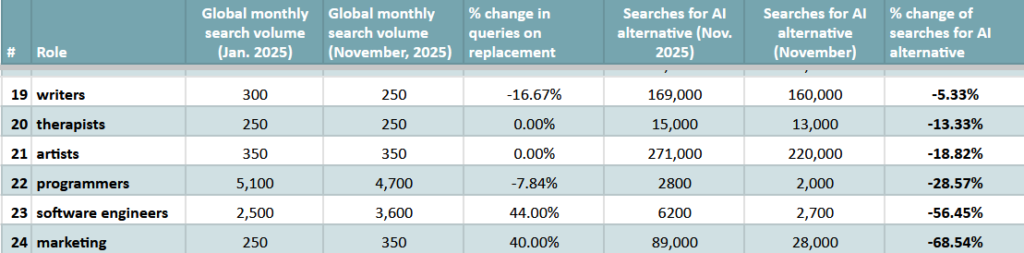
The most surprising data emerges from the tech industry itself. Both programmers and software engineers have seen significant drops in searches for AI alternatives, down 28.57% and 56.45% respectively. However, this creates a paradox for software engineers: while their interest in using AI alternatives has cratered by more than half, anxiety over job replacement has actually jumped by 44%.
Marketing assistants have recorded the steepest decline in the entire dataset. Searches for "AI marketing" have tumbled by a massive 68%, plummeting from 89,000 in January to just 28,000 currently. This sharp drop suggests that after firsthand testing, many professionals are discovering the limitations of the technology and realising that human creativity remains superior in this field.
Despite the rapid change in certain fields, it's not all doom and gloom
On one side, naysayers predict a grim future where automation displaces millions of workers, leading to widespread unemployment. Conversely, people who are ready to embrace the shift argue that AI possesses the potential to create far more novel roles than those it renders obsolete.
To remain competitive in this evolving landscape, the consensus is that we must remain adaptable. Success will depend on a commitment to lifelong learning, the cultivation of strong soft skills, and the ability to remain agile.
By specialising in specific niches and evolving alongside the market, individuals can position themselves to not only survive but thrive, turning the disruption of the AI era into a significant opportunity.
