


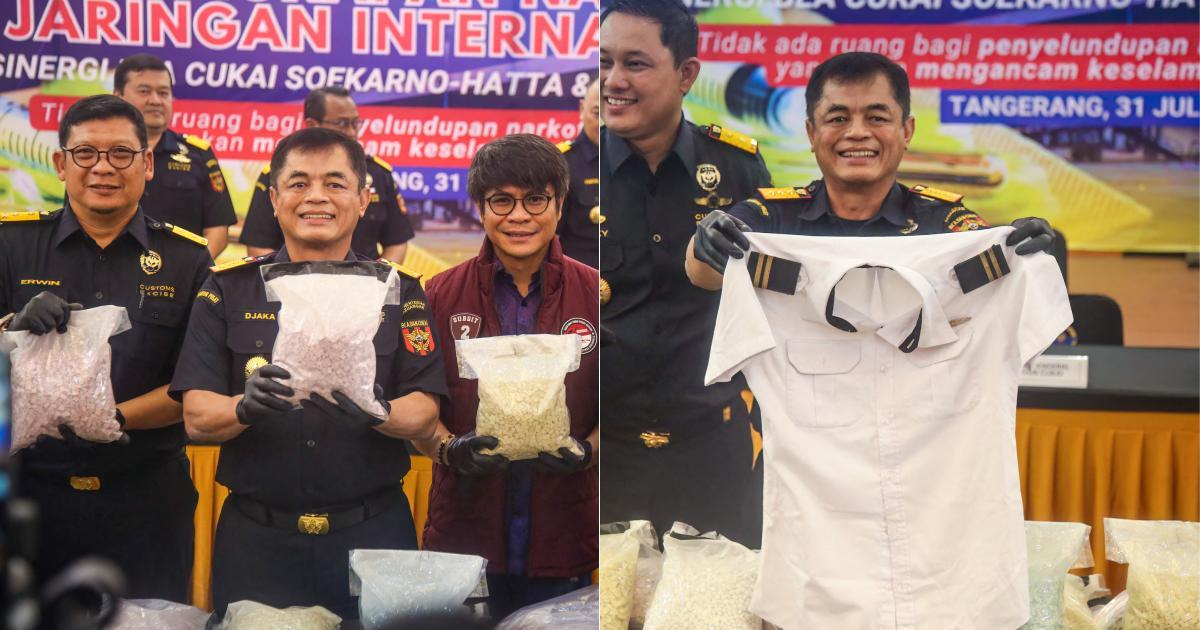
 Cover image via Ramu/AFP
Follow us on Instagram, TikTok, and WhatsApp for the latest stories and breaking news.
A Malaysian pilot is facing the death penalty in Indonesia after customs officers caught him smuggling more than 70,000 ecstasy pills worth an estimated 60 billion rupiah (around RM13.5 million) into Jakarta
The 39-year-old Malaysian, identified only by the initials MSO, was arrested at Jakarta's Soekarno-Hatta International Airport on Wednesday, 29 July, shortly after flying a passenger flight from Kuala Lumpur.
Indonesian authorities said an X-ray scan of the pilot's crew luggage flagged unusual objects, prompting a closer inspection.
Officers then uncovered 14 packages containing 70,114 ecstasy (MDMA) pills weighing around 26kg, along with 4g of methamphetamine in his hand luggage, believed to be for personal use.
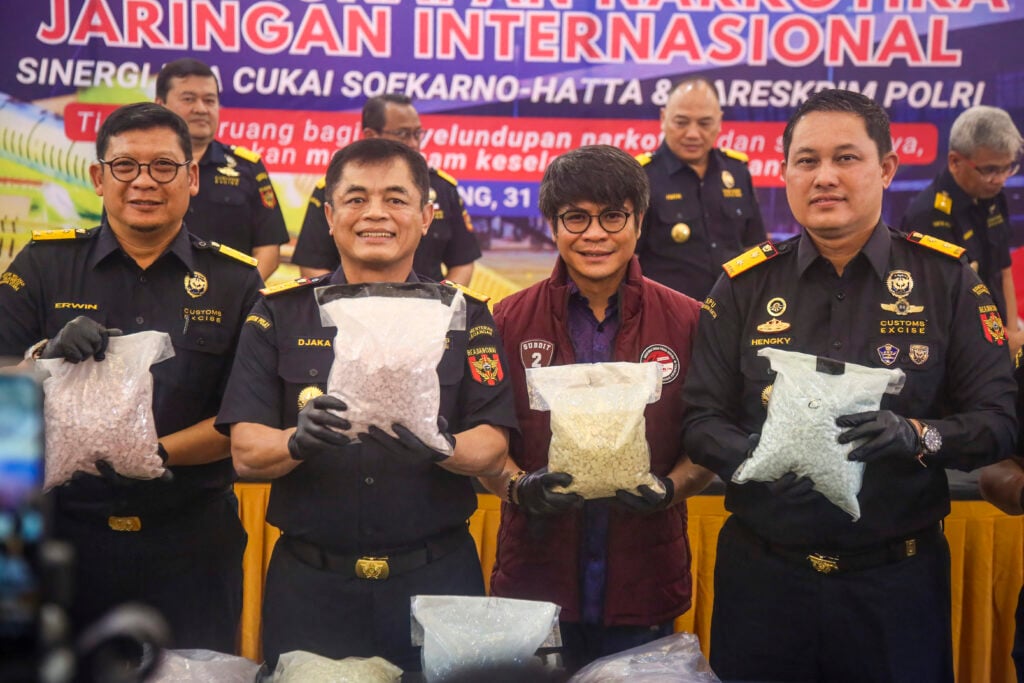
Indonesian Customs officials display drugs smuggled by a Malaysian pilot as evidence during a press conference at Soekarno-Hatta International Airport in Tangerang, near Jakarta, on 31 July.
Image via Ramu/AFPThe pilot tested positive for meth, MDMA, and cocaine after landing the plane
A post-arrest drug screening found that the pilot had flown the aircraft while under the influence of multiple narcotics.
"The results of his urine test came back positive for meth, MDMA, and cocaine. So, at the time of the flight, he was under the influence," Soekarno-Hatta customs official Hengky Tomuan Parlindungan Aritonang told reporters at a press conference on Friday, 31 July.
Hengky added that the pilot likely did not expect to be directed to the special customs lane reserved for pilots and crew, but maintained that the same monitoring procedures applied to everyone.
The case has raised fresh concerns about aviation safety and prompted authorities to review crew screening procedures on both sides of the Malacca Strait.
He was allegedly paid RM50,000 to transport the drugs
During questioning, the pilot admitted he had agreed to move the drugs on behalf of an international trafficking syndicate in exchange for roughly RM50,000 to deliver the suitcase after landing in Jakarta.
Authorities said a handler in Malaysia had instructed him to check into a hotel, where a syndicate member would later collect the luggage.
The payment is a fraction of the shipment's estimated RM13.5 million street value.
Police drug crimes unit official Awaludin Amin said investigators suspect the pilot was working as part of a wider international syndicate, and he has since been formally charged with drug smuggling.
Investigators said this was the Malaysian pilot's third smuggling attempt
The pilot reportedly told investigators this was not his first drug smuggling operation.
He admitted to previously smuggling drugs into Sabah, as well as successfully bringing 7kg of methamphetamine into Jakarta on an earlier trip. If confirmed, this would make the latest incident his third alleged smuggling operation and second involving Indonesia.
Indonesia's Bareskrim Polri is now coordinating with Bukit Aman's Narcotics Crime Investigation Department (NCID) to track down the syndicate members believed to be operating from Malaysian soil.
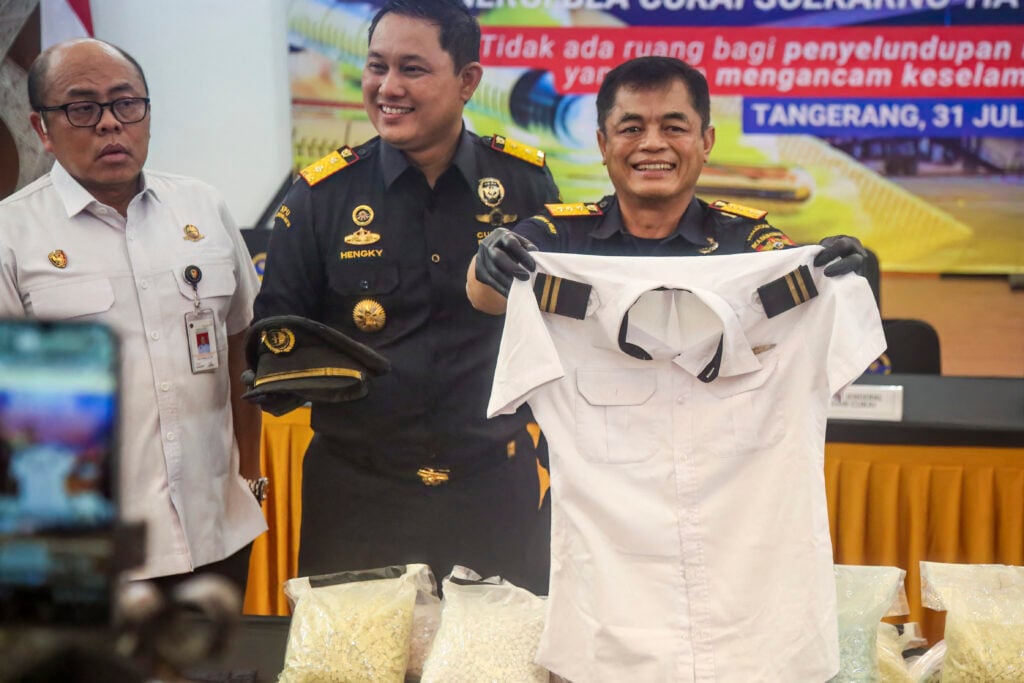
Indonesian Customs officials display the uniform of a Malaysian pilot and drugs he smuggled as evidence during a press conference at Soekarno-Hatta International Airport in Tangerang, near Jakarta, on 31 July.
Image via Ramu/AFPThe pilot faces execution by firing squad. However, Indonesia hasn't carried out a drug-related execution since 2016.
The pilot has been charged under Articles 113(2), 114(2), and 132(1) of Indonesia's Law No. 35/2009 on Narcotics, which carries penalties ranging from life imprisonment to death by firing squad.
Indonesia has some of the world's toughest anti-drug laws and dozens of foreign nationals remain on death row for trafficking offences.
However, according to the AFP, the country has maintained an unofficial moratorium on drug executions for years; the last time it carried out a death sentence for a narcotics offence was in 2016, when one Indonesian and three Nigerian nationals were executed by firing squad.
Foreign drug cases remain a recurring flashpoint in Indonesia: two British men were sentenced in March to nine and 11 years in prison respectively for smuggling cocaine into Bali, while Bali police arrested two Russian nationals in June over an alleged attempt to smuggle nearly 8kg of hashish into the resort island.
The Malaysian airline company has since stated that it's fully cooperating with investigators in Indonesia
The airline said in a statement that it takes the allegations seriously and has launched an internal review, adding that it "will extend its full cooperation to the relevant authorities in accordance with all applicable laws and regulations".
The airline declined to comment further, reported AFP.
SAYS has reached out to the Malaysian airline company for a statement.
Meanwhile, the Malaysian Embassy in Jakarta confirmed to AFP that it had received notice of the arrest of a Malaysian national at the airport, saying it "respects" Indonesia's legal process, adding that it is working with Indonesian authorities to secure consular access to the detained pilot.
Bukit Aman NCID director Datuk Hussein Omar Khan confirmed the pilot will be prosecuted entirely under Indonesian law, while Malaysian police assist with the broader investigation into the trafficking network.
Meanwhile, Malaysian regulators are investigating how the drugs left KLIA undetected
Malaysia's Civil Aviation Authority (CAAM) has launched an investigation into how roughly 26kg of narcotics passed through security screening at Kuala Lumpur International Airport (KLIA) before departure.
CAAM chief executive Datuk Captain Norazman Mahmud stressed that flight crew are not exempt from baggage screening under the Civil Aviation Security Regulations 2019.
The regulator is also auditing the airline's compliance with its mandatory Alcohol and Drug Management Programme, which bars flight crew from operating aircraft while under the influence of psychoactive substances.
Indonesian customs officials, meanwhile, have already tightened security for airline crew, introducing more frequent random baggage checks and enhanced screening at dedicated crew lanes.
The pilot remains in detention in Jakarta as investigations continue into the wider trafficking syndicate believed to be operating out of Malaysia.
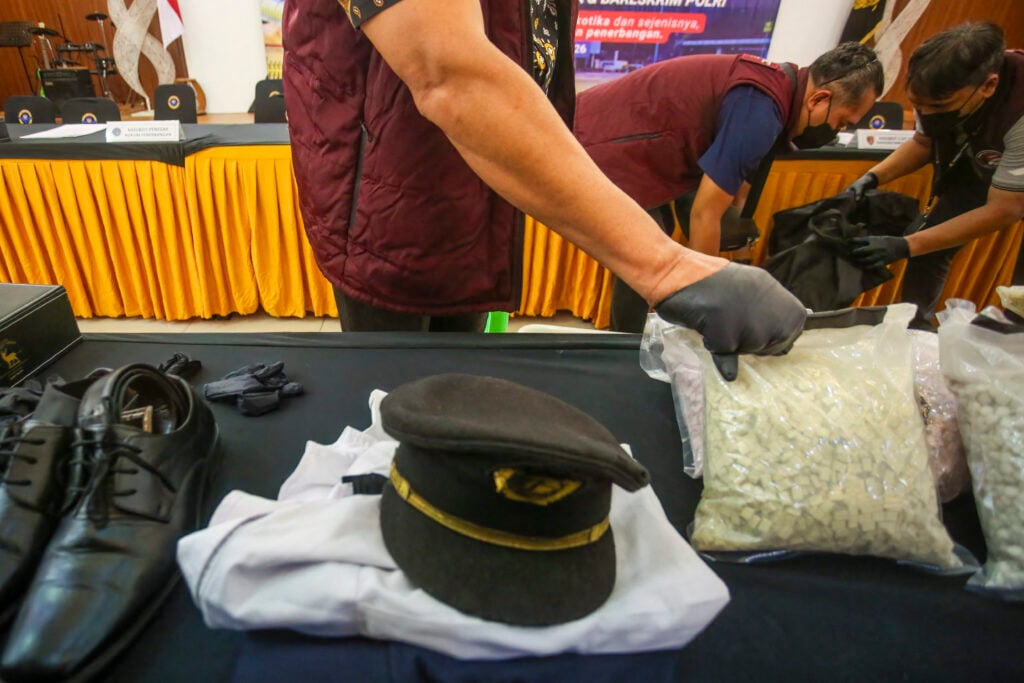
Indonesian Customs officials prepare to display the uniform of a Malaysian pilot and drugs he smuggled as evidence before a press conference at Soekarno-Hatta International Airport in Tangerang, near Jakarta, on 31 July.
Image via Ramu/AFP