
Australian Says Malaysians Have More “Breathing Room” Financially, Locals Disagree
An Aussie praised Malaysia's relatively low household debt compared to countries like Australia and the US, but many Malaysians argued the numbers ignore wages, purchasing power, cost of living, and local earning power.


 Cover image via Mohd Rasfan/AFP
Follow us on Instagram, TikTok, and WhatsApp for the latest stories and breaking news.
A post comparing household debt levels between Malaysia and Australia has sparked a wider debate online about whether Malaysians are actually financially better off than people living in wealthier countries
The discussion began after an Australian Reddit user in the r/malaysia subreddit shared his thoughts on a viral chart showing household debt per capita across multiple countries.
The chart, reportedly based on data from the Institute of International Finance (IIF) and UN World Population Prospects 2024, ranked Australia among the world's most indebted households at USD83,100 (around RM328,000) per capita.
Malaysia, meanwhile, was ranked much lower at USD9,700 (around RM38,300) per capita.
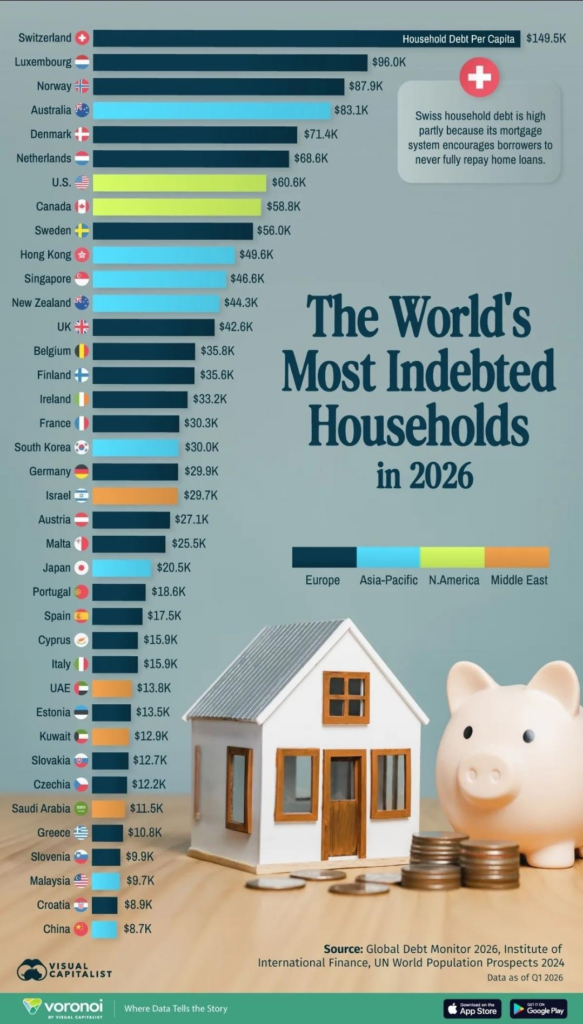
The user said many Australians with stable jobs and homes are still heavily burdened by long-term mortgages and rising living costs
"A median house in Sydney is pushing AUD1.6 million (around RM4.5 million)," the user wrote.
"You sign a 30-year mortgage before you're 35 and that becomes your lifelong liability."
The Aussie also claimed that Malaysians may be underestimating the financial pressures of migration and higher salaries abroad.
"Yes, wages are lower. Yes, there are real frustrations that locals know better than me. I'm not here to tell Malaysians their country is perfect," the Redditor wrote.
"But I see so many posts here about wanting to migrate to Australia for a 'better life', and I just want to say, please understand what you're signing up for.
"The number on your payslip goes up, but so does everything else. The financial anxiety is real, and it never really goes away."
The post quickly gained traction, but many Malaysians pushed back against the comparison, arguing that raw debt figures alone do not reflect actual quality of life or financial strength
Several users pointed out that Malaysia's lower debt levels must be viewed together with local wages and purchasing power.
One commenter noted that Malaysia's GDP per capita is significantly lower than Australia's, arguing that the comparison becomes less favourable once adjusted against earnings.
For context, while Australia's household debt per capita is about 8.5 times higher than Malaysia's, its GDP per capita (income-generating power) is also roughly five times higher than Malaysia's.
Another user highlighted how ordinary purchases can take a much larger share of income for Malaysians.
"The median salary in Malaysia is around RM3,000. That's 3 months-plus of working just to get an iPhone," the commenter wrote.

A woman near the Sydney Harbour in Sydney, Australia.
Image via Claudio Galdames Alarcon/Anadolu/AFPOthers also criticised the use of US dollar conversions
They said it creates a misleading impression because Malaysians earn and repay debt in ringgit, not US dollars.
Some users also argued that the chart ignores differences in household structure.
One commenter pointed out that Malaysian households are generally larger than Australian households, meaning more dependents often share the same household income.
The same user also noted that household debt itself is not automatically negative, as higher-income countries often have greater borrowing capacity due to stronger wages, social safety nets, and dual-income households.
Another recurring point in the discussion was that Malaysia actually has one of the highest household debt-to-GDP ratios in Southeast Asia.
While Malaysia's debt per capita appears low compared to Western nations, some argued debt-to-GDP ratio is a more meaningful indicator because it measures debt relative to the country's economic output.
Much of Malaysia's household debt is tied to housing loans, vehicle financing, and consumer credit.
Residential mortgages make up the largest share of household borrowing in Malaysia, followed by vehicle loans, due to the country's heavy dependence on cars outside major urban areas
At the same time, several commenters noted that Malaysia's banking system is relatively mature compared to many neighbouring countries, making loans more accessible to ordinary consumers.
Despite concerns over household debt, Bank Negara Malaysia has previously stated that Malaysian households also hold significant financial assets such as savings, EPF contributions, and investments, which help cushion financial risks.
Still, the Reddit discussion ultimately revealed a broader divide in how people measure financial wellbeing.
For some, lower debt represents greater freedom and less financial pressure.
For others, income strength, currency value, healthcare access, housing quality, and purchasing power matter far more than debt figures alone.

A pair of kayakers watch the sails of the Sydney Opera House.
Image via Ayush Kumar/AFP