
Civil Servants Can Now Hold Up To RM300,000 In Investments Under New JPA Asset Rules
Officers who wish to exceed the threshold must obtain approval.


 Cover image via
 Follow us on Instagram, TikTok, and WhatsApp for the latest stories and breaking news.
The Public Service Department (JPA) has issued a new directive on asset declarations for civil servants, including revised limits on shareholdings and investments
In a circular dated 16 June, JPA director-general Tan Sri Wan Ahmad Dahlan Abdul Aziz said the updated guidelines are intended to clarify and provide guidance on asset ownership and declarations by public officers under Regulation 10 of the Public Officers (Conduct and Discipline) Regulations 1993.
Under the regulation, all public officers are required to declare in writing to their respective heads of department all assets owned by themselves, their spouse, or their children, including those held by others on their behalf.
JPA had earlier announced plans to review circulars, regulations, and guidelines that are more than 20 years old or no longer relevant, including rules governing civil servants' share ownership.
According to the circular, the latest measures aim to strengthen integrity, accountability, and transparency in the public service, while ensuring the rules remain relevant to current developments and modern investment practices.

Under the new guidelines, civil servants may hold investments worth up to RM300,000 without prior approval
This combined limit applies to assets including shares in private companies, shares in public-listed companies, cooperative shares, non-government unit trusts, digital assets approved by the Securities Commission (SC), as well as bonds, sukuk, debentures, and other securities.
This is an increase from the previous RM100,000 limit.
Officers who wish to exceed the RM300,000 threshold must obtain approval from their respective approving authority.
For private company shares, ownership in each company is also capped at 5% of the company's paid-up capital or RM300,000, whichever is lower.
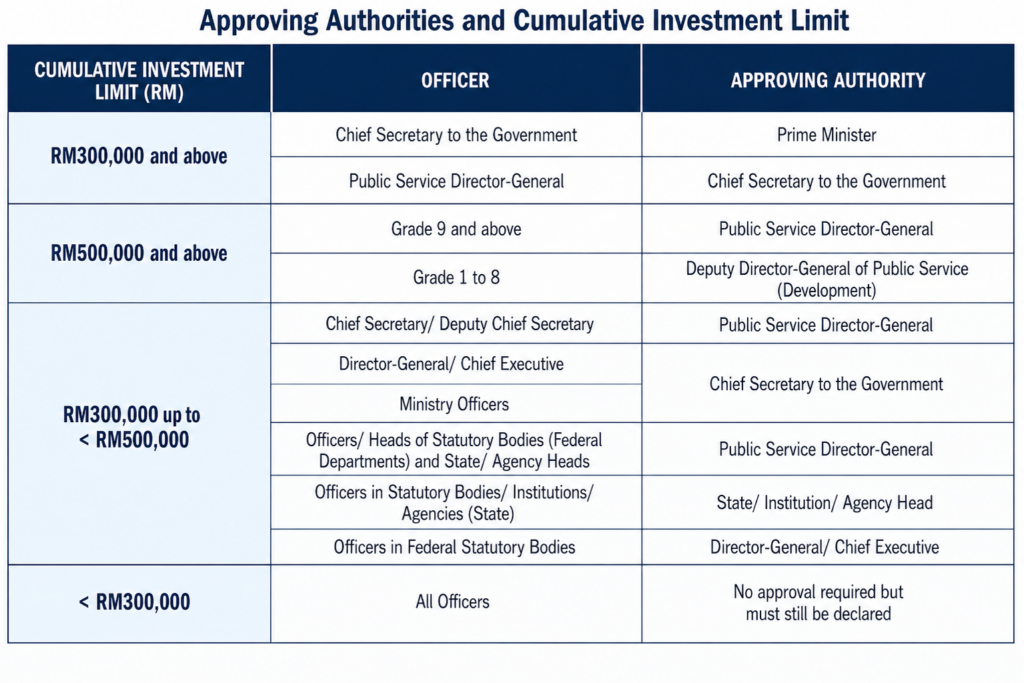
The circular also sets limits for investments made through platforms recognised by the SC
For equity crowdfunding (ECF), officers may invest up to RM10,000 per company, with a maximum total investment of RM50,000 within a 12-month period.
Meanwhile, digital assets purchased through Digital Asset Exchange (DAX) platforms are also capped at RM300,000, with higher amounts requiring approval.
Civil servants are also required to declare income from any approved outside employment every June and December
This includes monthly allowances, bonuses, incentives, shares, dividends, and other forms of income.
Meanwhile, officers who receive dividends or investment returns exceeding six times their monthly salary are required to declare the income to their head of department.
According to the circular, officers who fail to declare their assets or violate any provision under the guidelines may face disciplinary action under the Public Officers (Conduct and Discipline) Regulations 1993.
