
EPF Ranks 11th Among World’s Top Pension Funds. Here Are The Stats Behind Its Standing
The Employees Provident Fund (EPF) had RM1.404 trillion in total assets under management (AUM) as of the end of last year.


 Cover image via
 Follow us on Instagram, TikTok, and WhatsApp for the latest stories and breaking news.
Malaysia's Employees Provident Fund (EPF) has been ranked 11th among the world's top 300 pension funds
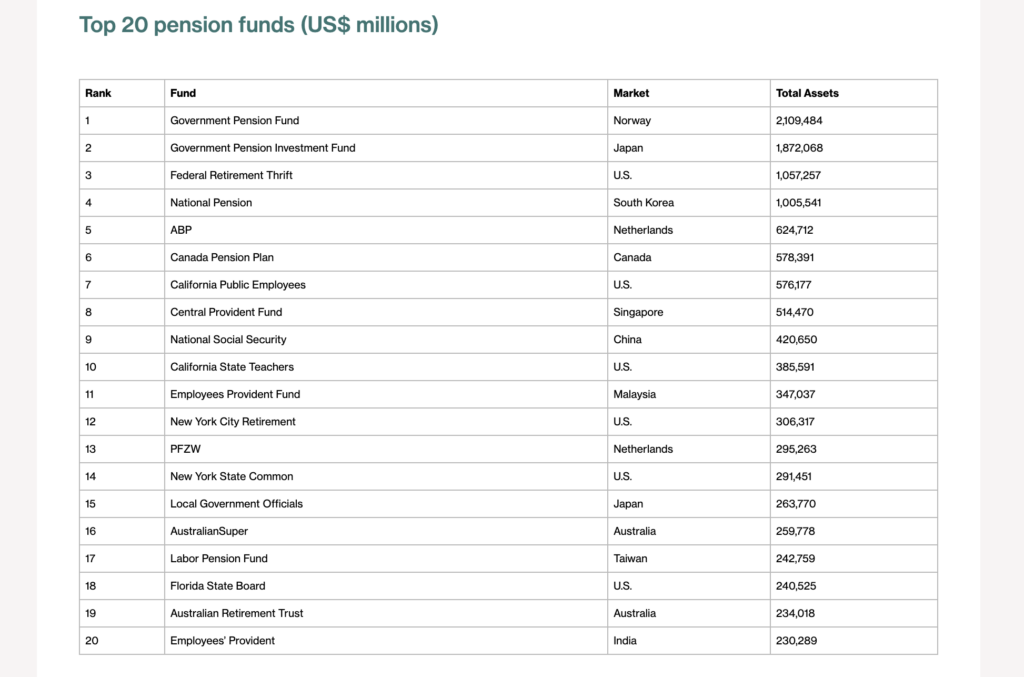
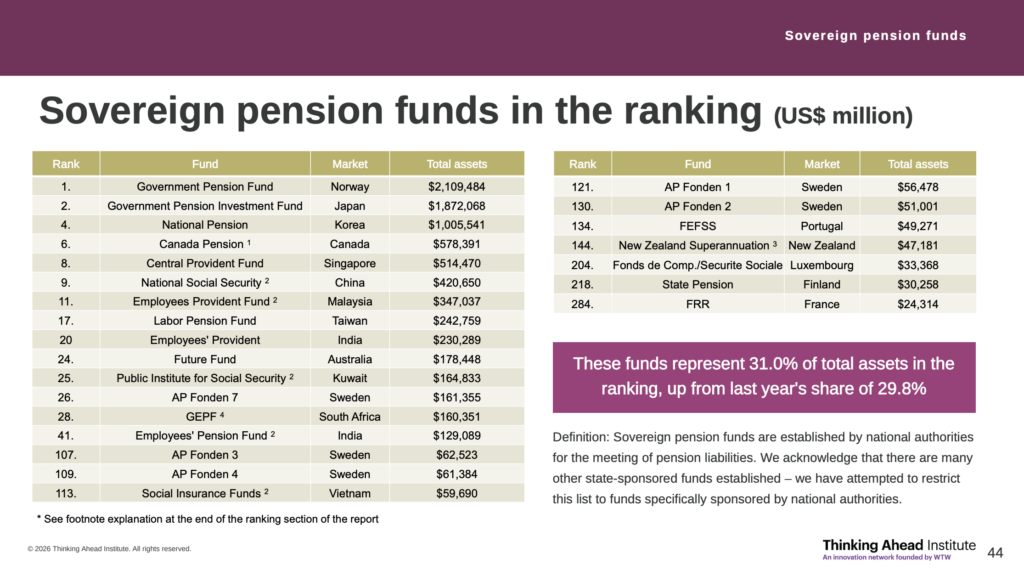
In the Global Top 300 Pension Funds report published by the Thinking Ahead Institute yesterday 7 September, EPF was ranked 11th among both the world's top pension funds and top sovereign pension funds, with total assets under management (AUM) of USD347,037 million (about RM1.4 trillion).
The report noted that the AUM of the top 20 funds increased by 14.7% in 2025, compared to 13.4% for the top 300 funds.
EPF's AUM has also grown over the years, reaching RM1.53 trillion as of June 2026. Here's the breakdown:
• As of June 2026: RM1.53 trillion (+8.97%)
• 2025: RM1.404 trillion (+12.32%)
• 2024: RM1.25 trillion (+9.65%)
• 2023: RM1.14 trillion (+14%)
• 2022: RM1 trillion (-0.99%)
• 2021: RM1.01 trillion (+1.2%)
The decline between 2021 and 2022 was largely caused by the RM145 billion in withdrawals by members under four COVID-19 pandemic-related schemes, namely i-Lestari, i-Sinar and i-Citra, and the special withdrawal schemes (Pengeluaran Khas).
Meanwhile, the top 20 pension funds recorded a compound annual growth rate (CAGR) of 5.5% over the past five years, compared to 5% for the top 300 funds.
EPF's conventional savings dividend averaged around 5.88% over the past five years. Here's the breakdown:
• 2025: 6.15%
• 2024: 6.30%
• 2023: 5.50%
• 2022: 5.35%
• 2021: 6.10%
Although the figures measure different things and are not directly comparable — as CAGR factors in investment returns, net contributions, withdrawals, fund consolidation, and exchange-rate movements — they provide broad context for assessing EPF alongside the world's largest pension funds.
The ringgit's resilience against the US dollar also helped EPF's position
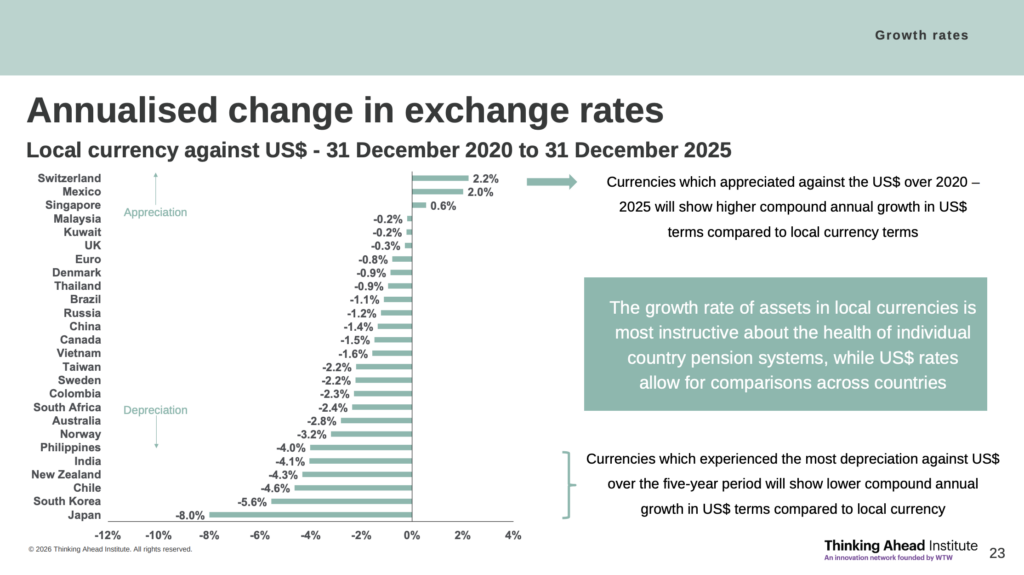
The ringgit ranked fourth on a chart measuring the annualised change in exchange rates between 2021 and 2025, depreciating by just 0.2% against the US dollar.
The report noted that emerging markets have generally recorded higher average annualised pension fund asset growth over the past five years, in local currency terms, than advanced economies, largely due to differences in market maturity.
Only the Swiss franc, Mexican peso, and Singapore dollar appreciated against the greenback at 2.2%, 2%, and 0.6%, respectively.
"The growth rate of assets in local currencies is most instructive about the health of individual country pension systems, while the US dollar rates allow for comparisons across countries," said the report.
Meanwhile, the Thinking Ahead Institute also noted that Malaysia has two retirement funds, with their combined AUM accounting for 1.4% of the top 300 funds' total assets
The US (38.9%), Japan (9.5%), and Norway (7.9%) took the top three spots in terms of their share of the top 300 funds, with 149, 11, and two funds, respectively.
Retirement Fund Inc (KWAP), the pension fund for Malaysia's public-sector employees, was the other Malaysian retirement fund on the list.
It ranked 136th, with an AUM of USD48.95 billion (about RM198 billion).
Last month, EPF said it recorded a RM29.77 billion investment income for the second quarter of 2026, marking a 44% increase compared to the same period last year.
However, it cautioned its members to temper their expectations, as such favourable market opportunities may not recur in the second half of the year.
You can find the Global Top 300 Pension Funds here.
