We Produce Our Own Oil, So Why Is The Strait Of Hormuz Closure Such A Big Problem For Malaysia?
The government's fuel subsidy bill has gone from RM700 million a month to RM4 billion. Here's an explanation of the reality behind that number.


 Cover image via
 Follow us on Instagram, TikTok, and WhatsApp for the latest stories and breaking news.
On 28 February, the US and Israel launched coordinated strikes on Iran
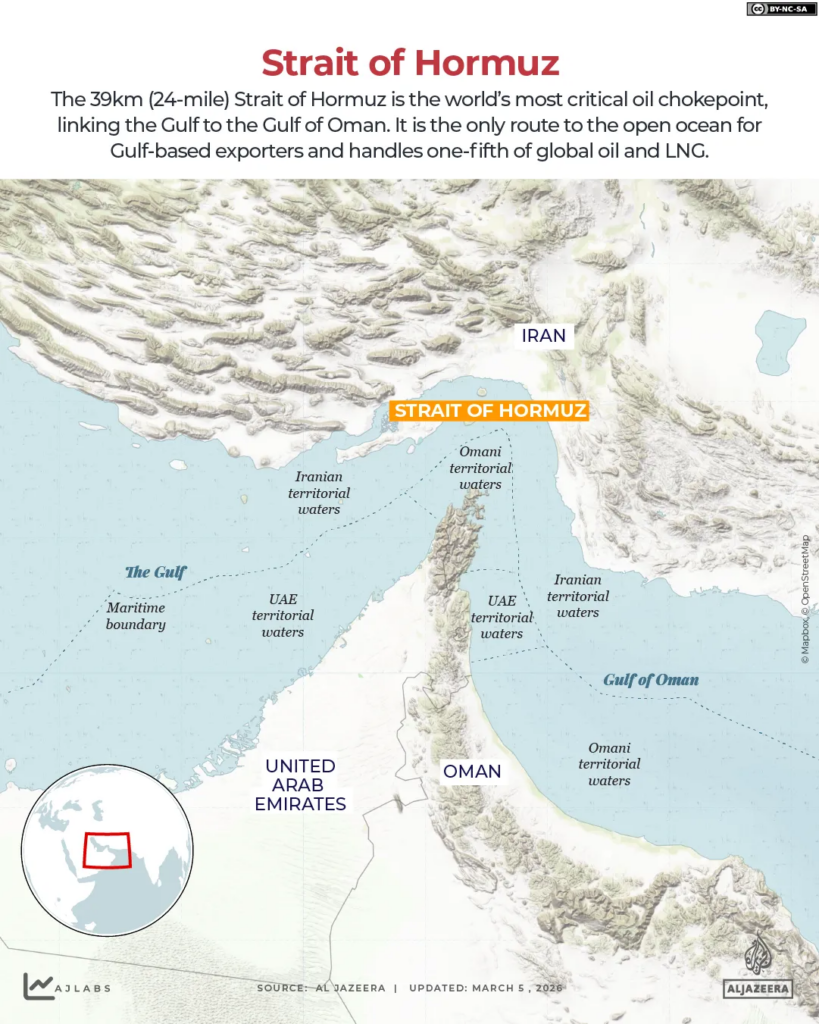
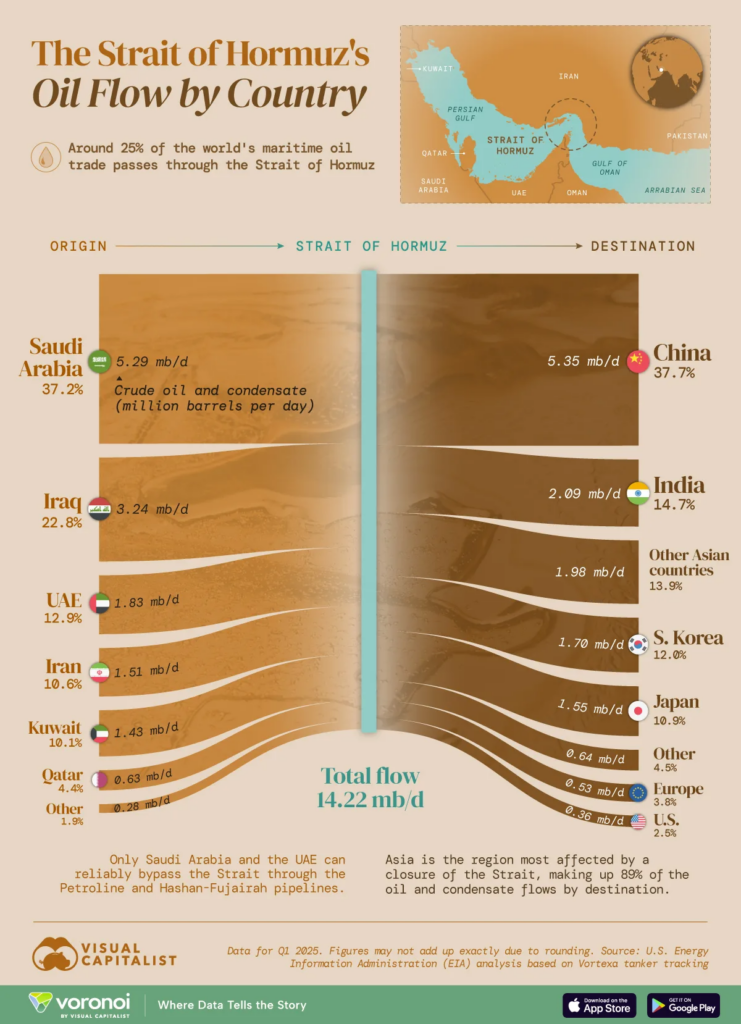
Tehran responded by closing the Strait of Hormuz, a narrow channel through which about 20% of the world's oil and gas normally flows.
Oil prices, which were sitting at around USD65 (RM260) a barrel before the war, surged past USD100 (RM401) within days, a jump of more than 40%.
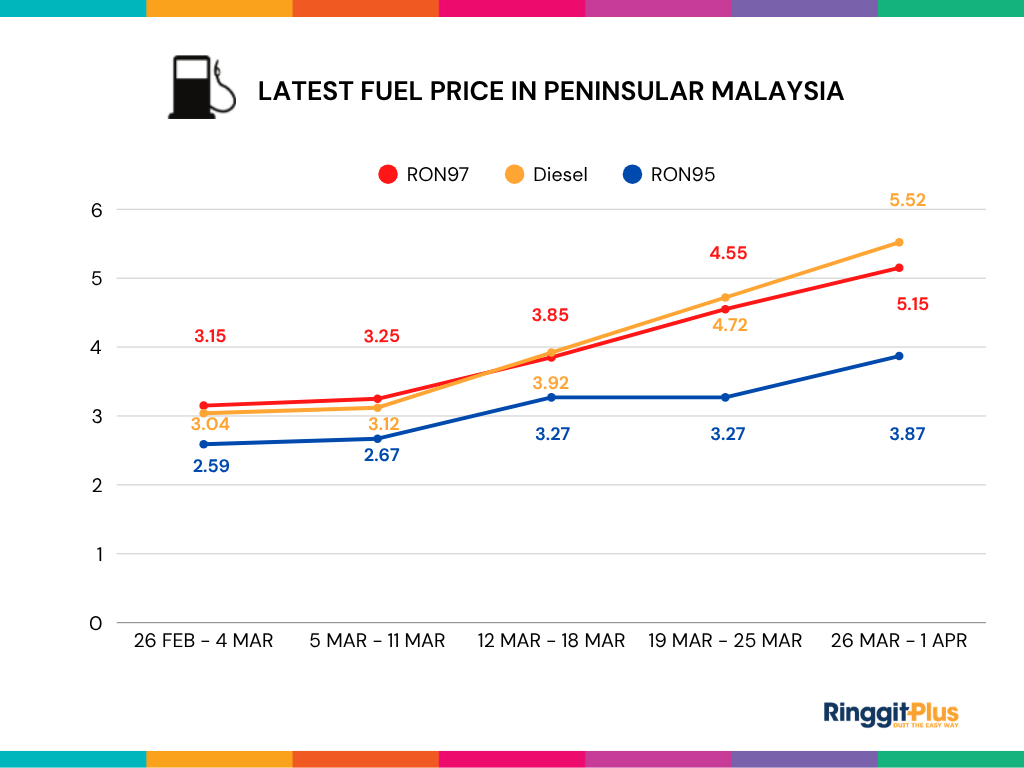
For most Malaysians, the first sign of impact was at the pump.
RON97 went up. Diesel went up. And the monthly government bill for keeping RON95 capped at RM1.99 ballooned from RM700 million to RM4 billion.
The common reaction from ordinary Malaysians was one of confusion: "We produce our own oil, so why is this hitting us so hard?"
The answer is about where our oil comes from, and where it goes.
Almost 70% of our crude comes from the Persian Gulf.
Malaysia does produce oil. We have PETRONAS, offshore platforms, and refineries across the peninsula. In 2025, we exported more oil and gas than we imported.
But producing oil and being energy self-sufficient are two different things.
Malaysia's domestic refineries are built to process a specific type of crude, heavier, cheaper oil that mainly comes from Saudi Arabia, the UAE, and Oman.
The crude Malaysia actually produces is a lighter, premium grade that fetches higher prices abroad. So we export our own crude for top dollar and import cheaper Gulf crude to keep our refineries running.
The result is that nearly 70% of Malaysia's crude oil imports come from the Persian Gulf. And roughly half of our total oil supply transits the Strait of Hormuz to get here.
So with the closure of the Strait of Hormuz, the problem is immediate.
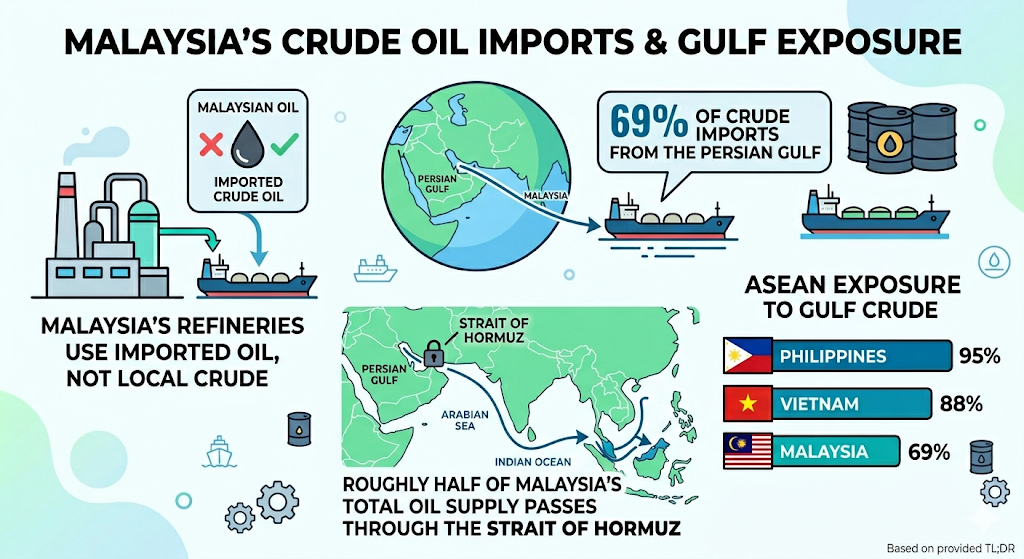
Malaysia's refineries run on imported Gulf crude, and roughly half of that supply passes through the Strait of Hormuz.
Image via SAYS/GeminiWhat the closure actually looks like
On 2 March, Iran officially confirmed the strait was closed. Tanker traffic, which normally sees over 100 vessels a day, dropped to single digits. Over 150 ships are anchored outside the strait to avoid risk.
Nearly 2,000 vessels are now stranded near the strait. In one week alone, 15 to 21 March, only 16 crossings by ships with their tracking systems switched on were recorded.
Ships that did attempt transit faced a new reality. Iran has set up what shipping experts are calling a "toll booth" system, where vessels must seek pre-approval from the Islamic Revolutionary Guard Corps (IRGC) before crossing.
War-risk insurance premiums for a single transit have jumped from around 0.15–0.25% of a vessel's hull value to as high as 5–10%.
For a large crude tanker, that can mean millions of dollars in additional costs per trip.
What's it costing Malaysia
The most direct hit for ordinary Malaysians: fuel prices.
RON97 and unsubsidised RON95 have both risen significantly. Subsidised RON95 remains capped at RM1.99, but holding that line is now extremely expensive.
The Finance Ministry confirmed earlier this week that with oil above USD100, the monthly subsidy bill has hit RM4 billion. That's nearly six times what it was in January this year.
The government has also cut the monthly RON95 quota per person from 300 litres to 200 litres, effective 1 April, and introduced new diesel purchase limits in Sabah and Sarawak to curb hoarding and smuggling.
There's a broader budget problem, too.
Budget 2026 was drawn up assuming oil at USD65 a barrel. It is now trading well above USD100. Every assumption the government made about revenue, subsidies, and fiscal headroom was built on a number that no longer exists. The gap between those two numbers is a fiscal problem the government has to absorb or pass on to consumers.
Doesn't being a net oil exporter help at all?
Partially.
Malaysia is the only net energy exporter in ASEAN, which means higher oil prices also boost PETRONAS revenue and government income. That gives Malaysia more buffer than neighbours like the Philippines or Vietnam.
But it doesn't cancel out the import bill. Malaysia is a net importer of refined petroleum products, the finished fuels that go into vehicles. When global prices rise, so does the cost of everything we bring in.
The net effect, as economists have pointed out, remains negative for the national budget once subsidy costs are factored in.
Where things stand today
There are some signs of movement.
Prime Minister Datuk Seri Anwar Ibrahim has confirmed that Iran has granted Malaysian vessels early clearance through the strait, and said Malaysia is working to secure the release of its tankers and crew so they can return home.
Anwar said he personally spoke with Iranian President Masoud Pezeshkian, as well as Egyptian, Turkish, and other Gulf leaders, as part of broader efforts to facilitate peace.
But the clearance is not unconditional.
Iran's position is that vessels may transit "provided that they neither participate in nor support acts of aggression against Iran" and do so in full coordination with Iranian authorities. In practice, that means every transit still requires IRGC approval.
PETRONAS has said mitigation measures are in place for June onwards, and the government has said supply is secured until May. Australia and other Asia-Pacific suppliers are being explored as alternatives if the disruption continues.
The wider risk hasn't gone away. Analysts have warned that a prolonged crisis could trigger export restrictions from major regional product exporters, including India, China, and South Korea, a second-order hit on top of the price shock already underway.
The bottom line
Malaysia's exposure to this crisis is the result of decades of rational economic decisions, exporting premium crude, importing cheaper Gulf oil, and building refineries accordingly. It made sense when the Gulf was stable.
What the Strait of Hormuz closure has done is turn a structural dependency into an active vulnerability. The government is managing it, but managing it costs money, and right now, that cost is RM4 billion a month and rising.