
This Is How DOSM Defines B40, M40 & T20 Income Groups. Check Which One You Fall Under Here
We've built a calculator for you to enter your household gross income and find out which income group you fall under.


 Cover image via
 Follow us on Instagram, TikTok, and WhatsApp for the latest stories and breaking news.
With the government reviewing whether high-income Malaysians should continue receiving the BUDI95 fuel subsidy amid supply pressures linked to the Middle East conflict, attention has returned to a key question: how does Malaysia define income groups?
Households in Malaysia are commonly divided into three broad categories: the bottom 40% (B40), middle 40% (M40), and top 20% (T20).
However, as Putrajaya considers a more targeted approach to fuel subsidies, it has yet to publicly detail how "high-income" households would be identified under any revised BUDI95 policy.
Prime Minister Datuk Seri Anwar Ibrahim previously said the government was still studying whether the cut-off should apply to the T20, T15, T10, or even T5 income groups.
The supposed Central Database Hub (PADU) system was developed to support more targeted policymaking by consolidating socioeconomic data across government systems.
According to the Finance Ministry, PADU contains information such as demographics, locality, employment, income, education, vehicle ownership, poverty status, and government aid received, allowing it to serve as a reference point for subsidy targeting.
However, the government also said in September last year that the initial rollout of BUDI95 did not rely on PADU's full dataset, as eligibility at the time was based on simpler criteria, such as Malaysian citizenship and possession of a valid driving licence.

The issue has gained renewed attention amid ongoing tensions in the Middle East, which have raised concerns over global fuel supply and subsidy costs
Some economists have argued that excluding the T20 from BUDI95 could save the government up to RM1.5 billion a month, while others have warned that a blanket income-based exclusion may be too blunt and could create wider economic effects, including inflationary pressure.
This has also raised a more fundamental question: what income level actually qualifies as T20 in Malaysia?
To answer that, this article refers to the Household Income Survey Report 2024, published by the Department of Statistics Malaysia (DOSM) in October last year, as the latest official reference for how household income groups are measured and broken down in the country.
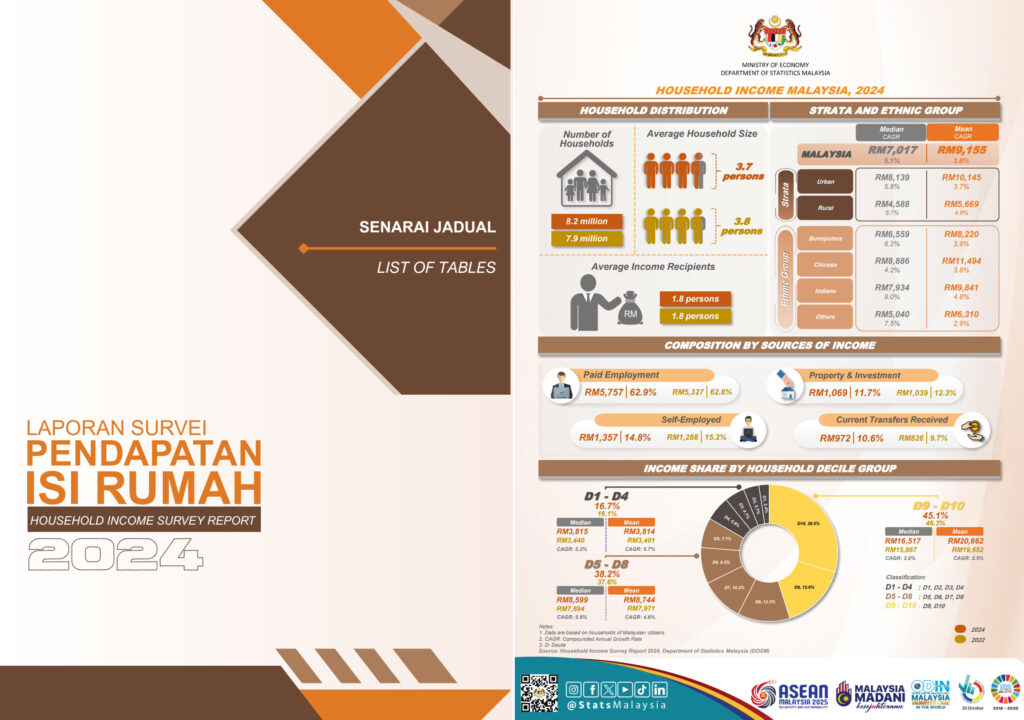
To present the data more accurately, DOSM divides households into income deciles, with each decile representing 10% of the population, creating classifications such as B10, B20, M40, M50, and so on.
Here is the breakdown:
Median of monthly household gross income of household decile group by state, 2024 (RM)
Scroll horizontally to view all decile columns.
| State | Decile | Group | |||||||||
|---|---|---|---|---|---|---|---|---|---|---|---|
| D1 | D2 | D3 | D4 | D5 | D6 | D7 | D8 | D9 | D10 | ||
* Monthly household gross income refers to the total combined pre-tax earnings of all individuals living in a household, including wages, salaries, investments, and transfers. It is used to assess a household's overall financial position.
Note: These figures may not fully reflect the government's preferred measure of household income, as they do not fully account for differences in household size, the number of dependents, cost of living across locations, debt burdens, and other factors.
