
Are You A Salaried Employee With Side Income? LHDN Wants You To Pay Your Tax Bimonthly
It's not a new tax, but the Inland Revenue Board (LHDN) now requires more Malaysians with side income to pay their taxes through the CP500 instalment system.


 Cover image via
 Follow us on Instagram, TikTok, and WhatsApp for the latest stories and breaking news.
If your monthly salary isn't your only source of income anymore, this is something you should know
Whether you are work freelance after office hours, edit videos on weekends, earn from content creation, rent out a property, receive royalties, or take on occasional side gigs, you might have received a CP500 notice from the Inland Revenue Board (LHDN) recently.
For many Malaysians, the first reaction is usually the same: "Why am I receiving this? Isn't my salary already taxed through monthly tax deductions (PCB)?"
The answer is simple: PCB only covers employment income. CP500 applies to income earned outside of your regular employment.
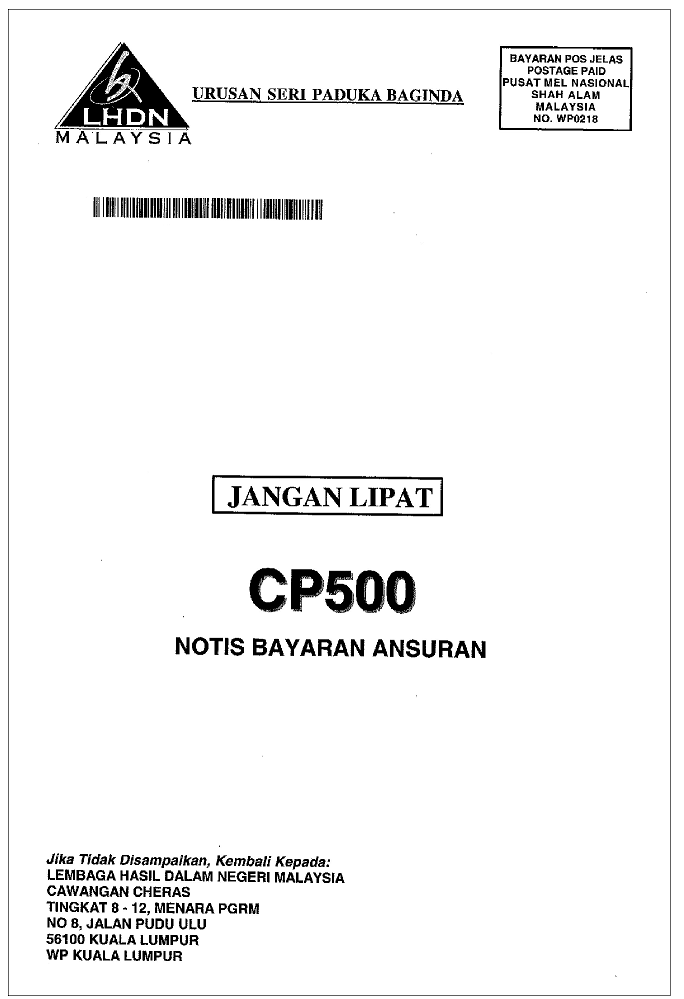
A CP500 form for illustration purposes only.
Image via QNE CloudFirst things first: What is CP500?
CP500 is LHDN's Notice of Instalment Payments for individual taxpayers who earn income outside of employment.
It is not a new "extra tax". While the system itself has been around for years, many salaried employees only recently began receiving these notices.
This expansion largely occurred because side income may have been misclassified in previous tax returns, inadvertently triggering the CP500 issuance in recent months.
An expert told The Star that LHDN is now expanding the use of CP500 to collect advance tax on income that is not covered by PCB.
To understand the CP500 mechanism, think of it as an advance payment system, where LHDN estimates your tax on non-employment income and spreads it across instalments instead of waiting for you to pay everything in one lump sum when you file your income tax return.
| Item | PCB / MTD | CP500 |
|---|---|---|
| What it covers | Employment income, such as salary and bonuses | Non-employment income, such as freelance, business, rental, and royalties |
| Who pays it | Your employer deducts it monthly from your salary | You make the instalment payment yourself |
| How often | Monthly | Every two months, up to six instalments a year |
| Final tax? | No. This advance payment is just an estimate, which is later credited against your final tax payable. | No. This advance payment is also just an estimate, which is later credited against your final tax payable. |
So yes, your side hustle can count, even if you are running a small online store on Instagram
As long as you are a salaried employee with side income, LHDN may tax that income separately from your salary.
| Side income type | Example | Why LHDN may care |
|---|---|---|
| Freelance services | Copywriting, video editing, design, photography, consulting | Usually treated as business or professional income if you are paid for your work |
| Content creation | Sponsored posts, paid reviews, YouTube/TikTok/platform income | LHDN has specific guidance that influencer/content income can be taxable |
| Rental income | Renting out a house, room, shoplot, or property | Rental is non-employment income |
| Royalties | Book royalties, music royalties, licensing fees | Royalties are also non-employment income |
| Business profits | Running a small online shop, selling products, offering paid services, or doing project-based work | Profit from business activity is non-employment income and may be subject to CP500 if LHDN estimates tax on it |
Previously, rental income was not included in the CP500 instalment system, reported e-invoicing service provider JomeInvoice.
However, starting from 2026, LHDN has expanded the scheme to include rental income, requiring affected taxpayers to make bimonthly tax payments instead of settling the entire amount in a lump sum at the end of the Year of Assessment (YA).
The big 2026 update: CP500 penalties are waived for now
Here's some good news for people to breathe a little easier.
LHDN has announced that individual taxpayers who receive CP500 notices for the first time will not be penalised in 2026 if they do not make CP500 instalment payments, allowing them time to adapt to the new system, the board told The Star yesterday, 4 June.
LHDN explained that the CP500 instalment scheme was initially designed for taxpayers earning business income or other taxable income beyond their salaries, including rental, interest, and royalty earnings.
The tax authority clarified that the penalty exemption does not extend to individuals who rely solely on business, rental, or other non-employment income streams, as these groups have long been required to make CP500 instalment payments.
For those who received the CP500 notice for the first time, it does not mean the tax is waived. It only means the penalty for not paying the CP500 instalments is waived during the 2026 transition period.
In simple terms, taxpayers are still expected to make their CP500 instalment payments for YA2026. However, those who miss their instalments may not be subject to the usual 10% late payment penalty.
The tax remains payable. Any outstanding amount will have to be settled in full as a lump-sum payment when you file your tax return in 2027.
| Question | Answer |
|---|---|
| Is CP500 cancelled? | No. |
| Is the tax waived? | No. Your tax liability still exists. |
| Is the 2026 CP500 penalty waived? | Yes, but only for first-time recipients who received it due to recent declaration errors. |
| Should you still pay voluntarily? | LHDN encourages voluntary payments to reduce your final tax balance later. |
| Can you amend the CP500 amount? | Yes, using Form CP502. |
| Instalment | Payment Month | Due Date | Status For YA2026 |
|---|---|---|---|
| 1st instalment | March | 31 March 2026 | Penalty waived |
| 2nd instalment | May | 31 May 2026 | Penalty waived |
| 3rd instalment | July | 31 July 2026 | Penalty waived |
| 4th instalment | September | 30 September 2026 | Penalty waived |
| 5th instalment | November | 30 November 2026 | Penalty waived |
| 6th instalment | January | 31 January 2027 | Penalty waived for YA2026 instalment |
What if the CP500 amount looks wrong?
If your side income has dropped, stopped, or was wrongly reported, you can apply to amend the CP500 amount using Form CP502.
For YA2026, LHDN stated that the first amendment can be made by 30 June 2026, while the second amendment can be made by 31 October 2026.
And if you only have salary income but still received CP500, LHDN said this may happen if income was previously reported under the wrong category in your tax return.
In that case, taxpayers can submit CP502 together with their EA/EC form to the board.
Taxpayers who did not receive a Form CP500 are advised to check with the LHDN branch managing their tax file here or contact the Hasil Care Line at +603-89111000.
Still confused? The frequently asked questions below may help clear things up:
CP500 FAQ
1. I have a full-time job and do freelance copywriting. Does CP500 apply to me?
It can. Your salary is covered by PCB, but your freelance income is separate non-employment income. If LHDN estimates tax on that income, you may receive a CP500 notice.
2. I make content online. Is that taxable?
Yes, it can be. LHDN's guidance on social media influencers covers income such as platform payments, paid reviews, ambassador fees, sponsorships, and even some non-cash benefits if they are received because of your content work.
3. If the CP500 penalty is waived in 2026, can I just ignore it?
You may not be penalised for not paying CP500 instalments in 2026, but the actual tax is not waived. If you skip the instalments, you may need to pay a larger balance when you file your tax return.
4. I only earn a salary and my employer deducts PCB. Why did I get CP500?
LHDN said some taxpayers received CP500 because income may have been reported under the wrong category in their previous tax return. If this applies to you, check your filing and consider submitting CP502 with your EA/EC form.
5. Do I need to keep receipts for my side hustle?
Yes. Keep invoices, payment records, receipts, bank statements, and expense documents. For content creators, LHDN's influencer guidance says income and supporting expense records should be kept for seven years.
6. Can I claim expenses from my side income?
Generally, expenses that are wholly and exclusively incurred to produce that income may be deductible, such as certain Internet, filming, editing, or production costs. Personal expenses are not deductible.
7. What should I do if I didn't receive a Form CP500 notice?
If you expect to have a CP500 schedule but haven't received it, it is best to get in touch with the specific LHDN branch that handles your physical tax file. Alternatively, you can reach out directly to the Hasil Care Line at +603-89111000 for assistance.
