
Malaysian Man Jailed After Being Fired For Failing To Scam Anyone
He accepted the role for a monthly salary of RM7,320, along with a 1% commission on funds transferred by victims.


 Cover image via Singapore Police Force
Follow us on Instagram, TikTok, and WhatsApp for the latest stories and breaking news.
A 30-year-old Malaysian who voluntarily joined a scam syndicate in Cambodia lasted just three days on the job before being fired for failing to scam anyone
Despite making no money and failing to deceive a single victim, Yip Chee Ming was sentenced by a Singapore court on 26 June to 16 months and two weeks in jail for being part of an organised crime group.
The court heard that Yip had agreed to work for a scam syndicate based in Phnom Penh that specialised in impersonating Singapore government officials and bank officers to cheat victims, reported CNA.
He pleaded guilty to one charge under Singapore's Organised Crime Act, while another cheating charge was taken into consideration during sentencing.
According to court documents, Yip learned about the opportunity through an acquaintance known as "Jason" in October 2024
The pair travelled from Malaysia to Cambodia later that month for an all-expenses-paid tour of the syndicate's operations, where Yip saw callers working from makeshift soundproof booths.
After deciding to join, he returned to Cambodia on 21 November 2024.
By then, the syndicate had already begun relocating after receiving information that Cambodian police might raid its previous premises.
Yip accepted a monthly salary of USD1,800 (RM7,320), along with a 1% commission on any money transferred by victims. He was to be paid in cryptocurrency.
His role was to impersonate a bank officer, convince victims there had been suspicious activity in their accounts, and transfer them to another scammer further up the operation chain.
The syndicate also provided callers with scripts, mobile phones equipped with scam tools, fake Singapore government backdrops, accommodation, meals, transport, and Cambodian work permits.
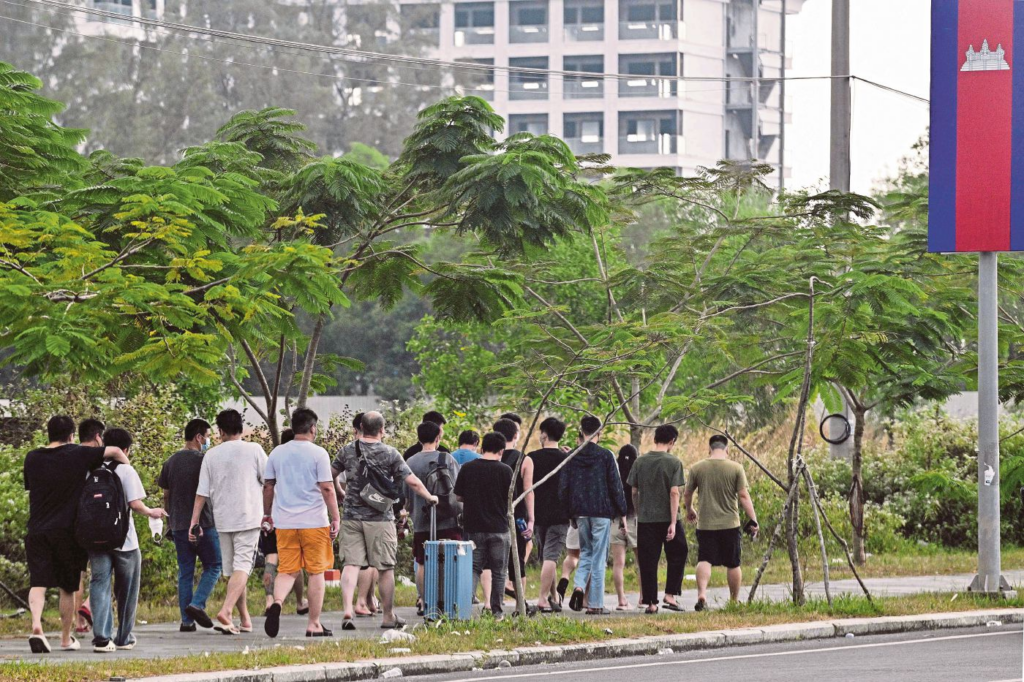
Workers walking out of a suspected scam centre compound in Sihanoukville on 15 January 2026.
Image via AFPOn his first day, Yip was given an iPhone 6 and a list of about 30 Singaporeans to target
He spent time memorising the script but, according to court documents, was unable to "deliver the lines confidently".
He failed to make a single successful scam call.
The following day, things didn't improve.
After another unsuccessful day, the syndicate decided it no longer wanted him.
Before sending him home, the syndicate leader confiscated Yip's personal phone and deleted all messages relating to his work with the criminal group.
He returned to Malaysia that same night without receiving any salary or commission.
Yip later moved to Singapore and worked as a delivery driver before being arrested in September 2025
His lawyer argued that the case was unusual because Yip had not managed to scam anyone, had not been paid, and had only been involved with the syndicate for three days.
However, Deputy Principal District Judge Luke Tan said those facts did not significantly reduce Yip's responsibility.
The judge noted that Yip had knowingly joined the syndicate for financial gain, understood that it targeted Singaporeans, accepted a salary and commission structure, and had been equipped with the tools needed to commit the scams.
He added that Yip did not leave because he regretted his actions.
Instead, "the accused was essentially fired because he could not confidently perform scam calls despite his best efforts".
While the court acknowledged Yip's cooperation with investigators and his willingness to testify against other alleged syndicate members, Judge Tan stressed that Singapore's Organised Crime Act exists to deter people from joining overseas criminal syndicates targeting Singaporeans.
The syndicate that recruited Yip is accused of causing at least SGD52.5 million (RM165.7 million) in losses across 528 reported cases over about a year, including SGD11.8 million (RM37.2 million) lost by at least 90 elderly victims.
